Top 5 Most Listened to Podcast Episode: Medicare Set Asides

November 20, 2024

image of microphone representing medicare set aside podcast

Medicare Set Aside Podcast Featured

We are delighted to announce that our very own Dan Anders, Chief Compliance Officer at Tower MSA Partners, has been featured in the Top 5 Most Listened to Episodes of Berkley Industrial Comp’s Adjusted Podcast!

The Adjusted Podcast recently reached its milestone 100th episode and is celebrating by highlighting its top episodes. Dan’s insightful discussion on Medicare Set Asides has made the list.

Listen to Dan’s episode here: Medicare Set Asides with Dan Anders

In this popular episode, Dan dives deep into the complexities of Medicare Set Asides, offering valuable guidance and expertise that have resonated with professionals across the workers’ compensation industry.

We are incredibly proud of Dan’s contribution and grateful to all the listeners who have made this recognition possible. Your support helps us continue our mission to provide clarity and solutions in the ever-evolving world of Medicare compliance.

Join us in congratulating Dan and the Adjusted Podcast team on this remarkable achievement! Let’s continue to engage, learn, and grow together in the workers’ compensation community.

Subscribe to our blog for more insights and updates from Tower MSA Partners.

MSA Amended Reviews – Key to Settlements of Old Dog Legacy Claims

October 26, 2023

Tower MSA Partners covering CMS expanded Amended Review availability for Medicare Set-Aside arrangements.

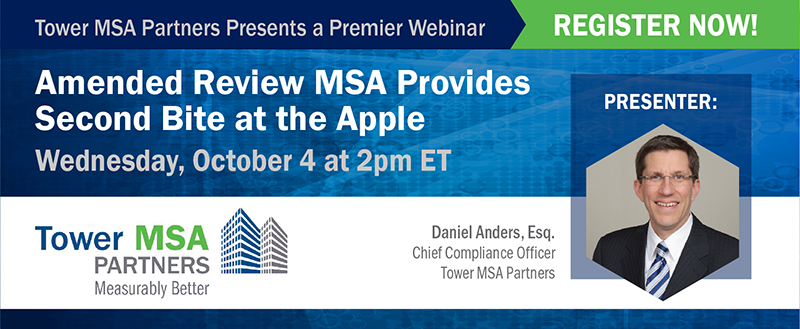
Tower MSA Partners’ Chief Compliance Officer Dan Anders’ enthusiasm for Amended Reviews kept the audience engaged during our recent Premier Webinar: Amended Review MSA Provides Second Bite at the Apple.

Several criteria dictate whether payers can submit an Amended Review, including the fact CMS needed to have approved the first MSA more than 12 months earlier. In addition, there must be a $10,000 or 10% (whichever is higher) difference between the first MSA allocation and the Amended Review MSA.

Our earlier post discussed CMS’s decision to remove the lookback period for Amended Reviews. Previously, we could only use this process if the original MSA had been approved during the last six years.  The removal of the lookback period opened the door for insurers and employers to examine their unsettled legacy claims that had any approved MSA and try to settle the claims.

Dan cautioned attendees not to submit an Amended Review MSA unless the injured worker seemed open to settlement.  “CMS’s change gave payers a second bite at the apple,” Dan said, “But it’s just one more bite, only one opportunity to obtain a new MSA.  You don’t get to eat the whole apple.”

The webinar shared facts and advice about Amended Reviews and highlighted several real case studies, including one where the second MSA amount was much higher than the first.  Some takeaways:

  • Request an MSA report to decide if an Amended Review MSA submission makes sense.
  • An Amended Review is not available until 12 months after CMS approved the first MSAA.
  • There’s no requirement to submit an Amended Review MSA for settlement purposes even if the CMS-approved MSA does not reflect current or future course of care.
  • Make sure all parties are at a stage where settlement is feasible.
  • Obtain medical documentation to support all medical and medication changes from the original MSA.
  • Unlike a regular MSA submission, where CMS requests more information and we can supplement and support the proposal in our response, the Amended Review MSA process offers no opportunity to provide documentation after submission. CMS will review what is provided and make its determination.

Attendees asked great questions:

  • Must the vendor who submitted the original MSA also submit the Amended Review MSA?

No. Tower can handle the Amended Review MSA even if a different vendor handled the original submission.

  • If an MSA was previously submitted for a Re-review, can it be submitted for an Amended Review MSA?

Yes.

  • Does the undertaking of an Amended Review make the previously submitted MSA null and void?

Only if the Amended Review MSA is submitted and approved.  The beauty of CMS-approved MSAs is that they never die.  If you can get the injured person and their attorney to agree, you can use it to settle, regardless of how outdated it is.

Like just about everything else CMS touches, the Amended Review process is complicated, and you can easily blow your one and only chance. Do not try this at home.

Dan is always happy to discuss cases and explore Amended Review and other options with you. Don’t hesitate to email him at Daniel.Anders@TowerMSA.com.

Remember, Tower can create MSA reports to help you decide if you want to pursue an Amended Review MSA. In addition, we’ll review your open claims with high CMS-approved MSAs and select those that could settle with an Amended Review MSA. We can also provide clinical recommendations to determine whether a physician statement, additional medical records or other intervention can result in a lower MSA.

Tower MSA Partners.  Don’t Settle with Anyone Else.

Tower MSA Partners Launches New Website and Celebrates 12th Anniversary

September 26, 2023

Tower MSA Partners celebrates its 12th anniversary and launches its new website.

Tower MSA Partners recently marked our 12 years in business with the rollout of a new, streamlined website that emphasizes our focus on your settlements.  We facilitate claim closure by aggressively seeking savings and making Medicare Secondary Payer (MSP) compliance and Medicare Set-Aside (MSA) prep better, faster and easier.

Working on the new site allowed us to reflect on our differentiators. We don’t try to be all things to all people.  We are singularly focused on MSP compliance, MSA preparation, and going above and beyond to serve our clients.  It’s you, our client partners, and your need to close claims and continually improve your workers’ comp programs that drives us.

This includes our built-for-this-industry MSP Automation Suite, which integrates Section 111 reporting with conditional payment resolution and MSA preparation processes.  Automation saves significant time, reduces errors and allows our client partners to focus on matters other than MSP compliance. And our annual SOC 2 Type II audit confirms the efficiency and effectiveness of our systems and processes.

As great as our tech is, however, at some point, it must give way to human expertise. It’s our legal and clinical specialists who apply their knowledge and experiences to remove barriers to settlement. Our clients appreciate our intuitive technology, but they love the personal service we provide.

As our name says, Tower is your partner. We actively listen to our clients’ goals and desires and make them our own.  Our specialists respond quickly to your questions with clear answers. We consult, advise and stay involved through claim closure and (when appropriate) approval from the Centers for Medicare and Medicaid Services (CMS).

We know that an MSA allocation can determine if a claim can close and we fight for every dollar of savings while we maintain 100% compliance with CMS and state regulations. Tower will also assemble and lead a settlement team to work with injured workers and their attorneys to bring claims to closure.

As we celebrate our 12th anniversary and the launch of a new website, we thank our clients – our partners – for your trust and support.  Many of you have been with us for all 12 years.  We look forward to many more years of innovation and successful settlements.

Please visit our new website, still www.TowerMSA.com, and tell us what you think.


Premier Webinar: Amended Review MSA Provides Second Bite at the Apple

CMS now allows any previously approved MSA to have a one-time Amended Review.  This means that CMS will consider a new MSA submission that may be lower or higher than the previously approved MSA. Essentially, it is a second bite at the apple for old MSAs that, for whatever reason–they were too high, or the injured worker was not ready to settle–weren’t utilized for settlement.

Tower is pleased to feature our Chief Compliance Officer, Dan Anders, who on Wednesday, October 4, at 2:00 PM ET, will address the following topics:

  • Criteria for an Amended Review MSA
  • Is an Amended Review MSA required?
  • Documentation to support an Amended Review MSA
  • Examples of Amended Review MSA submissions

Besides Amended Review MSAs, the webinar will also consider how MSA Re-Reviews can reduce MSA amount resulting from CMS counter-highers.

A Q&A session will follow the presentation, and you can provide questions when you register. Please click the link below and register today!

Please note there is no CEU credit offered for this webinar.

Register Here

CMS News Roundup: New Conditional Payment Appeals Guide & Webinar on Section 111 Reporting

May 25, 2023

Tower MSA Partners covers CMS new guide on Medicare conditional payment appeals and the upcoming Section 111 reporting webinar.

The Centers for Medicare and Medicaid Services (CMS) recently released a how-to guide for appealing Medicare conditional payment demands. The Non-Group Health Plan (NGHP) Applicable Plan Appeals Reference Guide consolidates conditional payment rules and best practices that the agency has issued through webinars, slides and its website.

Section 2.0 gives a breakdown of the appeals levels and explains how to submit an appeal and authorization/letter of authority requirements.  Section 3.0 details what can be appealed and supporting documentation.  Section 4.0 lists additional resources.  Finally, an appendix provides sample letters and model language for applicable plans to appoint recovery agents.

It is important to note that this guide does not cover Conditional Payment Notices (CPNs), which are issued before demand letters to allow the recipient 30 days to dispute the charges.  However, the bases for CPN disputes are the same as those found in Section 3.0.  When the dispute fails or is not timely, a demand letter is issued and the demand letter can be appealed, even with the same arguments used to dispute the CPN.

We appreciate CMS taking the time to draft and release this guide.  It joins the WCMSA Reference Guide and the Section 111 User Guide as critical reference tools for anyone impacted by Medicare Secondary Payer compliance.

CMS Section 111 Non-Group Health Plan (NGHP) Unsolicited Response File Webinar

The Centers for Medicare and Medicaid Services (CMS) recently published a Section 111 reporting webinar notice for a webinar on June 6, 2023 at 1:00 PM ET and states:

CMS will be hosting a webinar regarding the upcoming implementation of the Section 111 NGHP
Unsolicited Response File option. The format will be opening remarks by CMS, a presentation that will include background as well as how to opt in and what to expect, followed by a question and answer session. For questions regarding this topic, prior to the webinar, please utilize the Section 111 Resource Mailbox PL110-
173SEC111-comments@cms.hhs.gov

As of July 2023, Responsible Reporting Entities (RREs) can opt-in to receive a monthly “NGHP Unsolicited Response File” via the Section 111 secure website. Per CMS, the file “will provide critical information about updates to ORM records originally submitted in the last 12 months and allow RREs to either update their internal data or contact the Benefits Coordination & Recovery Center (BCRC) for a correction.”

It is important for an RRE to review and confirm that the changes made by the BCRC and listed in this report are correct.  If not, then the BCRC must be contacted to advise them that the RRE disagrees with the change made by the BCRC.  We encourage anyone involved in managing Section 111 reporting to tune in.  Please note that there is no pre-registration; the link and call-in numbers are on the notice.  You log in shortly before the webinar’s start time.

Related Articles

CMS to Provide RREs with Response File on ORM Record Changes

Premier Webinar: Easy MSA Cost Savings Through Structured Settlements

May 18, 2023

Tower MSA Partners webinar on structured settlements for Medicare Set-Asides cost savings and compliance.

One of the easiest ways to lower the settlement cost is through a structured Medicare Set-Aside. Not only does this reduce the payer’s cost of funding the MSA, but it also provides the injured worker a consistent stream of funds for injury-related medical care over their lifetime.

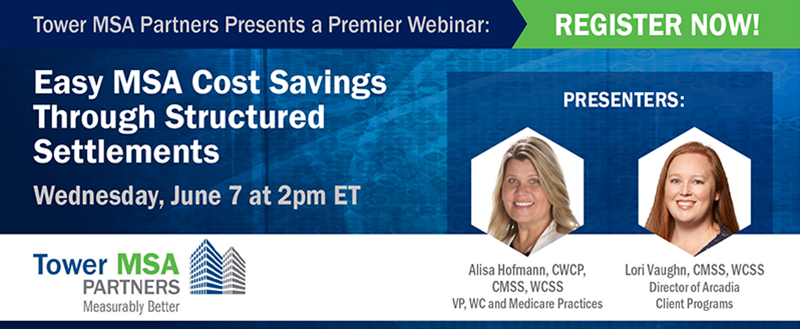
 On June 7 at 2 pm (EDT) Tower will present an informative session on structured settlements for MSAs. Tower’s Chief Compliance Officer will moderate a special guest panel from Arcadia: Alisa Hofmann, Vice President – Workers’ Compensation and Medicare Practices and Lori Vaughn, Director of Arcadia Client Programs. This hour-long webinar will show how structured MSAs can benefit all stakeholders in a settlement – the injured party, Medicare and the insurance carrier or employer.

Attendees will learn:

  • How to work with a structured settlement provider to incorporate an MSA structure into settlement.
  • The methodology CMS uses to calculate a structured MSA.
  • Rules around converting a CMS-approved lump sum MSA into a structured MSA.
  • The role of a structured settlement broker pre-settlement, during settlement negotiations and post-settlement.

A Q&A session will follow the presentation, and you can provide questions you’d like to have answered when you register. Please click the link below and register today!

Please note that there is no CEU credit offered for this webinar.

Register here.

About Alisa Hofmann:

Alisa is the Vice President of Workers’ Compensation and Medicare Practices at Arcadia Settlements Group and currently works on the Business Development team. She has been handling and overseeing Workers’ Compensation claims for almost three decades with various national carriers.  Alisa obtained her BA in Organizational Communication at Otterbein University. She maintains her adjuster licensing in many states, also holds Life, Health, and Accident Licensing, and many Insurance Accreditations. Alisa has been an active member of the National Structured Settlement Trade Association since 2019, and a member of The MSP Network where she serves on the Professional Administration and Structure-Education Committee.

About Lori Vaughn:

Lori Vaughn has 15+ years of experience in the structured settlement industry and currently oversees structured settlement programs for multiple workers’ compensation and private insurance carrier clients. She leads teams of consultants, case managers, and corporate employees, and is the primary point of contact for the corporate management team for each client. Lori obtained her BS in Kinesiology from California State University, Fresno, and her MS in Kinesiology from California Baptist University. She holds her Life, Health, and Accident licenses in many states and is a member of the National Structured Settlements Trade Association.

Tower Partners: People Behind the Settlements Interview with Kevin Puckett of KP Underwriting

February 16, 2023

Tower MSA Partners graphic with Kevin Puckett of KP Underwriting with the question “Rated ages…what are they and how do they affect MSA’s”.

Tower MSA Partners is pleased to launch “Tower Partners: People Behind the Settlements.”  This quarterly series will dig into the elements that go into smooth, cost-effective settlements and introduce Tower’s team members and corporate partners who make them possible.

First up is Kevin Puckett, owner and president of KP Underwriting, who is responsible for assigning a rated age on most of the MSAs we write.  As Kevin explains, a rated age is the statistical age of a person due to their medical conditions.  A person’s actual age may be 60, but their comorbidities and other conditions could cause their rated age to be 65.

Why is this important to the MSA?  Because an MSA is calculated over the injured worker’s life expectancy. A higher rated age that reflects a shorter life expectancy reduces future medical costs. This reduction can be significant, sometimes tens or even hundreds of thousands of dollars.

Case in point: a 67-year-old woman with a rechargeable spinal cord stimulator (SCS) would have required two revisions (one every nine years) over her 18-year life expectancy, in addition to other medical costs. The MSA’s initial allocation was $142,410.64. However, the rated age came back at 72, reducing life expectancy from 18 to 14 years.  This allowed Tower to remove one SCS revision along with other medical costs. The revised MSA was $98,586.35, a $43,824.29 reduction to the allocation.

Now, let’s turn to our rated age expert and partner, Kevin Puckett.

Q & A with Kevin Puckett

What is a rated age? 

A rated age is an adjusted age and reduced life expectancy, that is the expected number of years of life remaining at a given age based on an individual’s medical impairments and the impact they have on their body and life expectancy.  The US Health & Human Services National Vital Statistics life expectancy tables set the baseline for life expectancy determinations.

What is your background in providing rated ages?  What qualifies you to provide this service?

I have been the President and Owner of KP Underwriting, LLC, an independent underwriting company since 2004.  KP Underwriting provides rated ages and modified life expectancies for companies that provide structured settlements, Medicare Set-Asides, and medical cost projections. Our services are also used for settlement purposes and to help set reserves. During my 30+ year career in medical underwriting, I worked with multiple life insurance companies, developing and managing underwriting departments before launching KP Underwriting.  I’ve also written underwriting manuals, audited underwriting departments, and provided expert witness testimony on life expectancy in multiple states and for the Department of Justice.  I earned my BBA in Business Administration with a minor in Biology from Eastern Kentucky University, an Associates designation from the Academy of Life Underwriting, and an FLMI (Fellow, Life Management Institute).

Is KP Underwriting approved to provide rated ages for CMS?

Yes, we’ve been approved since 2006. KP Underwriting is the single largest provider of rated ages in the country, having provided several hundred thousand rated ages to the Centers for Medicare and Medicaid Services (CMS).

What documentation do you require to calculate the rated age?

Medical records should contain two primary categories of records as listed below.  Medical records within the past two years are considered current and have more weight in rated age calculations.

  • Current status of the claimed injury includes:
    • Length of time since injury, permanency of the condition, functional status, stability of treatment, nature of the ongoing treatment.
  • Overall medical status of the individual including:
    • All co-morbidities, personal medical history, pharmaceutical use and related conditions.

Medical records older than two years can be utilized, however, the rated age will normally be more conservative as health history and medical impairments can change drastically over a two-year timeframe or longer.

Can you provide examples of diagnoses that will increase the rated age?

Two conditions can impact the rated age and life expectancy: the injury itself and medical impairments.  Good examples of both are as follows:

  • Injuries
    • Spinal Cord Injuries, head injuries, amputations, burns, chemical exposure, and falls are the most significant. The best thing to consider with injuries is how and if it impacts daily functioning.
  • Medical impairments
    • Most major health impairments will impact the rated age, such as diabetes, stroke, coronary artery disease, obesity, smoking, peripheral artery disease, kidney, colon, and liver diseases, HIV/AIDS, post-covid syndrome, and major respiratory disorders, to name a few. This is a very broad category.  One of the things I cannot stress enough is that medical impairments usually have the biggest impact on the rated age.

Do you solely consider the injury-related diagnoses or both the injury and non-injury-related diagnoses?

The injury and residuals and any medical impairments are both considered in processing the rated age.  We try to let our clients know that not only healthy people get injured.  Medical impairments usually have the biggest impact on rated ages.  In some instances, medical impairments can prevent or delay healing from the injury. For example, diabetes can delay healing in cuts or burns, leading to amputation or slower response to treatment.

What is your typical turnaround time to provide a rated age?

KP Underwriting’s turnaround time is usually 2-3 hours, with rush requests completed within an hour.  All cases that come in before 4 pm EST are completed the same day.  All cases after 4 pm are completed first thing the next business day.

What does your rated age report contain?

 The rated age report sent back to our clients is on KP Underwriting letterhead and contains the name, date of birth, gender, current age and current life expectancy, rated age and rated life expectancy, a brief medical summary of the impairments and injuries used in consideration of the rated age, and the table used in our calculations.  These are tailored to meet our clients’ needs.

How long has KP Underwriting been in business?

KP Underwriting has been in business since 2004. Initially, we prepared rated ages mainly for life companies and structured settlements.  We branched out in 2006 to include rated age services for MSAs.

Do you do all the rated age calculations, or do you have a staff that assists you?

KP Underwriting grew quickly to the point that I needed help to do them.  I currently have a staff of 10-from underwriters to processors- who assist in the rated age process.

If you want more information on KP Underwriting, you can visit their website or contact Kevin at kevinp@kpunderwriting.com or (502) 345-8048.  And if you have a question about a specific MSA or the impact of rated ages on MSAs in general, I am happy to speak with you.  Email Daniel.Anders@TowerMSA.com.

Celebrex and Abilify Price Drops Trigger MSA Reductions

December 14, 2020

Vial of pills illustrating MSA Reductions in RX costs

Recently, the lowest average wholesale price of Celebrex 200mg and the price of multiple strengths of Abilify dropped dramatically resulting in major MSA reductions.
 
A widely used, non-steroidal anti-inflammatory drug, Celebrex (Celecoxib), is FDA-approved for several conditions:

  • Ankylosing spondylitis
  • Juvenile rheumatoid arthritis
  • Acute migraines
  • Osteoarthritis
  • Acute pain
  • Primary dysmenorrhea
  • Rheumatoid arthritis

Per Red Book, the lowest average wholesale price for Celecoxib 200mg dropped from $1.79 to $0.33, an 81.56% price reduction.
 
Abilify (Aripiprazole) is an antipsychotic drug FDA-approved for the following conditions: 

  • Schizophrenia
  • Acute treatment of manic and mixed episodes associated with bipolar
  • Adjunctive treatment of major depressive disorder
  • Irritability associated with autistic disorder
  • Treatment of Tourette’s disorder

Per Red Book, the lowest average wholesale price for multiple strengths (2mg to 30mg) of Aripiprazole dropped from the $30 to $36 range to a range of $0.07 to $0.17 per dose, an almost 100% price reduction.
 
Tower Action in Response
 
Because Tower’s system tracks all medications allocated in MSA reports, we have already pulled reports from the past two years that allocated these medications and advised clients of the potential for MSA reductions. You can also contact us to determine whether a particular MSA qualifies for MSA reductions.  Revisions to the MSA can be done now or prior to MSA submission to CMS.
 
Please contact Dan Anders, Tower’s Chief Compliance Officer, at Daniel.anders@towermsa.com or (888) 331-4941 with questions.

Need a Medicare Set Aside Second Opinion?

October 27, 2020

nurse conducting research for a Medicare Set Aside Second Opinion in a manual

Has a Medicare Set Aside ever disrupted one of your settlements?  Any one of these things — unexpected medical, surgical or pharmacy costs, compliance issues, the way MSA administration will be handled, or the presence or absence of a structured settlement–can halt negotiations. 

Tower addresses cost drivers and deals with compliance situations long before preparing an MSA, so our clients don’t have to worry about MSAs impeding settlements and injured workers can be assured that their future medical needs will be met . 

However, recently we’ve been asked to review MSAs prepared by other companies and found significant cost drivers and other obstacles to settlements.  Fortunately, our free Medicare Set Aside Second Opinion service saved the settlements and helped to secure claim closures. 

Medicare Set Aside Second Opinion Case Study

Here’s one case. Based on her experience with managing a claim and its costs, an adjuster thought the $220,000 MSA produced by another MSP provider was too high and asked us to review it.

Following our standard workflow for new MSAs, our Intake Team compared the MSA’s “accepted body parts” against the client’s claim system and found significant discrepancies.

The MSA allocated for a lifetime’s supply of sertraline, a drug used to treat anxiety and depression. However, “psyche/stress” was not an accepted body part and the workers’ comp insurer had not been paying for it. 

Tower drafted a Body Part Letter that clarified the compensable conditions and specified those that were not accepted by or paid for by the insurer. Removing the drug from the allocation saved more than $58,000.

This 2nd Opinion review also detected recommendations for inappropriate medical treatment, including an unnecessary bladder surgery. Our Physician Follow Up Service – available at no extra cost to our clients – contacted the physician and obtained written confirmation of this, reducing the allocation by another $37,000+.  We also obtained a rated age from K.P. Underwriting that further reduced the treatment and prescription cost over life expectancy.  The total savings came to over $98,000.

MSA Value is in Claim Closure 

How could we do this when the other provider couldn’t?  It comes down to our philosophy and attitude.

Tower does not treat MSAs as commodities. Instead, we recognize that the real business value of an MSA is in its ability to facilitate claim settlement and closure.

Our role is to collaborate with clients to analyze and assess risk, review medical and pharmacy records to determine Medicare exposure, intervene when treatment changes are needed, and recommend the appropriate time to complete the MSA.

In short, we proactively work to reduce costs and posture files for settlement.

How We Achieve Settlement Success

We created MSA best-practices technology and continually update it to make sure we can always accurately allocate the MSA without overfunding.  Our MSP Automation Suite contains the very latest CMS coverage, coding and individual state pricing data.  We measure everything and analyze CMS responses line by line so we know what the agency will accept, what it won’t and when to push. 

We know where cost drivers tend to hide, and our Intake and Clinical Teams are trained to hunt them down. We know which interventions to apply at the right time to reduce costs.  We know how to phrase treatment and pharmacy changes and supply the precise documentation CMS needs to approve the MSA.

And we do all this the first time around, so you won’t need a second opinion. 


With Tower, payers can enter settlement negotiations with realistic MSAs that they can explain and defend.  (We’ll participate in these negotiations if you’d like.) 

Settle well the first time with Tower. But, if you have a questionable MSA, let us give you our free 2nd opinion. Download more information here or refer an MSA for a 2nd Opinion by contacting our Intake Team at 888-331-4941 or referrals@towermsa.com.

CMS Adds New Pricing Resource to WCMSA Reference Guide

October 14, 2020

stethescope on a Workers’ Compensation Medicare Set-Aside Arrangements

In a recent update to its WCMSA Reference Guide, the Centers for Medicare and Medicaid Services released a state-by-state list of the major medical centers it uses for pricing future medical expenses in proposed MSAs.  This zip code-based list (See Appendix 7 of the guide) will help MSA preparers and submitters more accurately price surgical procedures, including spinal cord stimulators and intrathecal pumps, per CMS requirements.

Background

From the reference guide:

Hospital fee schedules are currently determined using the Diagnosis-Related Groups (DRG) payment for the median major medical center within the appropriate fee jurisdiction for the pricing ZIP code, unless otherwise defined by state law (see Appendix 7).

While that sounds good, until this update, no one but CMS and the Workers’ Compensation Review Center (WCRC), which reviews submitted MSAs for CMS, knew for certain the major medical center. 

Nonetheless, Tower’s experienced clinical team has historically been successful in identifying appropriate facility pricing, thus avoiding significant variances between the proposed surgical pricing and the CMS calculation. The release of the list removes any remaining uncertainty.

Practical Implications

The list of major medical centers should eliminate one area of variances in surgical pricing. (Variances can still occur based upon differences in the type of surgery allocated or the components of the allocated surgery.)  In short, it should lead to more accurate pricing surgical procedures in proposed MSAs and reduce MSA counter-highers.

The list of major medical centers has been published as part of the reference guide and also within the Workers’ Compensation Medicare Set-Aside Portal (WCMSAP).

As a member of the National Alliance of Medicare Set-Aside Professionals, now the National MSP Network (MSPN), Tower has consistently advocated for the release of this list.  We appreciate the efforts of MSPN leadership to pursue this with CMS management. 

A big thank you to Steve Forry and John Jenkins at the CMS Division of MSP Program Operations and to the WCRC for their work to assemble and release this information for public use.

If you have any questions, please contact Dan Anders, Chief Compliance Officer, at Daniel.anders@towermsa.com or 888.331.4941.