How Pre-MSA Triage Prevented $774K in Unnecessary Costs

November 4, 2025

Image of Tower MSA Partners Why Case Studies Matter series: Blog 2 How Pre-MSA Triage Prevented $774K in Unnecessary Costs

In Tower MSA Partners’ recent blog post, Why Case Studies Matter: Real-World Proof of MSA Savings,” we introduced this 12-month series demonstrating how Tower MSA Partners turns complex Medicare Set-Aside challenges into measurable savings and compliance wins.

Now, we’re diving into one of the most overlooked, and powerful, steps in the process: Pre-MSA Triage.

Before an MSA is ever submitted to CMS, Tower’s clinical and compliance teams perform an in-depth review that identifies unnecessary treatments, outdated medications, and questionable recommendations that inflate costs.

This early intervention isn’t just smart, it’s transformative. In one recent case, it prevented $774,000 in unnecessary costs before an MSA ever reached submission.

The Challenge: When “Wait and See” Becomes Expensive

For many payers, MSA management doesn’t begin until after a settlement is nearly complete. By then, most treatment plans and prescriptions have been in place for years, leaving little room to make meaningful changes.

Unfortunately, waiting too long can cause costs to spiral. We often see:

  • Outdated medical regimens that no longer reflect the claimant’s current condition
  • Duplicate or overlapping treatments prescribed by multiple providers
  • Inconsistent medical documentation that increases CMS scrutiny
  • Unnecessary or long-term opioid use that drives future cost projections

When these red flags go unaddressed, the resulting MSA can balloon to unrealistic levels, delaying settlements and unnecessarily tying up reserves.

Pre-MSA Triage changes that narrative.

Tower’s Approach: The Power of Early Insight

At Tower MSA Partners, Pre-MSA Triage is a strategic intervention process led by clinicians, compliance specialists, and pharmacists working collaboratively.

Here’s how it works:

  1. Early Case Identification
    As soon as a claim is identified as a settlement candidate, Tower’s team reviews the medical and pharmacy history to identify risk factors likely to inflate MSA costs.  This includes duplicative and open-ended medications.
  2. Clinical Analysis & Pre-MSA Triage Report
    A clinical expert examines treatment appropriateness, drug utilization, and long-term projections and provides a Pre-MSA Triage report.
  3. Claimant & Provider Communication
    Tower facilitates direct communication with physicians to update treatment plans, discontinue unnecessary therapies, or substitute safer, more cost-effective options.
  4. Final MSA Report
    These clinical changes are incorporated into the full MSA report.   The report gives adjusters and settlement teams actionable insights, providing a roadmap for CMS MSA submission and approval and settlement.

This proactive approach ensures that MSA allocations reflect actual, reasonable future medical needs, not inflated or outdated care plans.

Real-World Results: $774,000 Saved Before Submission

In one case, Tower MSA Partners was engaged to evaluate a complex workers’ compensation claim that had been open for years.

The initial Pre-MSA projection exceeded $900,000 due to:

  • High-cost brand-name medications
  • Redundant pain management treatments
  • Ongoing prescriptions that no longer matched clinical reality

Through Pre-MSA Triage, Tower’s team:

  • Identified outdated prescriptions no longer medically necessary
  • Coordinated with the treating physician to adjust the regimen
  • Applied evidence-based medical guidelines to revalidate care
  • Recalculated the MSA using corrected medical data

The result? A $774,000 reduction in projected future medical costs — achieved before the MSA was ever submitted.

The claim settled smoothly, with full CMS compliance and no delays.

This outcome demonstrates the power of collaboration, early action, and data-driven oversight. It also illustrates why Pre-MSA Triage is one of the most effective tools for balancing cost containment with patient care.

Lessons for Claims Professionals

The takeaway for insurers, TPAs, and self-insured employers is clear:
the earlier you intervene, the more control you have, both financially and clinically.

Key lessons include:

  • Start early. Integrating Pre-MSA Triage into claims workflows helps identify and correct costly issues before they compound.
  • Use clinical expertise. Medical professionals provide the insight needed to align treatment with guidelines and compliance requirements.
  • Collaborate often. Open communication among payers, providers, and Tower’s team ensures settlements move forward efficiently.
  • Document everything. A clear, defensible record of intervention builds confidence with CMS reviewers and reduces the risk of rejections or delays.

By applying these principles, payers gain greater control over outcomes, not just cost savings, but also improved accuracy, defensibility, and claimant satisfaction.

What’s Next: The Power of Peer Review

Pre-MSA Triage sets the stage for the next layer of cost containment, Physician Peer Review.

In our upcoming blog, “$1 Million Saved with Physician Peer Review: Here’s How,” we’ll explore how Tower’s network of medical specialists helped identify excessive treatment recommendations and achieve over $1 million in verified savings while maintaining full CMS compliance.

Stay tuned to see how medical oversight continues to transform outcomes for complex claims.

The Takeaway

Pre-MSA Triage isn’t just an optional step, it’s the foundation of effective MSA management.

By identifying risks early, Tower MSA Partners helps clients avoid inflated settlements, streamline CMS submissions, and achieve measurable cost reductions.

Each case tells a story of strategic collaboration and clinical excellence, and this $774K success is just the beginning.

Frequently Asked Questions

What is Pre-MSA Triage?
An early review that identifies outdated treatments and medications before an MSA is created.

Why does timing matter?
Starting early prevents inflated projections and costly surprises at settlement.

How does Pre-MSA Triage lower costs?
By removing unnecessary therapies and correcting medical or pharmacy issues that drive MSA totals up.

Do you contact treating physicians?
Yes, Tower works with providers to update treatment plans and discontinue unnecessary care.

Does this improve CMS approval?
Yes, cleaner medical records and updated care plans lead to smoother CMS submissions.

Is this only for big claims?
No, both routine and complex claims benefit from early clinical review.

How much can it save?
Savings vary, but reductions like the recent $774,000 example are common when outdated care is corrected.

Is this the same as Physician Peer Review?
No, Peer Review is the next level of clinical oversight used when specialty input is needed.

Why is Pre-MSA Triage important?
It sets the foundation for accurate, defensible, and cost-effective MSA outcomes.

 

Why Case Studies Matter: Real-World Proof of MSA Savings

October 7, 2025

Image of Tower MSA Partners Why Case Studies Matter series: Blog 1 Real-World Proof of MSA Cost Savings.

While Medicare Set-Asides (MSAs) are essential for compliance in certain workers’ compensation settlements, they can also lead to inflated costs if not carefully managed. Without proper oversight, unnecessary treatments, duplicate services, or overly conservative assumptions can cause MSA totals to rise dramatically. These inflated amounts not only delay settlements but also tie up resources that could be better used elsewhere.

At Tower MSA Partners, we help insurers, self-insured employers, and third-party administrators (TPAs) navigate this complex process with precision and cost control, ensuring settlements are compliant, efficient, and fair.

This kickoff blog launches a 12-month series of real-world case studies demonstrating how proactive strategies, clinical expertise, and deep regulatory knowledge deliver measurable savings and smoother claim resolutions.

Common MSA Challenges

For many claims professionals, MSAs can feel like a “black box.” The process often seems like paperwork sent off to CMS, followed by a waiting game for approval. This lack of transparency can lead to missed opportunities for cost savings and compliance improvements.

Here are a few recurring challenges we see: – Unnecessary treatments or duplicate costs included in MSA submissions – – inconsistent and contradictory treatment patterns – Lack of early intervention to address treatment plans before they escalate – Missed opportunities to optimize claims for both cost control and compliance

These issues affect everyone involved—from injured workers to payers. Through detailed case studies, this series will show how a strategic, proactive approach prevents these challenges and leads to better settlement outcomes.

Real Savings, Real Impact

The strength of this series is in real numbers and real results. In the coming months, we’ll highlight outcomes such as: – $774,000 saved by identifying and resolving issues before MSA submission – $1 million saved through a physician peer review that corrected unnecessary treatment recommendations – $98,000 saved with a second-opinion MSA review before finalizing settlement

These results represent actual cases handled by Tower MSA Partners. They demonstrate how compliance and cost containment can work together to protect Medicare’s interests while avoiding overfunding.


Why Case Studies Matter

Every claim is unique, yet the challenges surrounding MSAs are surprisingly consistent across the industry. Factors like rising medical costs, evolving CMS guidelines, and the push to close claims quickly create a complex balancing act.

Through these case studies, Tower MSA Partners aims to: – Improve the quality and defensibility of MSA submissions – Speed up settlements by eliminating preventable delays – Lower claim costs without compromising care – Provide clarity and confidence for claims professionals handling complex cases

When payers understand why certain costs are included and how they can be managed, they make smarter, more informed decisions that benefit their organization and the injured workers they serve.

What’s Ahead in the Series

Each month, we’ll release new content focusing on a specific area of MSA management, including: – Early Intervention Strategies – Preventing inflated costs before an MSA is created – Physician Peer Review – Validating treatment plans and prescriptions – Compliance Best Practices – Reducing the risk of CMS penalties and rejections – Ongoing Claim Management – Preventing cost creep over time – Legacy Claim Resolution – Closing backlogged claims to free reserves and improve efficiency – Case Optimization and Review – Streamlining processes to improve accuracy and outcomes

The series will conclude with a Top 10 Lessons Learned wrap-up blog summarizing a year’s worth of data and insights for claims professionals and legal teams.

The Takeaway

MSAs don’t have to be overwhelming or overly expensive. With the right approach, organizations can achieve compliance, control costs, and resolve claims efficiently. This series will provide real-world proof of how Tower MSA Partners helps clients reach these goals, step by step.

Stay tuned for our first in-depth case study, where we’ll explore how early intervention prevented nearly $800,000 in unnecessary costs and paved the way for a smooth, compliant settlement.

Frequently Asked Questions

What causes Medicare Set-Asides to become inflated?
Inflated MSAs often come from unnecessary treatments, duplicate services, outdated prescriptions, or conservative medical assumptions that were never updated.

Why do MSA case studies matter?
They show real savings and real outcomes so payers can understand how proactive MSA strategies improve accuracy, compliance, and cost control.

What are the most common challenges in MSA preparation?
Unnecessary care, inconsistent documentation, lack of early intervention, and missed opportunities to correct treatment plans.

How does Tower MSA Partners reduce MSA costs?
Through early clinical review, pharmacy analysis, physician communication, and regulatory expertise that remove unnecessary or inaccurate costs.

Who benefits from proactive MSA management?
Claims adjusters, TPAs, self-insured employers, risk managers, and injured workers all benefit through faster, cleaner, and more cost-effective settlements.

How much can proactive MSA strategies save?
Savings vary, but real cases show reductions such as $774,000 saved before MSA submission and $1 million saved via physician peer review.

Does improving MSA accuracy slow down settlements?
No. Addressing medical and documentation issues early creates smoother CMS approvals and eliminates preventable delays.

What topics will this 12-month case study series cover?
Early intervention, physician peer review, compliance best practices, legacy claim resolution, and prevention of medical cost creep.

How does this series help claims professionals?
It provides transparent examples, clearer processes, and actionable steps for improving accuracy, compliance, and settlement outcomes.

Does My Settlement Qualify for a Zero MSA?

August 5, 2025

Tower MSA Partners graphic with medical and legal icons asking 'Does My Settlement Qualify for a Zero MSA?' and a green 'Find Out' button.

As the final post in our Do I Need an MSA? series, we turn to $0 MSAs.  While CMS no longer reviews and approves $0 MSAs, they remain a legitimate and strategic option in specific settlement scenarios. And when a $0 MSA is appropriate, the parties can settle with the confidence that Medicare’s interests are protected as well as the injured workers’ access to Medicare to pay for treatment.

But when exactly is a $0 MSA appropriate?

Let’s explore.

What Is a $0 MSA?

A $0 Medicare Set-Aside (MSA) allocates no funds for future Medicare-covered medical expenses related to the claimed workers’ compensation injury. In short, it means the settling parties believe either that the denied nature of the claim means Medicare is primary for future medical or, if an accepted claim, that there is no further need for injury-related treatment or medications.

While this sounds simple, CMS requires specific criteria to be met and supported by documentation to ensure that Medicare’s interests are still being considered appropriately. After all, even a $0 allocation must be defensible.

When Is a $0 MSA Appropriate?

The Workers’ Compensation Medicare Set-Aside Arrangement (WCMSA) Reference Guide, Section 4.2, outlines the situations in which a $0 MSA is appropriate. Below are the scenarios:

  1. The Claim Is Denied and No Medical or Indemnity Payments Have Been Made

This is the most straightforward situation:

  • The insurer has not paid any medical or indemnity benefits (except for investigational purposes) prior to settlement,
  • The claim remains fully denied, and
  • The settlement does not allocate funds for future or past medical.
  1. Denied Claim with Prior Payments

If some medical payments were made early in the life of the claim, but the carrier later issued a formal denial and maintained it throughout, a $0 MSA may still be possible. Criteria to be met:

  • The claim was denied,
  • Denial was within state statutory timeframe allowed to pay without prejudice, and
  • The settlement does not allocate funds for future or past medicals.
  1. Court Decision on Compensability of Claim or Ongoing Medical

If a court, commission or board finds after a hearing on their merits that either the claim is not compensable or that the employer does not owe additional medical or indemnity benefits, then a $0 MSA is applicable.  The payer needs to ensure that they abide by such a decision in terms of not paying for additional medical or indemnity short of a compromise settlement.

  1. Injury-related Medical Condition Has Resolved

In some cases, the injured worker may have recovered fully, no longer receives treatment, and no further Medicare-covered services are anticipated. Even if the claim was accepted at one time, a $0 MSA may be appropriate if:

  • There is sufficient medical evidence to support full recovery,
  • The treating provider documents that no future treatment is required,

CMS Policy Change: $0 MSA Submissions No Longer Reviewed After July 17, 2025

As noted above, effective July 17, 2025, CMS no longer reviews $0 MSA submissions. This change reflects a shift in resource prioritization: CMS sees limited value in reviewing MSAs that allocate no funds to future medical.

However, this does not remove the obligation to protect Medicare’s interests. Instead, the burden falls more squarely on the settling parties to:

  • Evaluate whether a $0 allocation is appropriate,
  • Document the justification thoroughly, and
  • Retain that documentation as evidence of compliance.

At Tower MSA Partners, we anticipate this shift will increase the importance of clear documentation and expert evaluation. Without CMS review, you need a partner who can help you build a strong, defensible case for a $0 MSA.

Documentation Checklist: Building a Defensible $0 MSA

To support a $0 allocation, especially in a post-CMS review environment, be sure to compile the following:

  • Denial Letter (for a denied claim) – Official claim denial from the payer
  • Claim Payment History – Showing medical, indemnity and expense payments
  • Medical Records (for an accepted claim) – Indicating no ongoing or anticipated treatment
  • Legal Documents – Any court orders or other legal documents pertinent to the denial or need for ongoing and future injury-related medical care.
  • Physician Statement – If applicable, confirming no future medical care is necessary

This documentation can be provided for Tower to review and prepare a report that confirms the case meets CMS $0 MSA criteria.

How Tower MSA Partners Can Help

Tower’s experienced team brings together clinical, legal, and claims expertise to:

  • Evaluate whether a $0 MSA is appropriate,
  • Provide recommendations to obtain a valid $0 MSA,
  • Prepare a clear and defensible report, and
  • Help to explain CMS’s $0 MSA criteria to settling parties and assist with appropriate settlement language.

Final Thoughts: The Power of Zero—When Used Wisely

A $0 MSA can be a powerful tool in the settlement process, helping to close claims quickly and reduce costs. But like all compliance strategies, it must be used wisely.

As CMS steps back from $0 MSA reviews, the responsibility for Medicare compliance falls squarely on the parties involved. Tower MSA Partners is here to guide you.

Ready to Evaluate a Zero MSA?

Let us help you determine whether your settlement qualifies for a $0 MSA, and make sure it’s documented the right way.

Contact Tower MSA Partners today to schedule a consultation.


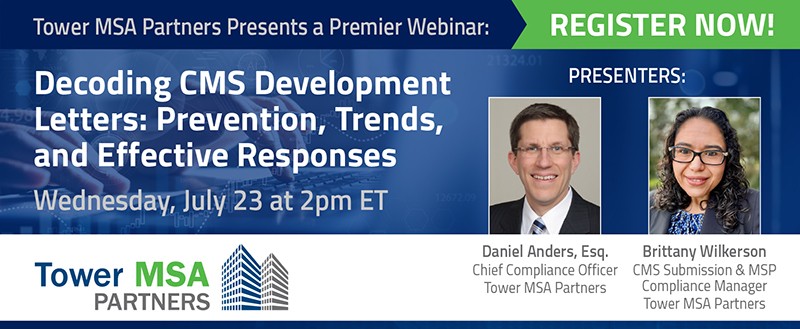
Decoding CMS Development Letters: Prevention, Trends, and Effective Responses

July 2, 2025

CMS Development Letters webinar details

Avoid CMS Development Letter Delays: Learn How in Our Upcoming Webinar

The Centers for Medicare & Medicaid Services (CMS) continues to issue an increasing number of CMS Development Letters following Medicare Set-Aside (MSA) submissions, and not all of them make sense. While some requests are warranted, many appear unnecessary, resulting in delays, frustration, and additional work for claims teams.

At Tower MSA Partners, our strategy has always been to prevent Development Letters before they happen. Even with meticulous planning, CMS sometimes requests additional documentation to finalize its review. That’s why it’s critical to know how to anticipate, address, and respond to these letters when they arrive.

Join us for a live webinar on July 23, 2025, at 2:00 p.m. ET as Tower’s Chief Compliance Officer, Dan Anders, and CMS Submission & MSP Compliance Manager, Brittany Wilkerson, break down:

      • The most common CMS Development Letter requests you can expect
      • Unusual and emerging requests CMS is making
      • Proactive steps to prevent Development Letters
      • How to partner with Tower to avoid or quickly resolve these requests

You’ll also have the opportunity to submit questions in advance to be answered live during the session.

Don’t let CMS Development Letters slow down your settlement process.

Register now and take a more confident, compliant approach to MSAs.

Register


Self vs. Professional MSA Administration: Which Is Right for the Injured Worker?

June 25, 2025

Banner with the Tower MSA Partners logo that reads, “Self vs. Professional MSA Administration: Which is right for the injured worker?” with a button that says “FIND OUT” and images of a person in a wheelchair, medical bill, money, and a prescription.

Comparing Options for Managing Medicare Set-Aside Funds Post-Settlement

When a workers’ compensation claim settles and includes a Medicare Set-Aside (MSA), that’s not the end of the story, it’s the beginning of a new responsibility for the injured worker. That responsibility? Administering the MSA in compliance with the Centers for Medicare & Medicaid Services (CMS) guidelines.

There are two options for handling this responsibility: self-administration or professional administration. Each comes with its own benefits and risks. So, which is right for the injured worker? Let’s break it down.

What Is MSA Administration?

MSA administration refers to how the injured worker manages and spends the money allocated for future medical care related to their injury. These funds must only be used for Medicare-covered expenses that are injury-related, and spending must be carefully tracked in case CMS ever audits the account.

Failing to comply with these rules can lead to serious consequences as Medicare may refuse to pay for injury-related care once the MSA funds are exhausted, leaving the injured worker on the hook.

Option 1: Self-Administration

With self-administration, the injured worker is responsible for managing their own MSA funds. This includes:

  • Setting up a separate interest-bearing account
  • Paying for medical treatments and prescriptions out of the MSA account
  • Ensuring payments are only for Medicare-eligible, injury-related services
  • Tracking all expenditures and retaining documentation
  • Reporting annual spending to CMS

Pros:

  • Full control over how and when funds are used
  • No administrative fees
  • May be appealing for workers who are detail-oriented or have experience managing finances

Cons:

  • Requires a thorough understanding of CMS guidelines
  • High risk of non-compliance, even with good intentions
  • No built-in advocacy or support in the event of disputes with providers or Medicare
  • Can become overwhelming, especially for those dealing with complex or ongoing care

Option 2: Professional Administration

Professional administration means a third-party administrator manages the MSA on the injured worker’s behalf. This service typically includes:

  • Establishing and maintaining the MSA account
  • Processing and paying medical bills and prescriptions
  • Ensuring all expenditures are CMS-compliant
  • Annual reporting to CMS
  • Providing injured workers with support and transparency

Pros:

  • Ensures CMS compliance and minimizes risk of Medicare denial
  • Reduces stress and complexity for the injured worker
  • Access to medical cost containment strategies, such as network discounts
  • Professional tracking, reporting, and auditing protections
  • Peace of mind for both the injured worker and the settling parties

Cons:

  • Typically involves a one-time setup fee and annual service fees (although this is usually paid by the employer or insurer at the time of settlement)
  • Less direct control over funds

Making the Right Choice

The right choice depends on the injured worker’s capabilities, preferences, and the complexity of their care. Here are a few considerations:

  • Complexity of Care: If the injured worker has ongoing treatments, expensive prescriptions, or multiple providers, professional administration can prevent missteps.
  • Comfort with Financial Management: Self-administration may be feasible for someone confident in managing money and navigating healthcare systems.
  • Compliance Risk Tolerance: Professional administration significantly lowers the risk of non-compliance and CMS scrutiny.
  • Support Needs: Injured workers often appreciate having an advocate who can assist with billing issues and provider coordination.

A Partner in Post-Settlement Success

At Tower MSA Partners, we work closely with injured workers, carriers, and attorneys to evaluate the best administration path for each case. When professional administration is chosen, we partner with Ametros to provide this service.

Ensuring compliance and protecting the long-term well-being of the injured worker doesn’t stop when the claim settles. Choosing the right MSA administration option is one of the most important settlement decisions, one that can make all the difference in the quality of care and peace of mind.

Stay tuned for our next article in the series on $0 MSAs.

What Are Some Common MSA Challenges?

June 10, 2025

Banner with Tower MSA Partners that asks “What are some common MSA challenges” with a button that says “find out”. There are various images of money, medicine, a magnifying glass and paperwork.

Fifth Installment in our Tower MSA Partners Series

Avoiding the Pitfalls That Can Derail Settlement Success

When it comes to resolving workers’ compensation claims involving future medical exposure, Medicare Set-Asides (MSAs) are a critical component, but they’re not without challenges. Whether you’re preparing an MSA for submission to the Centers for Medicare & Medicaid Services (CMS) or managing one post-settlement, there are several recurring pain points that can complicate and delay the settlement process. In this post, we explore the most common MSA challenges and share strategies to address them proactively.

CMS Development Requests

Perhaps the most frustrating challenge for claims professionals is when an MSA submitted to CMS results in a request for additional information. Common reasons include:

  • Missing or outdated medical records
  • Clarification of accepted and denied body parts and conditions
  • DME records not provided
  • Need for personal prescription history

Each delay may add weeks, even months, to the settlement timeline. Working with a partner that understands CMS submission requirements inside and out, and stays ahead of guideline changes, can minimize these setbacks.

At Tower MSA Partners, our Physician Follow-up service is key to development letter avoidance.  At no cost to our client partners, Tower will contact the treating physician to confirm matters such as the last date of service and ongoing treatment and medications. By doing so, we ensure documentation is complete, consistent, and aligned with CMS’s expectations before submission.

Overfunded MSAs Due to Inaccurate Cost Projections

Another issue is inflated MSAs, which can stall settlements or make them financially unworkable. MSAs are meant to reflect reasonable and necessary future medical costs, but they can become overfunded when:

  • Treating physicians list aggressive or non-evidence-based treatment plans
  • High-cost medications are projected indefinitely, even if alternatives exist
  • Outdated surgical recommendations are included
  • Medicare pricing is not properly applied, or generic equivalents are overlooked

To avoid this, the MSA projection must go hand-in-hand with medical intervention. That includes communicating with providers to clarify treatment intent, securing appropriate clarifications, and exploring the use of evidence-based guidelines. Tower’s clinical team excels in this area, often reducing MSA costs significantly through strategic interventions and updated treatment plans.

Navigating the Gray Areas of Compliance

MSAs are meant to protect Medicare’s interests, but interpretation of compliance can vary. For example:

Navigating these gray areas requires expertise in CMS’s evolving guidelines, as well as a solid understanding of case law and best practices. Missteps, such as underfunding or improper spending, can leave all parties exposed to future liability.

Tower MSA helps payers and attorneys make informed, case-by-case decisions on whether submission is warranted, whether re-review is advantageous, and if a $0 MSA is feasible.

Timing and Settlement Coordination

MSAs don’t exist in a vacuum. Delays in obtaining MSA approvals can impact the broader settlement process, especially when dealing with multi-party negotiations, liens, or Social Security Disability applications. If the MSA process isn’t started early enough or coordinated with other settlement activities, it becomes a bottleneck.

That’s why early intervention is key. At Tower, we help claims professionals identify MSA candidates early in the claim lifecycle and integrate MSA timelines into the overall resolution strategy.

Legacy Claims and “Old Dogs”

Some of the most complex challenges come from aging claims, especially those with inconsistent treatment history, outdated care plans, or decades-old documentation. These “old dog” claims often present inaccurate MSAs or complex settlement dynamics.

In these cases, seeking an Amended Review (where CMS previously approved an MSA on the claim) or engaging Tower’s clinical team to reassess and clarify treatment plans can be game-changing. We’ve helped clients reduce legacy claim MSAs by hundreds of thousands of dollars through re-review, updated records, and provider outreach.

Proactive Partnership = Smoother Settlements

Ultimately, many MSA challenges stem from incomplete documentation, lack of clarity, or missed opportunities for cost mitigation. A proactive, strategic approach, combined with deep CMS expertise, can resolve these challenges before they become roadblocks.

Tower MSA Partners doesn’t just provide MSA compliance, we provide settlement support that moves claims forward. From early identification and medical cost mitigation to CMS submission, we ensure your MSAs support, not stall, your claim closure goals.

Stay tuned for our next article in the series, “Self vs. Professional MSA Administration: Which Is Right for the Injured Worker?”

What’s Included in a Medicare Set-Aside (MSA)?

May 13, 2025

Tower MSA Partners presents What’s included in an MSA with a button that says find out.

Fourth Installment in our Tower MSA Partners Series

In our previous posts, we introduced the fundamentals of Medicare Set-Asides (MSAs), explained how they work, and outlined when an MSA is necessary. Now, we turn to the next important question: what exactly is included in an MSA?

At Tower MSA Partners, we ensure that every MSA is carefully developed to provide for the injured worker’s future medical care needs while protecting Medicare’s interests. In this article, we break down the typical components of an MSA allocation.

Future Medical Costs

The core of any MSA is the projection of future medical expenses related to the work injury or illness that Medicare would otherwise cover. These expenses include, but are not limited to:

  • Physician visits (primary care and specialists)
  • Hospitalizations
  • Physical therapy
  • Diagnostic testing (X-rays, MRIs, CT scans)
  • Durable Medical Equipment (DME), such as wheelchairs or prosthetics
  • Home health care services, if related to the injury
  • Surgical procedures

Each projected cost is based on the injured worker’s medical history, current treatment plan, and anticipated future needs as determined through a comprehensive medical record review.

It is important to remember that CMS relies on the notes and opinions of the treating physician(s). Examining physicians, such as IMEs, PQMEs, AMEs, and the like, do not carry weight with CMS. Furthermore, statements from injured workers indicating that they do not plan to pursue a certain course of treatment, such as a spinal cord stimulator, will not be considered by CMS if a treating physician continues to recommend it as a treatment option.

Prescription Medications

In addition to medical services, the MSA must also allocate funds for prescription medications related to the injury. These include:

  • Ongoing maintenance drugs (such as pain management medications)
  • Antibiotics for recurring infections tied to the injury
  • Future prescriptions based on ongoing treatment needs

It’s important that the medications included in the MSA are tied directly to the work-related condition and are likely to be needed based on current and reasonably foreseeable medical standards.

Treatment Trends and Cost Mitigation

Accurately projecting future care is essential to ensuring that the MSA is sufficient but not overinflated. This means factoring in:

  • Discontinuation of treatments that are no longer medically necessary
  • Weaning off medications (such as opioids) where clinically appropriate
  • Updates or clarifications from treating physicians to mitigate outdated or unnecessary ongoing care assumptions

At Tower, we work closely with treating providers to clarify treatment plans and identify opportunities to right-size the MSA appropriately.

CMS Submission Documentation Requirements

If the MSA is submitted to the Centers for Medicare & Medicaid Services (CMS) for review and approval, there are specific documentation requirements:

  • Submission of all relevant medical and pharmacy records for the most recent two years for each settling body part or condition
  • The Medicare Set-Aside Report
  • Claim payment history
  • Claim prescription drug history
  • Claimant executed Consent to Release form
  • Clear explanation of how the MSA will be funded (lump sum vs. annuity) and administered (self-administered or professionally administered)
  • If applicable, court orders, denial letters and depositions

Tower strives to provide a straightforward allocation for future medical care supported by the necessary treatment records and pharmacy history.  In doing so, we avoid CMS development letters and expedite the settlement process for the parties.

Conclusion

A properly developed Medicare Set-Aside includes a detailed projection of future medical costs, related prescription medications, and compliance with CMS submission requirements. Ensuring these elements are accurately captured is critical to protecting Medicare’s interests and the injured worker’s access to necessary care.

At Tower MSA Partners, our expert team builds MSAs that are precise, defensible, and compliant, helping you navigate settlements with confidence.

Stay tuned for our next blog in the series, where we will explore “What are Some Common MSA Challenges? “

Need assistance with your Medicare Set-Aside allocations? Contact Tower MSA Partners today.


How Do I Know If I Need a Medicare Set-Aside?

April 22, 2025

Tower MSA Partners banner with copy that reads “How do I know if I need an MSA” with a button that says find out with papers, medication, money, a magnifying glass, and EKG results.

When planning a settlement with a Medicare beneficiary injured worker or someone close to becoming a Medicare beneficiary, ensuring that the burden of future medical care is not shifted to Medicare is paramount. In our previous posts, we introduced the fundamentals of Medicare Set-Asides (MSAs) and detailed how they work within workers’ compensation claims. Now, we take a closer look at the key factors, such as projected medical costs, specific monetary thresholds, and special circumstances, that determine whether an MSA is required.

Refining the Decision: Beyond the Basics

While earlier blogs explained the overall structure and regulatory importance of MSAs, this post focuses on the critical evaluation of each case. Determining whether an MSA is necessary hinges on two primary considerations: Medicare eligibility and settlement size. At the same time, there are instances where, after a thorough review, a $0 MSA is both appropriate and legally supported.

Medicare Eligibility: Immediate vs. Imminent

A starting point to determine the need for an MSA is whether the injured worker is or is not Medicare eligible.

  • Immediate Eligibility:
    For injured workers who are already covered by Medicare, any settlement must include an MSA (CMS now requires the payer to report the MSA amount at the time of settlement), whether that is a $0 allocation or an earmark of funds exclusively for care that Medicare would otherwise cover.
  • Imminent Eligibility:
    When a claimant is not Medicare eligible but is expected to qualify for Medicare within the next 30 months due to being 62 ½ or older or having applied for or receiving Social Security Disability Insurance (SSDI) benefits, an MSA should also be a consideration – especially when there is a clear need for long-term future medical care.

Settlement Size: Monetary Thresholds as a Trigger

For many years, CMS has had in place monetary thresholds for when they will review and approve an MSA:

  • For Medicare-eligible individuals, settlements exceeding $25,000 allow for a CMS-approved MSA.
  • For those approaching Medicare eligibility, settlements where anticipated future healthcare costs exceed $250,000 allow for a CMS-approved MSA.

Whether an MSA is submitted to CMS or not, most settling parties will include an MSA in the settlement if these triggers are met. The situation becomes more complicated when the monetary thresholds are not met.

For example, consider a Medicare-eligible claimant where the settlement will be $15,000.  As noted earlier, CMS requires you to report an MSA amount. As such, either a $0 or a specific MSA dollar amount will need to be included in the settlement.

Now say you have a $100,000 settlement involving a 63-year-old claimant who is not a Medicare beneficiary, the injured worker’s specific medical history and need for long-term medical care should be considered in determining whether an MSA is appropriate.

$0 MSA

In many cases, reserving funds for future medical care is necessary, yet thorough medical and legal evaluations sometimes support a $0 MSA. Recent policy changes have further clarified this area. We will cover this in more detail in a future post.

MSA Decision Best Practices

Here are some targeted best practices for determining whether an MSA is necessary:

  1. Identify the Medicare status of the claimant.
  • If you are a payer, then you have access to the Section 111 reporting information on whether the claimant is a Medicare beneficiary. If not a payer, then make an inquiry to the claimant as to their Medicare status.  If not a Medicare beneficiary, then are Medicare’s interests nonetheless implicated based on their age or having applied for SSDI benefits?
  • Follow Tower’s “Do I Need a Workers’ Compensation Medicare Set-Aside (WCMSA)” decision tree to determine whether an MSA is appropriate.
  1. Settlement Value and the MSA
  • CMS MSA Submission Approval:
    While an MSA may be a consideration in any settlement involving a Medicare beneficiary claimant or one close to Medicare eligibility, depending on settlement value, CMS approval of the MSA can be obtained.
  • Non-CMS Approved MSAs:
    An MSA should still be considered when CMS MSA approval cannot obtained. This is especially true when the claimant is a Medicare beneficiary, even when the settlement is $25K or less and where the claimant has applied for or is receiving SSDI, even when the settlement is $250K or less.
  1. Engage Specialized Expertise
  • Consult Compliance Experts:
    Collaborate with attorneys, or experts like Tower MSA Partners, specializing in Medicare Set-Asides to ensure that every decision is compliant with CMS and state guidelines.
  • Stay Updated:
    Keep abreast of any regulatory changes, such as the recent CMS update eliminating $0 MSA reviews, to ensure ongoing compliance.
  1. Enhance Stakeholder Communication
  • Internal Alignment:
    Ensure that all team members, from legal advisors to claims adjusters, understand the criteria for establishing an MSA.
  • Client Transparency:
    Clearly explain to injured workers how their settlement is structured and the rationale behind inclusion of an MSA in settlement, ensuring they understand the implications for their future care.

Conclusion

Determining whether a Medicare Set-Aside is necessary involves a careful analysis of Medicare eligibility and settlement value. An MSA may be needed in both situations where CMS approval and can and cannot be obtained.  In either case, the goal for the settling parties is to close out medical with the reasonable assurance that they have not shifted the burden of future medical care to the Medicare program.  In most cases this will involve some type of allocation for future medical care while in some a $0 MSA may be the right solution.

For personalized guidance on evaluating your case or determining the most appropriate MSA strategy, Tower MSA Partners is here to help. Contact our team to navigate the complexities of Medicare Set-Asides with confidence.

Stay tuned for the next article in our series on “What is Included in an MSA?”

CMS Implements WCMSA Reporting and Eliminates Amended Review Wait Time

April 10, 2025

Person reviewing WCMSA report with a magnifying glass.

CMS is implementing important changes that impact how workers’ compensation Medicare Set-Aside (WCMSA) amounts are reported and how Amended Reviews are managed. These updates are outlined in the latest revisions to CMS’s user and reference guides.

Key Updates and Important Dates

  • Effective April 4, 2025:
    CMS has begun requiring Section 111 reporting for workers’ compensation MSAs for TPOC dates of April 4, 2025 and later. All relevant guides now reflect the updated WCMSA reporting requirements tied to this start date.
  • Elimination of the One-Year Waiting Period:
    Previously, once an MSA was approved, a waiting period of one year was required before an Amended Review could be submitted. With the new changes, an Amended Review MSA can now be submitted at any time after approval as long as the other criteria are met.

What’s New in the CMS Guides?

Section 111 Mandatory Insurer Reporting User Guide (Version 8.0)

  • Updated Field Numbers:

Field numbers have been updated throughout the user guide to align with the WCMSA reporting requirement effective April 4, 2025.

  • Clarification on Reporting Thresholds:

In Chapter IV, under Technical Information (Section 6.4 – TPOC Reporting), the guide now clearly states that the $750 reporting threshold applies to non-trauma (alleged ingestion, implantation or exposure incident) no-fault as well as workers’ compensation cases.

  • Additional MSA Correction Scenarios:

Three new scenarios have been added to the event table in Section 6.6.4. These are specific to errors or corrections linked to WCMSA reporting.

  • Enhanced Appendices:
  • The guide’s Appendices A, B, and G include updated reporting requirements. Notably, ZIP+4 guidance has been improved. Additionally, effective October 6, 2025, if an agent’s name is provided in the submission, the Recovery Agent TIN field is now mandatory.

WCMSA Reference Guide (Version 4.3)

  • Settlement Notification Updates:
    A “Notice of Settlement Received” letter has been introduced in Appendix 5. Whenever a WCMSA is reported, CMS will issue this letter to the claimant. This requirement applies even to MSAs that are not CMS-approved, ensuring that all claimants receive appropriate notification and that annual attestations are submitted for documented expenditures.
  • Streamlined Amended Review Process:
    Along with removing the one-year wait, Sections 16.3 and 19.4 now clarify that the change of submitter policy applies to Amended Review MSAs as well. This allows for greater flexibility in managing and updating MSAs after they have been approved. See Tower article here on Amended Reviews.

WCMSA Self Administration Toolkit (Version 1.7)

  • Reference-Only Guidance:
    The toolkit now clearly states that it is a reference manual—not an exhaustive step-by-step guide—to assist users with WCMSA administration.
  • WCMSA Basics Introduction:
    A new section introduces the fundamentals of WCMSA administration, making it easier for users to understand the process from the beginning.
  • Portal Access Instructions:
    Detailed instructions and a screenshot now guide users on how to access the WCMSA portal on Medicare.gov for submitting their annual attestation.
  • Removal of the Inheritance Section:
    The previously included section on what happens to the MSA funds after the Medicare beneficiary’s death has been removed. It is unclear why this was removed as it provided instructions on how the MSA funds are to be handled after the Medicare beneficiary dies (There remain instructions in Section 19.2 of the WCMSA Reference Guide on what happens to the MSA funds post-death).

Questions or More Information?

For any questions regarding these updates or for further assistance, you can reach out to Tower MSA Partners’ Chief Compliance Officer, Dan Anders, at 888.331.4941 or via email at daniel.anders@towermsa.com.


How Does a Workers’ Compensation Medicare Set-Aside Work?

April 1, 2025

Tower MSA Partners banner with copy that reads “How does an MSA work” with a button that says find out and a hand touching papers with a calculator, stethoscope, and medication by it.

Second Installment in Our Tower MSA Partners Series

At Tower MSA Partners, we understand that navigating a Workers’ Compensation Medicare Set-Aside (WCMSA) can seem complex. It is an unavoidable complexity as the Medicare Secondary Payer Act provides that medical expenses related to a workers’ compensation injury cannot be shifted onto the Medicare program.  In this installment, we break down the process into clear, actionable steps—from determining the amount of an MSA to securing the Centers for Medicare & Medicaid Services (CMS) approval and finally funding the account. Let’s walk through each stage.

Determine the WCMSA Amount

This consists of a medical and legal review of relevant claim documents by your MSA partner to determine the appropriate amount to fund the account:

  • Medical History Review:
    A thorough review of the injured worker’s medical records, treatment plans, and projected future medical treatments, including surgeries, and DME is conducted. This detailed analysis helps estimate the expenses that Medicare would potentially cover over the worker’s lifetime.
  • Legal History Review:
    If a $0 MSA is indicated or there are other bases to support an exclusion of diagnosis or treatments for legal reasons, then a legal history review is also completed. Such a review identifies valid support for limiting the MSA amount under state statutes.
  • Accuracy and Mitigation Opportunities:
    The MSA should accurately reflect reasonably probable future medical care. Often, outdated and open-ended medical records and prescription histories result in unnecessary treatment and medications being added to the MSA. Your MSA partner should identify opportunities for mitigation and contact the treating physicians to clarify ongoing and future medical care.
  • MSA Report:
    The comprehensive MSA report, prepared by your MSA partner provides the expected lifetime medical costs. The report should indicate the MSA calculated as a lump sum and as a structure (seed MSA amount and annual payments), so the parties have both options available.  This report is an integral part of the submission to CMS, if needed, demonstrating that the WCMSA is properly funded.

By accurately determining the WCMSA amount, you ensure that the injured worker’s future healthcare needs are met without jeopardizing compliance.

CMS Review and Approval

After establishing the WCMSA amount, the next critical phase involves submitting the proposal for CMS review, if needed:

  • Submission for CMS Approval:
    CMS MSA review and approval is voluntary, but recommended in most cases, when the injured worker is a Medicare beneficiary, and the estimated settlement exceeds $25,000 or when the injured worker has a reasonable expectation of Medicare eligibility within the next 30 months and the estimated settlement exceeds $250,000.  Work with your MSA partner to obtain the claimant executed Consent to Release form and answer required submission questions, such as estimated settlement amount, how the MSA will be funded (lump sum or annuity) and administered (See below). Once your calculations and documentation are in order, the WCMSA proposal can be submitted to CMS. This formal submission initiates the review process.
  • Review Process:
    CMS will evaluate the proposal to confirm that the WCMSA is necessary and that the funding is sufficient. This includes verifying the documentation and ensuring that all criteria are met.
  • CMS Determination:
    Upon successful review, CMS will issue a Determination Letter stating the approved WCMSA amount. CMS can approve the MSA as submitted or issue a counter-higher or lower.  This letter is critical, as it validates that the MSA is sufficient to consider Medicare’s interests such that if the funds were to run out Medicare would step in and pay for injury-related medical expenses.

A smooth review process is achieved by meticulous preparation and prompt responses to any CMS queries.

Fund and Administer the WCMSA

The final step is to properly fund and administer the WCMSA according to strict regulatory guidelines:

  • MSA Administration: Depending on what the injured worker agrees to, he or she can either choose to self-administer the MSA funds or have a third party MSA professional administration company administer the funds.
  • Dedicated Interest-Bearing Account:
    The approved WCMSA funds must be placed in a dedicated, interest-bearing account.
  • Purpose-Bound Use:
    Funds in the WCMSA account must be used exclusively for medical expenses related to the workers’ compensation claim that Medicare would otherwise cover. This ensures that the funds remain available for their intended purpose.
  • Ongoing Compliance:
    If self-administered, the beneficiary must submit an annual attestation confirming the proper use of the funds. Professional administration may involve additional oversight, such as periodic deposits and considerations for fund reversion.

Proper funding of the WCMSA not only fulfills CMS requirements but also secures the injured worker’s future medical care.

Conclusion

Navigating a Workers’ Compensation Medicare Set-Aside is a detailed process that involves assessing the need, determining the correct funding amount, securing CMS approval, and ensuring proper fund management. At Tower MSA Partners, our commitment is to guide you through every step, ensuring that your WCMSA complies with all regulatory standards while safeguarding the healthcare needs of injured workers.

For more insights or assistance with your WCMSA process, feel free to reach out to our team. Stay tuned for our next installment, where we explore guidelines for determining when an MSA is required and best practices for compliance.