Tower MSA Partners Section 111 Reporting Primer Webinar 2026

June 23, 2026

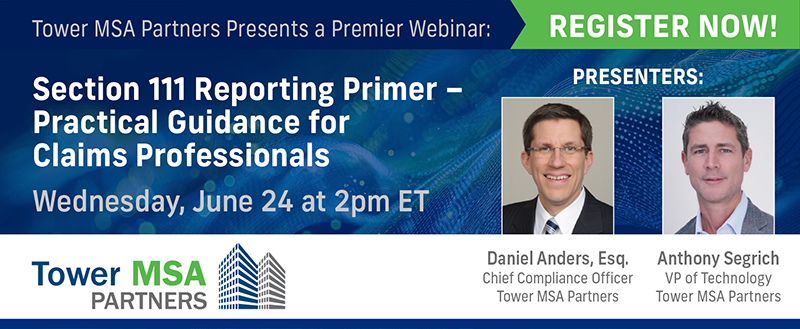
Tower MSA Partners Section 111 Reporting Primer webinar featuring Dan Anders and Anthony Segrich on June 24 at 2 p.m. ET

Understanding ORM, TPOC, and Common Reporting Pitfalls

The introduction of WCMSA fields to the Section 111 reporting process has rightly been forefront over the past year. However, confusion remains when it comes to the traditional reporting requirements of ORM reporting, ORM terminations and TPOC reporting.

Webinar Details

On Wednesday, June 24 at 2:00 p.m. ET, join Tower’s Chief Compliance Officer, Dan Anders, and VP of Technology, Anthony Segrich, who will break down the practical application of Section 111 reporting requirements. 

Who Should Attend

This webinar will provide practical, real-world guidance that adjusters can immediately apply to their claims handling and settlement practices.  Attorneys and others involved in the settlement process will also gain a better understanding of how Section 111 reporting affects Medicare conditional payment recovery and post-settlement medical considerations.

You will learn:

  • When claims should be reported to CMS
  • Common ORM reporting mistakes and misconceptions
  • When ORM can — and cannot — be terminated
  • Understanding TPOC reporting triggers and timing
  • Reporting considerations in denied claims and disputed settlements
  • Best practices to reduce compliance risk and reporting errors

A Q&A session will follow the presentation. Questions may be submitted in advance during registration.

Please reserve your spot today.

Click to register.

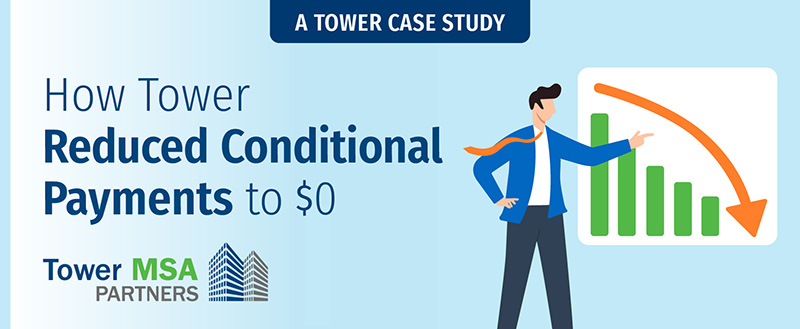
How Tower Reduced Conditional Payments to $0

Image of Tower MSA Partners Why Case Studies Matter series, Blog 9 Conditional Payments Reduced to Zero

In Tower MSA Partners’ last post, From Backlog to Breakthrough, Reducing 43 Percent of Legacy Claims, we explored how structured review helped a payer resolve 43% of its legacy claim backlog. This month, we focus on a different but equally important component of Medicare compliance. A payer requested Tower MSA Partners’ assistance with Medicare conditional payments after receiving an unexpectedly high reimbursement demand. Through detailed investigation, clinical review, and strategic communication with Medicare, Tower reduced the conditional payment amount to zero. This case shows how expertise in documentation and compliance protects payers from unnecessary financial exposure.

Identifying the Problem

Medicare conditional payments arise when Medicare covers medical treatment that may be related to a worker’s compensation or liability claim. In this case, Medicare issued a demand letter listing charges that totaled several thousand dollars. Tower’s analysts reviewed the itemized charges and immediately identified discrepancies. Many of the listed treatments were unrelated to the claimed injury, some were incorrectly dated, and others were duplicates. Without intervention, the payer would have reimbursed Medicare for services that were not their responsibility.

The Conditional Payment Resolution Solution

Tower MSA Partners performed a complete conditional payment review. Analysts compared each charge to the claimant’s medical history, verified diagnoses, and confirmed which treatments were causally related to the claimed condition. The review found multiple services that did not match the injury, unrelated emergency visits, and unrelated diagnostic imaging. Tower prepared a detailed dispute package explaining why each unrelated charge should be removed. Medicare accepted the documentation and eliminated every disputed line item, reducing the conditional payment amount to zero.

Collaboration and Communication

Tower communicated closely with the claims professional throughout the process, providing updates on findings and ensuring that the payer understood the basis of each dispute. The clinical team also prepared clear documentation for Medicare that supported the request for removal of unrelated charges. This level of communication helped streamline the review process and ensured the payer had complete visibility of the findings. Because the documentation was thorough and aligned with Medicare standards, the dispute was accepted without further development.

Why Oversight Makes the Difference

Conditional payments require precise evaluation because even a single unrelated treatment can create unnecessary financial exposure. Many payers reimburse Medicare due to uncertainty about which charges apply. Tower’s clinical oversight identifies unrelated treatment, strengthens dispute documentation, and prevents avoidable reimbursement. This case shows how expert review transforms a costly demand into a compliant resolution that protects the payer and ensures accurate reporting.

Lessons Learned

  1. Conditional payment reviews must be detailed to identify unrelated charges.
  2. Accurate documentation leads to successful Medicare disputes.
  3. Collaboration with claims professionals ensures clarity and confidence.
  4. Strategic oversight prevents unnecessary reimbursement. This case resulted in a zero-dollar conditional payment demand.

Results That Reflect Expertise

Through thorough review and precise documentation, Tower reduced Medicare conditional payments to zero. The payer avoided unnecessary expenses and gained confidence that the claim was handled accurately and compliantly. Tower MSA Partners continues to demonstrate the importance of clinical insight, administrative precision, and regulatory expertise in managing Medicare related obligations.

FAQs

What are Medicare conditional payments?

Medicare conditional payments occur when Medicare pays for treatment that may be related to a compensable claim and seeks reimbursement from the responsible payer.

Why do conditional payment demands include unrelated charges?

Medicare often uses broad diagnosis codes, which can pull in unrelated treatment unless each line item is reviewed.

How does Tower reduce conditional payments?

Tower verifies each charge, identifies unrelated services, and prepares detailed dispute documentation for Medicare.

Can Medicare reduce conditional payments to zero?

Yes. When documentation proves that charges are unrelated to the claim, Medicare may remove the items entirely.


Workers’ Compensation MSP Outcomes & Regulatory Insights Report

June 16, 2026

2022-2025 Performance Analysis

One of the most comprehensive multi-year MSP outcome analyses available in the workers’ compensation industry.

Executive Summary

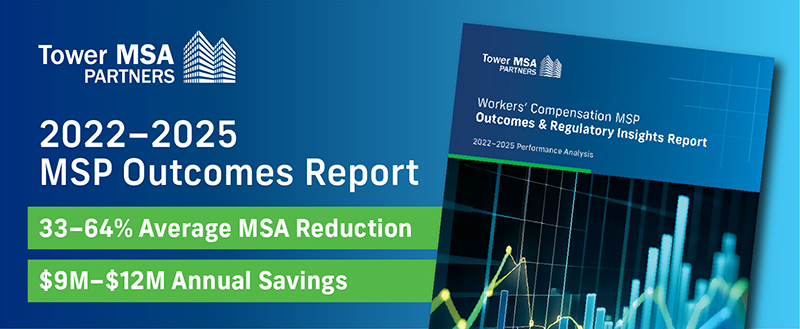
Tower MSA Partners is pleased to provide this first-of-its-kind report, offering one of the most comprehensive multi-year MSP outcome analyses available in the industry. The report provides wide-ranging data points and key metrics across MSA services, conditional payment programs, and CMS-published benchmarks.

These outcomes reflect an integrated model that combines clinical engagement, disciplined allocation methodology, CMS alignment controls, pharmacy mitigation strategies, and aggressive conditional payment resolution.

This report presents aggregated, anonymized performance metrics from 2022 through 2025 to serve as directional benchmarks for workers’ compensation stakeholders evaluating their Medicare Secondary Payer strategy.

Key Findings

Between 2022 and 2025, Tower MSA Partners delivered measurable, repeatable reductions in Medicare-related settlement exposure while maintaining disciplined alignment with CMS expectations.

Across this four-year period:

  • 33% to 64% annual reduction in projected MSA amounts through clinical intervention
  • $9 million to $12 million in annual MSA-related savings generated through physician and pharmacy optimization
  • 23% lower CMS-approved MSAs compared to CMS national averages
  • 84% to 90% of submissions avoided development letters
  • 82% of conditional payment demands reduced to $0 in 2025
  • Three-day average turnaround time once documentation is complete

In 2025 alone:

  • Average CMS-approved Tower WCMSA: $67,692
  • CMS national average WCMSA: $86,169
  • Average savings differential per file: $18,477

Why This Matters

Medicare Secondary Payer strategy is no longer simply a compliance requirement. It directly impacts settlement velocity, reserve accuracy, pharmacy exposure, and overall financial predictability.

The outcomes presented in this report demonstrate that a disciplined MSP framework can materially improve both operational and financial performance. Organizations that combine clinical oversight, pharmacy management, documentation discipline, and regulatory expertise are better positioned to achieve compliant and cost-effective settlement outcomes.

What’s Included in the Report

  • Multi-year MSP performance benchmarks
  • Medicare Set-Aside outcome analysis
  • CMS approval and development metrics
  • Pharmacy and opioid mitigation outcomes
  • Conditional payment resolution trends
  • Regulatory developments impacting workers’ compensation
  • Settlement optimization insights
  • Industry benchmark data from 2022-2025

Access detailed benchmarks, regulatory developments, CMS trends, and performance metrics from 2022 through 2025.

CMS Solicits Feedback on ORM Termination in Section 111 Reporting

June 1, 2026

cms orm termination and section 111 reporting compliance

In a May 26, 2026, letter to the stakeholder community, the Centers for Medicare and Medicaid Services (CMS) requested feedback on the voluntary termination of Ongoing Responsibility for Medicals (ORM), as it relates to Section 111 reporting.  Per the letter:

Currently, Chapter III, Section 6.3.2 – ORM Termination, provides various scenarios under which an RRE may terminate their ORM status when such status appropriately ends. DMPO desires industry feedback on whether the current parameters are appropriate, reasonable, and sufficient.

DMPO requests that any person or entity desiring to share feedback, ideas, concerns, or questions do so no later than June 9, 2026. Feedback need not be in any formal format or follow any particular parameters. DMPO is unable to guarantee a direct response to all feedback but will take all submissions into consideration as the policy around ORM termination is reviewed. Comments received after the above date will still be considered for future enhancements.

All submissions should be e-mailed to the new DMPO-managed mailbox relating to all Coordination of Benefits and Recovery (COB&R) inquiries:

COBR@cms.hhs.gov

ORM termination is critical not only to ending a payer’s responsibility for payment of injury-related medical care but also to allowing the injured claimant to access medical benefits for injury-related care. Even when care is not injury-related, an open ORM can still result in Medicare denying payment for medical care based on the false assumption that the treatment is related to the injury.

Tower MSA Partners will provide feedback to CMS. We encourage our client partners to share their feedback or reach out to us so we can relay your comments and concerns to CMS. Please contact Tower’s Chief Compliance Officer, Dan Anders, at daniel.anders@towermsa.com.

CMS Section 111 Update: Key Changes to ORM Termination and TPOC Reporting

May 13, 2026

The Centers for Medicare and Medicaid Services (CMS) has released an update to the Section 111 NGHP User Guide (Version 8.4), introducing important clarifications related to:

  • Ongoing Responsibility for Medicals (ORM)
  • Total Payment Obligation to Claimant (TPOC) reporting
  • Wrongful death claims
  • Medicare Set-Aside (MSA) reporting in multi-defendant cases.

While many of these updates reinforce existing practices, several changes carry meaningful compliance implications for Responsible Reporting Entities (RREs).

Expanded Guidance on ORM Termination

CMS updated Chapter III, Section 6.3.2 of the Policy User Guide to clarify acceptable circumstances for terminating ORM.

The revised language states:

“Where the insurer’s responsibility for ORM has been terminated per the terms of the pertinent insurance contract, such as maximum coverage benefits, or any other reason that is not prohibited by the terms of the insurance contract or applicable state or federal law.”

CMS also added:

“Note: An insurer’s refusal to accept ORM, or to continue to accept ORM, is a valid ORM termination reason, provided that the refusal is permitted by applicable state or federal law and the terms of the insurance contract.”

What This Means

This update introduces helpful flexibility, but it does not create new substantive grounds for terminating ORM. Nonetheless, RREs may feel more comfortable with terminating ORM based on the following:

  • Claim denials
  • Independent Medical Examination (IME) results
  • Maximum Medical Improvement (MMI) determinations
  • Claimant non-compliance (e.g., refusal of treatment or IME)

In short, CMS has clarified when termination may be recognized, not expanded the legal basis for termination.

Clarification of TPOC Date in Workers’ Compensation Settlements

CMS also added a helpful example in Section 6.4 of the Policy Guide regarding the proper TPOC date to use when commission approval of a workers’ compensation case is required:

“Example: The parties to a workers’ compensation case execute an agreement regarding the claim on 01/20/2026. The state requires the workers’ compensation commission to approve the final settlement details and said approval occurs on 02/05/2026.”

According to CMS, the TPOC date is February 5, 2026, because it was the later of:

  • The date the agreement was fully executed
  • The date the court or commission approved the agreement.

What This Means

For many workers’ compensation settlements, this confirms what has already been standard industry practice: the commission approval date will be the TPOC date.

Updated Approach to Wrongful Death Claims

CMS also modified the language in Section 6.5.1.4 related to wrongful death claims.

Previously, CMS stated that wrongful death settlements were not reportable if they:

  • Did not claim or release medicals, and
  • Did not have the effect of releasing medicals

The revised language now emphasizes Medicare recovery rights and documentation.

“Note: In order for the wrongful death theory of liability to preclude Medicare from recovering from a settlement, judgment, award, or other payment, complete documentation must be provided that shows what was claimed and released or had the effect of being released. Additionally, a citation to the appropriate state statute or case law that precludes recovery from a wrongful death settlement should be included with any such dispute or appeal.

The prior language was:

Settlements, judgments, awards, or other payments entirely under the wrongful death theory of liability, which do not claim and release medicals, or have the effect of releasing medicals, are not required to be reported because Medicare would have no recovery claim against such a payment.

What This Means

It is unclear why CMS modified the language in this section, which shifts the focus from the release of medicals to recovery; however, the underlying requirements remain: a settlement is not reportable unless medicals are claimed and released as part of that settlement.  This includes a wrongful death settlement.

TPOC Reporting in Multi-Defendant Cases

CMS also clarified reporting requirements for multiple settlements involving the same claimant. The updated guidance confirms that where liability is proportionate or several, but not joint and several, each RRE should report only its own TPOC amount.

CMS added the language in bold:

Multiple settlements involving the same individual – If there will be multiple TPOCs submitted for the same individual, for the same incident, but reported by different RREs (proportionate or several liability but not joint and several), the records shall reflect each RRE’s unique TPOC amount and not the aggregate TPOC the beneficiary will be receiving. If more than one RRE has assumed responsibility for ongoing medicals, Medicare would be secondary to each such entity.

Example

If:

  • The total settlement is $100,000, and
  • One RRE’s share is $25,000

Then that RRE reports a TPOC amount of $25,000 — not the full settlement amount.

What This Means

This reinforces that reporting obligations where there is not joint and several liability are entity-specific, aligning each RRE’s reporting with its actual financial responsibility and avoiding over-reporting of settlement amounts.

The update helps avoid:

  • Over-reporting settlement amounts
  • Duplicate reporting
  • Confusion around proportional liability scenarios

Medicare Set-Aside (MSA) Reporting Clarifications

CMS also revised guidance regarding WCMSA reporting in cases involving:

  • Multiple dates of injury, or
  • Multiple defendants

CMS updated with new information in bold:

“As it relates to multiple dates of incident, an MSA, if applicable, shall be reported under the earliest date of incident, if only one TPOC is made. If multiple TPOCs are submitted, but only one MSA is reported, the MSA shall be reported on the first TPOC only. Where there are multiple defendants (RREs) reporting each RRE must report the total MSA Amount—not just its assigned or proportionate share. System logic exists such that only the first reported MSA amount will be applied for purposes of coordination of benefits.”

The updated language states that where multiple RREs are reporting, each RRE must report the full MSA amount — not merely its proportionate share.

CMS further notes that system logic applies only the first reported MSA amount for coordination of benefits purposes.

What This Means

This creates a notable distinction between:

  • Financial responsibility, and
  • Reporting obligations

Even where liability is divided, all RREs are required to report the entire MSA amount, making coordination among defendants critical to ensure consistency and avoid confusion.

Example (using the scenario above)

Assume:

  • Total settlement = $100,000
  • One RRE’s share = $25,000
  • WCMSA amount = $50,000

The RRE would report:

  • TPOC Amount: $25,000
  • WCMSA Amount: $50,000

Because all RREs must report the full MSA amount, coordination among defendants is critical to ensure consistency and avoid reporting discrepancies.

Final Thoughts

These updates do not fundamentally change Section 111 reporting—but they do tighten expectations around documentation, consistency, and defensibility.

RREs should review internal protocols, particularly around:

  • ORM termination decisions
  • Wrongful death claim handling
  • Coordination in multi-defendant settlements

Small missteps in these areas can create outsized compliance risk.

If you have any questions, please reach out to Tower’s Chief Compliance Officer, Dan Anders, at daniel.anders@towermsa.com .


From Backlog to Breakthrough, Reducing 43 Percent of Legacy Claims

May 5, 2026

Image of Tower MSA Partners Why Case Studies Matter series, Blog 8 Reducing Legacy Claims

A large payer came to Tower MSA Partners with a backlog of legacy claims that had stalled for months, and in some cases years. These claims included outdated medical records, unclear treatment histories, and MSAs that had never been reviewed for accuracy. Through structured medical review and focused cleanup, Tower helped the payer resolve 43% of these legacy claims. This case  reflects a broader trend in workers’ compensation, where successful legacy claim resolution depends on accurate clinical validation and updated MSA preparation.

Why Legacy Claims Stall

Legacy claims don’t linger because they are unsolvable, they stall because the underlying data is no longer accurate.

In this case:

  • Treatment histories no longer reflected current care
  • Medications included in MSAs had long been discontinued
  • Medical projections were based on outdated assumptions
  • Files had not been clinically reviewed in years

These issues led to inflated exposure, unclear settlement positions, and hesitation from all parties involved.

Turning Aging Files into Actionable Claims

Tower MSA Partners implemented a structured review process focused on clinical accuracy and defensibility.

Each claim was evaluated to:

  • Remove discontinued or unnecessary medications
  • Correct or eliminate outdated treatment projections
  • Align medical records with current care status
  • Rebuild MSAs based on actual medical necessity

Tower’s clinical team actively reconciles treatment patterns against real-world care. This ensures allocations reflect what is actually happening—not what was assumed years ago.

The result: MSAs that are accurate, defensible, and ready to support settlement.

How Collaboration Supports Legacy Claim Settlement

Updating the MSA alone is not enough—claims move when all stakeholders are aligned.

Tower worked closely with the claims team to clearly document and explain each change, giving adjusters confidence in the updated exposure. In parallel, structured settlement and professional administration partners were introduced to address claimant concerns about future medical care.

This combination helped:

  • Reduce claimant resistance
  • Eliminate uncertainty around future treatment funding
  • Create cleaner, more predictable submissions to CMS

Files that had been stagnant for years were now positioned for resolution.

Why Legacy Claim Resolution Makes a Difference

Without clinical validation, MSAs drift away from reality over time. They become inflated, difficult to defend, and harder to settle.

Tower’s approach restores alignment between medical documentation and actual care by:

  • Verifying current treatment status
  • Eliminating unsupported projections
  • Ensuring compliance with CMS expectations

This transforms legacy claims from uncertain liabilities into actionable settlement opportunities.

Results That Reflect Expertise

Through a focused legacy claim strategy:

  • 43% of legacy claims were resolved
  • Previously stalled files became settlement-ready
  • MSAs were updated to reflect current medical reality
  • Submissions were supported by clear, defensible documentation

What This Means for Payers

If you have claims that have not moved in years, there is a strong likelihood they are being driven by outdated medical assumptions—not true exposure.

Correcting those assumptions can unlock significant progress without increasing settlement spend.

Ready to Move Your Legacy Claims?

Tower MSA Partners helps payers reduce backlogs, improve MSA accuracy, and accelerate settlements through clinical intervention and disciplined review.

If you’re carrying aging claims that continue to stall, it may be time to reassess what’s driving them.

Contact our team or connect with Hany Abdelsayed, Executive Vice President, Strategic Services, at hany.abdelsayed@towermsa.com to discuss your legacy claim strategy.

Frequently Asked Questions

What is legacy claim resolution?

Legacy claim resolution is the process of reviewing long-standing or stalled claims to correct outdated medical projections and prepare accurate MSAs that support settlement.

Why do legacy claims stall?

They often include outdated treatments, discontinued medications, and unclear medical histories that make MSAs inaccurate or inflated.

How does Tower reduce legacy claim backlogs?

Tower updates records, verifies treatment plans, corrects pharmacy projections, and prepares accurate MSAs supported by current documentation.

Does CMS accept updated MSAs on old claims?

Yes. CMS accepts updated allocations when the documentation accurately reflects the claimant’s current medical needs.

How long does legacy claim resolution typically take?

The timeline depends on the condition of the claim files and the level of medical review required. Many legacy claims can move toward settlement within weeks once records are updated and MSAs are corrected to reflect current medical needs.

CMS Webinar Clarifies WCMSA Reporting Rules

April 22, 2026

Section 111 WCMSA reporting updates

In an April 15, 2026, webinar, Centers for Medicare and Medicaid Services (CMS) staff discussed important clarifications that will materially impact how Workers’ Compensation Medicare Set-Asides (WCMSAs) are reported under Section 111.

Several of these comments go beyond technical guidance—they directly affect whether CMS will review a WCMSA at all, how settlements are interpreted, and how Medicare coordinates benefits post-settlement.

Below are the most important takeaways, along with what they mean in practice for payers, TPAs, and Responsible Reporting Entities (RREs). A copy of the CMS slides can be found here.

Why Section 111 Reporting Now Drives WCMSA Outcomes

CMS is increasingly using Section 111 reporting as a primary enforcement tool for post-settlement compliance and coordination of benefits.

As a result, reporting errors now create direct financial and compliance exposure. They may:

  • Eliminate the opportunity for CMS WCMSA review
  • Trigger incorrect Medicare denials
  • Create duplicate or inaccurate records in CMS systems
  • Increase exposure for both payers and claimants

WCMSA preparation, settlement strategy, and Section 111 reporting must now operate as a coordinated process.

TPOC Reporting Before WCMSA Approval Ends Review

The most significant takeaway from the webinar is this:

Reporting TPOC with an MSA amount before CMS approval will effectively end the WCMSA review process. CMS explained that Section 111 reporting is treated as the payer’s definitive representation of settlement posture. Once TPOC is reported with an MSA amount, CMS assumes the parties have elected a non-submit MSA strategy and will not reopen the matter for review.

CMS clarified that:

  • If TPOC is reported with a WCMSA amount, the Workers’ Compensation Review Contractor (WCRC) will not accept a new submission
  • If a WCMSA is already under review, the WCRC will close the file without issuing a determination

CMS’s position is that reporting TPOC signals the claim has settled and the parties have chosen to proceed with a non-submit MSA.

Key Risk

Reporting TPOC prematurely permanently removes the ability to obtain CMS approval, even if approval was originally planned.

CMS WCMSA Reporting Requirements You Cannot Ignore

Professional Administrator EIN Reporting

While the professional administrator’s EIN is technically optional, CMS made clear that even if there is an MSA professional administrator, failing to report it will result in the MSA being treated as self-administered.

Why it matters:

When misclassified as self-administered, CMS systems generate beneficiary correspondence that may conflict with the actual trust or professional administration arrangement, increasing beneficiary confusion and compliance disputes

Case Control Number (CCN) Requirements

For CMS-approved WCMSAs, the Case Control Number (CCN) must be reported, even though optional.

Why it matters:

Because CCNs are only assigned to CMS-approved WCMSAs, their absence in reporting is a key indicator to CMS systems that an MSA was not reviewed

Funding Method Must Match CMS Approval

CMS emphasized that the reported funding method must align exactly with the approval:

  • Lump sum approvals must be reported as lump sum
  • Structured approvals must be reported as structured

Any change to funding requires CMS approval before reporting.

CMS Introducing Tolerance for Minor Value Differences

CMS acknowledged that small discrepancies can occur between approved MSA amounts and reported values.

To address this, CMS has:

  • Eliminated sensitivity to cents
  • Introduced a tolerance threshold for minor variances

This reduces technical errors, but material discrepancies will still create issues.

WCMSA Reporting for Multiple Dates of Injury

CMS maintains its position on multi-date-of-injury settlements:

  • Report one TPOC and one WCMSA tied to the earliest date of injury
  • Since the WCMSA covers all settling dates of injury, include all diagnosis codes associated with all settled injuries under that earliest date

Additional dates of injury should still be reported, but with:

  • $0 WCMSA amounts

For example, if a settlement resolves three dates of injury, one claim should report the earliest DOI with the full WCMSA amount and all applicable diagnoses, while the remaining two claims are reported with zero-dollar WCMSAs

Common Section 111 Reporting Mistakes That Create Risk

CMS reinforced several expectations that, in practice, are common failure points:

  • Report only after the settlement is finalized*

Reporting a “pending” settlement date remains unacceptable

  • Ensure data accuracy across all systems

Misalignment between MSA vendors, claims teams, and reporting units is a frequent issue

  • Populate all applicable fields

“Optional” fields often drive how CMS classifies and processes the MSA. As such, some “optional” fields should be considered required.

*Finalized means all settlement terms are fully executed, court approval if needed, medicals released, and no further contingencies remain.

The consistent theme: incomplete or inconsistent data leads to downstream problems for both payers and beneficiaries.

How to Adjust Your WCMSA and Section 111 Process Now

Organizations should take immediate steps to align their processes with this guidance:

  • Do not report TPOC until WCMSA approval is obtained (if approval is being sought) and settlement is made final
  • Always include the CCN for CMS-approved MSAs
  • Treat the professional administrator EIN as required when applicable
  • Validate funding method and amounts before submission to ensure they match CMS approval
  • Implement controls for settlements with multiple dates-of-injury to ensure proper consolidation of diagnoses and reporting structure

Final Takeaway: Section 111 Is Now a Compliance Gatekeeper

CMS is increasing its reliance on Section 111 reporting to drive compliance and post-settlement enforcement.

Organizations that treat WCMSA approval, settlement negotiations, and reporting as separate workflows are at increasing risk of irreversible errors, particularly when TPOC is reported too early.

Getting this right now requires tighter coordination, stronger internal controls, and a more deliberate approach to settlement and reporting timing.

Tower MSA Partners helps organizations align WCMSA strategy with Section 111 reporting to reduce risk and improve outcomes. Contact our team to review your process. Please reach out to Tower’s Chief Compliance Officer, Dan Anders, at daniel.anders@towermsa.com with any questions.

Frequently Asked Questions

When should TPOC be reported for a WCMSA?

TPOC should be reported only after the settlement is finalized and medicals released (Indemnity-only settlements are not reported). If a WCMSA is being submitted for CMS approval, TPOC should not be reported until after that approval is received. Reporting too early can prevent CMS from reviewing the WCMSA.

What happens if TPOC is reported before CMS approval?

If TPOC is reported with a WCMSA amount before CMS approval, the review process will be terminated. CMS will not issue a determination, and the opportunity for approval is lost.

Is the professional administrator EIN required for WCMSA reporting?

While the EIN is technically optional, CMS may treat the MSA as self-administered if it is not reported. This can lead to incorrect assumptions about how the MSA will be managed and may impact communication with the beneficiary.

What is a CCN in WCMSA reporting

CMS assigns the Case Control Number to track approved WCMSAs. It must be included in Section 111 reporting to ensure accurate recordkeeping and proper coordination of benefits.

How does CMS manage multiple dates of injury in WCMSA reporting?

CMS requires one WCMSA to be reported and tied to the earliest date of injury. All related diagnoses for the settled injuries should be included under that claim. Additional dates of injury should still be reported, but with zero WCMSA amounts.

$210K Saved: Why Clinical Oversight Is the Hidden MSA Advantage

April 9, 2026

Image of Tower MSA Partners Why Case Studies Matter series, Blog 7 Clinical Oversight Savings

In Tower MSA Partners’ last post, $231K in Savings from Free Physicians Follow-Up, we demonstrated how ongoing medical review produced $231K in savings through free physician follow-up. This month, we highlight the broader impact of clinical oversight itself. A payer asked Tower MSA Partners to review a complex claim involving long-term pain management, active comorbidities, and multiple prescribing providers. Through clinical oversight, Tower identified inaccuracies and outdated treatments that reduced the projected allocation by $210,143 (approximately $210K). This case reinforces why clinical insight is a powerful advantage in Medicare Set-Aside (MSA) management.

Identifying the Problem

The claim had a long history of treatment, frequent medication changes, and overlapping specialties that created inconsistencies in documentation. The initial MSA prepared by another vendor included medications that were no longer prescribed, therapy frequencies that were inconsistent with current care, and several treatments that lacked documentation supporting ongoing medical necessity. Without clinical oversight, these issues would have resulted in inflated costs and potential CMS challenges. The payer needed an accurate allocation that reflected the claimant’s present health status and documented treatment plan.

The Clinical Oversight Solution

Tower MSA Partners conducted a comprehensive clinical review of all medical records, pharmacy histories, diagnostic reports, and provider notes. The clinical team identified medications that had been discontinued, adjusted prescription regimens based on updated records, and corrected treatment frequencies. The review also uncovered redundant therapies that no longer aligned with best practice guidelines. Each correction was supported with clinical rationale and evidence-based justification. After applying these corrections, the revised MSA decreased by $210K while meeting all CMS expectations for accuracy and documentation.

Collaboration and Communication

Tower’s team worked closely with the claims professional to explain each update and its clinical foundation. Clear communication ensured that all parties understood the reasoning behind each correction. Defense counsel and treating providers were involved as needed to validate treatment patterns and confirm medication changes. This collaborative approach helped create a strong, defensible MSA that moved through CMS review without additional development requests. Precise documentation and clinical clarity built confidence across the entire review chain.

Why Oversight Makes the Difference

Clinical oversight strengthens MSA accuracy by applying an evidence-based medical lens instead of a purely administrative review, ensuring allocations are clinically appropriate and defensible under CMS review. Over time, complex claims develop treatment patterns that do not always reflect current clinical standards or actual patient needs. By applying clinical judgment, Tower identifies outdated or unnecessary items that inflate lifetime costs and weaken compliance. This case shows how oversight protects payers from significant overfunding while ensuring the MSA remains a true reflection of medically necessary care.

Lessons Learned

·       Clinical oversight reveals inconsistencies that administrative reviews often miss.

·       Updated medical documentation ensures accurate and defensible MSA projections.

·       Collaboration with providers strengthens clarity around treatment plans.

·       Savings come from clinically guided corrections and accurate projections.

·       The $210K reduction resulted from correcting outdated services and aligning projections with best practice.

Results That Reflect Expertise

The payer saved $210K and gained a fully compliant, defensible MSA supported by updated medical documentation and evidence-based clinical review. Tower MSA Partners demonstrated how clinical insight delivers meaningful savings while strengthening the accuracy and defensibility of every allocation. Clinical oversight is an essential advantage in managing complex claims and achieving both cost containment and compliance excellence.

FAQs

What is clinical oversight in MSA review?
Clinical oversight is a medically guided evaluation of an MSA that ensures treatments and medications reflect current clinical standards and documented medical necessity.

How does clinical oversight reduce MSA costs?
It identifies outdated treatments, incorrect therapy projections, and discontinued medications that inflate lifetime medical costs.

When is clinical oversight most valuable?
It is essential for complex claims involving long-term treatment, multiple providers, or frequent medication changes.

Does CMS recognize clinically supported changes?
Yes. CMS accepts proposed MSA amounts when they are supported with accurate clinical documentation and clear reasoning.


CMS will host a webinar on WCMSA Reporting on April 15

March 14, 2026

cms orm termination and section 111 reporting compliance

The Centers for Medicare and Medicaid Services will host a webinar on Workers’ Compensation Medicare Set-Aside (WCMSA) Reporting on Wednesday, April 15, 2026, at 1:00 p.m. ET.

Per CMS:

CMS will be hosting a WCMSA Reporting Webinar. The intent of the webinar is to review

the WCMSA reporting process that was implemented in April 2025, discuss some of the

issues encountered from CMS’ perspective, and review WCMSA reporting best practices.

As parties impacted by the WCMSA reporting, we also welcome anyone else involved in

the submission and administration of WCMSAs, including attorneys and Medicare

beneficiaries, to join. Please bear in mind that this Webinar is intended to broadly address

the WCMSA reporting process and questions regarding specific cases are not appropriate

for this setting.

There is no pre-registration for the webinar. Full details, including instructions on how to submit questions before the webinar, are available here and in the “What’s New” section of the CMS website.


Premier Webinar: MSP Compliance in 2026 – Regulatory Updates, Section 111 Audits & Settlement Risk

March 9, 2026

Tower MSA Partners webinar banner for “MSP Compliance in 2026, Section 111 Audits and Settlement Risk” on March 11, 2026 at 2 PM ET.

In 2025, the Medicare Secondary Payer landscape changed in meaningful ways. Section 111 WCMSA reporting became operational, and CMS discontinued formal review of $0 MSAs—fundamentally altering how payers approach settlement strategy and compliance risk.

Now in 2026, CMS is preparing to initiate its first round of Section 111 reporting audits.

What does all this mean for carriers, self-insureds, and defense counsel?

On Wednesday, March 11 at 2:00 p.m. ET, join Tower’s Chief Compliance Officer, Dan Anders, for a focused, practical discussion on how these regulatory developments are impacting workers’ compensation claims handling—and what organizations should be doing now.

You will learn:

  • The current status of Section 111 WCMSA reporting and how it is affecting settlement negotiations
  • What to expect from upcoming CMS Section 111 audits, including likely audit focus areas and compliance vulnerabilities
  • How to evaluate and document $0 MSAs in the absence of formal CMS review
  • Emerging MSA trends based on recent CMS guidance and Tower benchmarking data
  • Practical steps to mitigate civil money penalty exposure and strengthen internal controls

A Q&A session will follow the presentation. Questions may be submitted in advance during registration.

Please reserve your spot today.

Registration link: https://attendee.gotowebinar.com/register/3480677134558573406