Amended Review MSA Case Study

May 26, 2022

CHALLENGE:

CMS approved an MSA on 5/7/2015 for $147,483. The parties were unable to settle the workers’ compensation case at the time.  Nearly four years later, the parties were again ready to consider settlement, but the 2015 MSA no longer reflected the injured worker’s current course of medical care.

SOLUTION:

CMS’s Amended Review process provides for submitting a new MSA, but such submission must take place within one to four years after the original CMS MSA approval. Upon receipt of the referral, Tower had left less than two months to meet the 5/7/2019 deadline to submit a new MSA.

A review of recent medical records caused Tower to suspect that a supplemental oxygen delivery system was no longer used and that the injured worker could switch from brand-name Crestor to generic. Tower’s Physician Follow-Up service obtained a signed statement from the treating physician confirming the oxygen system was discontinued and that the injured worker now used the generic.

Based on this physician’s statement, Tower revised the MSA down to $46,171 and submitted shortly before the Amended Review deadline. CMS approved the new MSA amount on 5/13/2019.

RESULTS:  $101,312 in Savings

While CMS’s Amended Review process is a valuable tool to facilitate settlement where a prior MSA approval does not reflect current care, it is Tower’s Physicians Follow-Up solution that obtains the necessary documentation to substantiate the requested changes to the previously approved MSA. Tower’s Physician Follow-Up is provided at no charge when initiated as part of the MSA and CMS submission process.

More Tower Success Stories can be found here!


CMS Clarifies Policy on Non-Submit MSAs in Updated Reference Guide

March 22, 2022

book marked by sticky notes illustrating changes Section 111 reporting on ORM

The January 2022 addition of Section 4.3 to the CMS WCMSA Reference Guide that discussed the agency’s treatment of non-submit Medicare Set-Asides caused quite a stir throughout the MSA industry and raised many questions for those who use non-submit MSAs in workers’ comp settlements.  A February CMS webinar addressed some of those questions and we now have an update (Version 3.6) to the CMS WCMSA Reference Guide that modifies and clarifies this section.

Revisions to Section 4.3

Below is a breakdown of the revisions to Section 4.3 along with comments.

More general language around non-submit MSAs

The original language called out certain MSA products as indemnifying:

“A number of industry products exist with the intent of indemnifying insurance carriers and CMS beneficiaries against future recovery for conditional payments made by CMS for settled injuries.”

The new language is more general:

“A number of industry products exist for the purpose of complying with the Medicare Secondary Payer regulations without participation in the voluntary WCMSA review process set forth in this reference guide.”

Comment:  The original language took aim at MSA indemnification agreements where the new language is broader and includes any product that addresses future medicals. It also reiterates that the CMS MSA review process is voluntary. This was likely in response to people who said that CMS’s original policy changed the MSA review process from voluntary to mandatory.

 ‘May’ instead of ‘Will’ Deny

 CMS’s original policy said that it “will” deny payment of medical services up to the total settlement amount whereas the revised policy indicates CMS “may at its sole discretion” deny payment.

Comment:  It appears that CMS is giving itself wiggle room depending on the circumstances of an individual case.  Also, as is further explained below, CMS has given itself the option to accept less than the entire settlement amount as sufficient to protect its interests.

Total Settlement Definition

The original Section 4.3 defined total settlement as “total settlement less procurement costs.”  This was now revised to define total settlement “as defined in Section 10.5.3 of this reference guide, less procurement costs and paid conditional payments.”

Comment:  Section 10.5.3 is CMS’s longtime definition of “total settlement.” It makes sense that the definition of total settlement in the non-submit context should align. CMS also acknowledges that besides procurement costs, payment of conditional payments from the settlement amount should also be deducted from the amount of the settlement available to pay for future medical.

Post-MSA exhaustion review

When released in January, Section 4.3 provided no option for CMS to acknowledge the non-submit MSA as sufficient. The updated policy now says, “CMS will ignore the non-submit MSA and use the total settlement amount (minus procurement costs and paid conditional payments) as the amount available to pay future medicals “unless it is shown, at the time of exhaustion of the MSA funds, that both the initial funding of the MSA was sufficient, and utilization of MSA funds was appropriate.”

Comment:  It will be the Medicare beneficiary’s responsibility, or someone working on their behalf, to demonstrate that the MSA was sufficient at the time of settlement and that the MSA funds were spent appropriately.  We can assume that CMS will use the standards found in the WCMSA Reference Guide and its MSA Self-Administration Guide to make its determination. If CMS finds either that the MSA was insufficiently funded or inappropriately utilized, does the Medicare beneficiary have a right to an appeal? Medicare beneficiaries have a right to appeal a denial of payment for medical care. Presumably, that right extends to the context of a non-submit MSA, but it remains unclear how this would play out in practice, and CMS did not address it here.

Policy start date:  Per CMS, Section 4.3, “shall apply to all notifications of settlement that include the use of a non-CMS-approved product received on, or after, January 11, 2022; however, flags in the Common Working File for notifications received prior to that date will be set to ensure Medicare
does not make payment during the spend-down period.”

Comment:  Before the January date, there was no obligation to notify CMS of a settlement that includes the use of a non-CMS-approved MSA product (Yes, there is a Section 111 reporting responsibility, but that does not include notification of a non-submit MSA). Is there an obligation now? Nothing in Section 4.3 affirmatively states such an obligation exists and there is no statutory basis that provides for such notification.

Under threshold MSAs:  CMS says “CMS does not intend for this policy to affect any settlement that would not otherwise meet review thresholds. This comment does not relieve the settling parties of an obligation to consider Medicare’s interests as part of the settlement; however, CMS does not expect notification or submission where thresholds are not met.”

Comment:  Again, by saying it does not expect notification where thresholds are not met, CMS implies that they do expect notification when a non-submit MSA is used and thresholds are met. Why would CMS expect no notification on an under-threshold MSA? I suspect there are two reasons:

  • If a claimant is a Medicare beneficiary with a settlement of $25,000 or less, CMS expects that the MSA is a low-dollar amount and not worth the time it takes to coordinate its benefits.
  • If a claimant is not a Medicare beneficiary but has a reasonable expectation of Medicare eligibility within 30 months and the settlement is $250,000 or less, CMS cannot track the claimant as they are not yet a Medicare beneficiary.

Summary comments on Section 4.3 revisions

CMS should be credited for quickly addressing several of the questions and concerns that arose from the original Section 4.3 language. The revised section backs off the seeming implication that the mere use of a non-submit MSA represents a potential cost shift to Medicare. With that said, CMS reiterated that if the non-submit MSA exhausts, then it must be demonstrated that the MSA was sufficiently allocated at the time of settlement and the funds properly expended. As we do not know how this policy will play out in practice, the non-submit MSA route continues to present a notable risk to the claimant Medicare beneficiary.

Other CMS Updates to WCMSA Reference Guide

Beyond Section 4.3, CMS also made updates to other sections of the guide:

Section 9.4.1.1 Most Frequent Reasons for Development Requests

CMS added language to this section around documentation required for disputed cases, in other words, $0 MSAs for denied claims. CMS stated that medical records are required even when the parties are in dispute. Further, draft or final settlement agreements and court rulings are required documentation if they exist.

Comment:  CMS has required the above for quite some time.  This is just putting the requirements into the reference guide.

Section 16.1 Re-Review

CMS added the following to its re-review criteria:

 “Should no change be made upon response to a re-review request (i.e., no error was identified), additional requests to re-review the same error will not be entertained. “

Comment:  Tower has on occasion gone back and forth with CMS on arguments to remove a certain treatment or medication from the MSA. This new statement implies that once CMS makes its decision regarding a particular item it will not entertain other arguments.

If you have any questions, please contact Dan Anders, Chief Compliance Officer, at 888.331.4941 or daniel.anders@towermsa.com.

 

CMS Webinar Delves Further into Non-Submit MSA Matters

February 26, 2022

Man confused on a Non Submit MSA

The Centers for Medicare and Medicaid Services recently hosted a webinar on Workers’ Compensation Medicare Set-Asides (WCMSAs). While the webinar covered several topics around MSA submissions, CMS policy toward non-submit and evidence-based MSAs was an attendance-driver, according to its presenter, John Jenkins, Health Insurance Specialist for the CMS Division of Medicare Secondary Payer Operations.

As Tower MSA Partners’ recent articles CMS: Non-Submit MSAs Potentially Shift Costs to Medicare and CMS Letter Confirms Non-Submit MSA Denial is Real noted, the addition of Section 4.3 to the WCMSA Reference Guide has raised many questions and led some payers to reconsider whether non-submit MSAs are the best option for them.

Here is a webinar summary with Tower’s comments on Mr. Jenkins’ statements pertaining to non-submit MSAs along with a breakdown of some of the other matters discussed.

Non-Submit MSAs

Mr. Jenkins explained that the addition of Section 4.3 on non-submit and evidence-based MSAs was in response to industry requests for CMS’s position on such products.

He said that Section 4.3 is consistent with prior policy announcements which advise that Medicare has a right of recovery up to the settlement amount when the MSA is not CMS-approved and is prematurely exhausted.

  • Tower comment:  As we indicated in our prior article on Section 4.3, we believed this would be CMS’s position.

Mr. Jenkins could not clear up the question about MSAs that do not meet the CMS WCMSA review thresholds, i.e., Medicare beneficiary and total settlement higher than $25,000.  First, he said CMS treats these as if they never existed, thus the total settlement would be considered available to pay for future medical. However, later he said that if CMS obtains the non-submit MSA amount, that amount may be used to determine the “marker” in their system (This marker determines whether Medicare will pay for a certain treatment). Ultimately, he indicated further policy guidance will be issued around under-threshold MSAs.

  • Tower comment:  The common working file is CMS’s system to coordinate benefits to Medicare beneficiaries so that Medicare does not pay when a primary payer is available to pay. CMS places the marker for certain diagnoses to enable it to deny payment for treatment related to those diagnoses codes.  CMS needs to clarify how under-threshold MSAs will be treated. If parties have included a clinically and/or legally reasonable and defensible MSA in the settlement or have acceptable reasons for not including one, CMS should limit the liability for future medicals to the MSA amount. Perhaps CMS will have a post-settlement review process but its details are not clear at this time.

Mr. Jenkins went on to indicate that if CMS receives the non-submit documentation, settlement, and MSA amount, then it will use this information to place a marker in the common working file to deny medical care until such time as the settlement is exhausted.

According to Mr. Jenkins, CMS expects that Medicare should never see an injury-related bill if the non-submit MSA is priced correctly. If the MSA prematurely exhausts, the Medicare beneficiary will have to provide reasons for its exhaustion. Then it would be up to CMS to determine if the allocation and spending of the MSA were appropriate, using the same process used to approve MSAs.

  • Tower Comment:  Mr. Jenkins said that they see many instances of CMS-approved MSA funds exhausting and expects the same from non-submit MSAs. Even the best cost projections for future medical care are, in the end, still predictions. Future medical inflation alone will increase costs in addition to changes in treatment and medications. Thus, while a majority of non-submit MSAs will appropriately cover future medical care, some non-submit MSAs–just like some CMS-approved MSAs–will exhaust.

Mr. Jenkins referenced conducting some type of review if non-submit MSA exhausts, similar to the current pre-settlement WCMSA review process. Naturally, this raises more questions.  First, who is completing the review? The current CMS WCMSA review contractor, CMS itself, or some other contractor? What criteria will be used as part of the review? What documentation must be submitted to support the MSA allocation as sufficient and the fund spending as appropriate? To verify adequate funding, the same documentation used at settlement (medical treatment records, prescription histories, and rated ages) would likely be required. We assume appropriate spending of the funds would be determined using healthcare bills and payment receipts.

Mr. Jenkins advised that if a structured MSA’s funds exhaust in any given year, CMS will not temporarily step in to pay for injury-related care as it does with a CMS-approved MSA.

  • Tower Comment:  This leaves anyone with a non-submit MSA annuity in a difficult position. They would need to use their personal funds to pay for medical until next annuity payment is received when they could theoretically reimburse themselves. Even if they can reimburse their medical bills from the annuity payment, CMS is not likely to agree that reimbursing interest payments that occurred from putting medical bills on a credit card is an appropriate use of these funds.

Mr. Jenkins was clear in stating that the MSA, whether CMS-approved or not, is an agreement solely between CMS and the Medicare beneficiary.

  • Tower Comment:  This indicates that CMS will not take any action against the employer or insurance carrier as they are not seen as a party to the agreement. That said, there remain repercussions to the payer. A Medicare beneficiary claimant may be reluctant to agree to a settlement with a non-submit MSA. Additionally, the workers’ compensation board, commission or other governing authority may be less likely to approve such a settlement.

Mr. Jenkins stated that a large number of CMS-approved MSAs exhaust early and that non-submit MSAs are even more likely to exhaust early.

  • Tower Comment:  The allegation that a large number of CMS-approved MSAs exhaust early is, thus far, unsupported by data from CMS.

As to whether Section 4.3 of the reference guide applies retrospectively or just prospectively, Mr. Jenkins said that while what was stated in this section has always been CMS policy, anything after 1/11/22 must meet this requirement.

  • Tower Comment:  We believe this statement is still unclear. Does this mean that CMS will only apply this policy to settlements that occur after 1/11/22 or does it apply to settlements that took place before 1/11/22 when MSA funds continued to be used after that date?

Finally, Mr. Jenkins advised that Section 111 reporting and WCMSAs are not connected. Therefore, the agency does not use the Section 111 Total Payment Obligation to the Claimant (TPOC) data to place a marker in the common working file.

  • Tower Comment:  While this has been our understanding, CMS’s statement that it does not use Section 111 reporting data to stop Medicare payment for post-settlement medical is significant. It means that unless the settling parties proactively advise CMS of a non-approved MSA, CMS will continue to pay for injury-related care because it is unaware that an MSA was funded.

While the webinar answered some questions around CMS’s approach to non-submit MSAs, many remain. We believe CMS needs to significantly increase its guidance to Medicare beneficiaries surrounding their rights, responsibilities, and the risks they face when settling a claim with a non-submit MSA. At a minimum, CMS may not automatically acknowledge the non-submit MSA amount as the extent of liability for future medical. Consequently, the Medicare beneficiary may be placed in a position to defend the MSA amount and their spend from that amount at some point years in the future.

Other MSA Matters

  • Submission of settlement documents:  CMS continues to identify cases where settlement occurred, and the settlement documents were not forwarded to CMS. These documents must be submitted to make the MSA effective in CMS’s system.
  • Electronic attestation:   Mr. Jenkins indicated that MSA administrators are not submitting yearly and final attestations electronically even though this option is available. He encouraged its use.
  • State statutes:  Advised that parties who wish to limit the MSA per the Georgia 400-week cap need to provide an order from the Georgia Workers’ Compensation Board confirming the claim as non-catastrophic. Also, if a California Independent Medical Review (IMR) confirms the denial of certain care, CMS will not exclude the denied care from the MSA without an “Alternative Treatment Plan” from the treating physician.
  • Pricing of Prescription Drugs:  Addressed a question about whether CMS would consider another pricing mechanism for prescription drugs other than Red Book by saying that CMS is always open to a discussion on alternatives.
  • Lack of updated medical treatment:  In situations where the claimant has not been treated in several years CMS will not assume that this is sufficient evidence to demonstrate that no further care is necessary. Instead, CMS will consider the worst-case scenario and assume that the claimant will return for care.
  • Comorbidities that prevent surgery:  If a comorbidity, such as cardiac or respiratory problems, prevents a surgery from proceeding, CMS will assume that the person will improve and thus allocate the surgery in the MSA.
  • Release from care statements:  If a treating physician releases a claimant from care this does not automatically create a presumption of no future care. CMS assumes that if a specialist releases the claimant from care that there may be follow-up with a primary care physician for ongoing maintenance unless otherwise indicated.
  • MSA Amended Reviews:  Advised that parties who have a previously approved MSA that falls outside of the 72-month window for submitting an Amended Review can still fund that older approved MSA as it will be the only one on record with CMS.

If you have any questions, please contact Dan Anders, Chief Compliance Officer, at 888.331.4941 or daniel.anders@towermsa.com.

 

Study Shows Post-Settlement Medicare Treatment Denials Do Occur

February 1, 2022

Study showing Medicare treatment denials for Medicare Set Asides and the importance of proper MSA administration and compliance.

A recent study finds Medicare treatment denials systematically occur in medical claims for Medicare beneficiaries with Medicare Set-Asides (MSAs).

“Don’t worry so much about the Medicare Set-Aside; Medicare will never deny post-settlement treatment claims.”  That is the refrain from some when the matter of an MSA inclusion in settlement arises.

Tower has consistently warned that Medicare has steadily increased efforts to protect the agency’s interests. One need only look at CMS’s Section 111 Mandatory Insurer Reporting platform or its two conditional payment recovery contractors, the CRC and BCRC, to see CMS is serious about enforcing the Medicare Secondary Payer (MSP) Act. Still, some believe that Medicare will not deny claims post-settlement.

Thanks to our Professional Administrator Partner Ametros, we now know CMS will deny post-settlement claims for injury-related treatment.

Ametros wanted to know what happened when a Medicare beneficiary with a fully funded, CMS-approved MSA failed to report proper exhaustion of funds to Medicare and then billed Medicare for injury-related claims.  To find out, Ametros’ General Counsel Shawn Deane and Senior Strategic Account Executive Jayson Gallant worked with the Research Data Assistance Center (ResDac) to analyze Part B claim data.

The result?

Researchers examined a random sample of five percent of the Medicare beneficiary population over a three-year period. They estimated the following number of claims were denied because WCMSA funds were responsible for their payment.

  • 35,980 in 2018
  • 36,060 in 2019
  • 30,720 in 2020

The key conclusion of the report is “Medicare is systematically denying MSA recipients’ claims, and with steady frequency.”

You can download the free report “A Study of CMS Policy on Treatment Denials for Injured Workers with a Medicare Set Aside from Ametros’ website (ametros.com/medicaredenials).  Plus, Ametros will present the study’s findings in a February 15 webinar starting at 1 p.m. EST. Register here.

Practical Implications

As Tower always suspected–and as CMS always warned–the agency will deny claims that should be covered by an MSA.  Consequently, the most important implication is the need for the proper administration of those funds whether that is with professional administration or self-administration assistance.  Both services are available through our partner Ametros and are recommended for most MSAs.

The study specifically indicated it did not consider non-submit MSAs or non-CMS-approved MSAs.  One might argue then that a non-submit MSA is the better option because if CMS is not aware of the MSA, it will not deny payment for injury-related medical care.  Such a position is problematic for the following reasons:

  • While CMS may not be aware of a non-submit MSA, it is aware of any settlement involving a Medicare beneficiary claimant because these are reported through the Section 111 reporting process.
  • CMS recently updated its WCMSA Reference Guide to add Section 4.3 which views non-submit/evidence-based MSAs “as a potential attempt to shift financial burden” to Medicare.  The guidance goes on to state that “CMS will deny payment for medical services related to the WC injuries or illness requiring attestation of appropriate exhaustion equal to the total settlement less procurement costs before CMS will resume primary payment obligation for settled injuries or illnesses.”
  • Given CMS has a process in place to deny injury-related treatment in CMS-approved MSAs, where a CMS-approved MSA is not on records, CMS can presumably use the Section 111 reporting information to deny payment for medical treatment up to the settlement amount.

Accordingly, a non-submit MSA when the MSA qualifies for CMS review/approval presents its own risks and with CMS’s increased focus on non-submit MSAs, these risks are heightened.

Whether a CMS-approved MSA or non-submit MSA is used, payers should commit to producing MSAs that balance care, cost and compliance and strongly encourage those MSAs are professionally administered by a company like Ametros.

Tower will host a webinar on February 5 at 2 p.m. ET, WC Settlements in Light of CMS Policy on Non-Submit MSAs which will touch on the Ametros study and further discuss the implications of CMS policy toward non-submit MSAs.  Register here.

Please contact Dan Anders at daniel.anders@towermsa.com or 888.331.4941 with any questions.


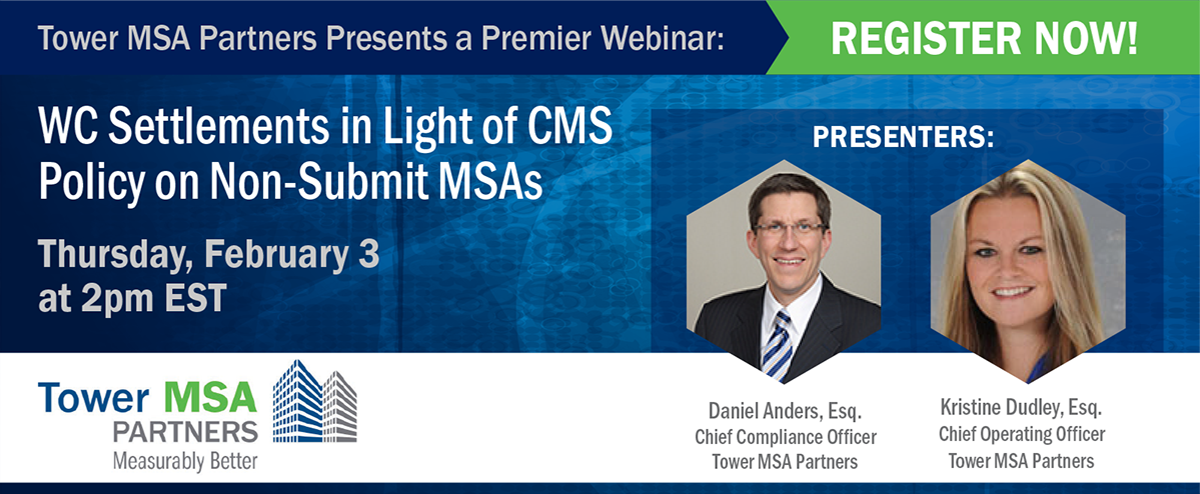
Premier Webinar: WC Settlements in Light of CMS Policy on Non-Submit MSAs

January 25, 2022

pictures of Dan Anders & Kristine Dudley and details for webinar on Non-Submit MSAs

The Centers for Medicare and Medicaid Services (CMS) recent policy statement which considers non-submit/evidence-based MSAs “as a potential attempt to shift financial burden” to Medicare left many questions in its wake (See CMS: Non-Submit MSAs Potentially Shift Costs to Medicare).  It has triggered many payers, along with injured workers and their attorneys, to reconsider the choice to avoid the CMS MSA review and approval process.

On Thursday, February 3 at 2:00 PM ET, Tower’s Chief Operations Officer Kristine Dudley and Chief Compliance Officer Dan Anders will address the many questions which arise out of this announcement and walk attendees through how a move from a non-submit to submit MSA program can still yield cost-effective settlements with the added protection of CMS approval.

Here’s just some of what you will learn:

  • Background on CMS policy on submit vs. non-submit MSAs and what it means for the future of MSAs
  • Potential defenses to CMS claim that a non-submit MSA was deficient
  • A how-to guide to transition from non-submit to submit MSA program which still settles WC cases
  • Tools available to contain MSA costs whether the MSA is submitted or not

While the webinar focus is on those that have primarily pursued a non-submit MSA course, portions on MSA cost containment and ensuring the availability of MSA funds over a lifetime are important to submitters and non-submitters alike.

A Q&A session will follow the presentation, and you can send your questions to Daniel.Anders@TowerMSA.com now. Please click the link below and register today!

Register here

CMS: Non-Submit MSAs Potentially Shift Costs to Medicare

January 13, 2022

CMS updates to the WCMSA Reference Guide addressing non submit Medicare Set Asides and Medicare Secondary Payer compliance.

The Centers for Medicare & Medicaid Services updated its Workers’ Compensation Medicare Set-Aside Reference Guide (Version 3.5) with new language on non-CMS-approved products used to address future medical care.

The update specifically addresses products commonly called evidence-based MSAs or non-submit MSAs. CMS says these products may be viewed as a potential attempt to shift financial burden to Medicare when they are not submitted, reviewed, and approved before settlement.

CMS Addresses Non-Submit MSAs in Updated WCMSA Guidance

CMS states that it cannot be certain Medicare’s interests are adequately protected unless a proposed amount is submitted, reviewed, and approved through the process described in the reference guide before settlement.

As a matter of policy and practice, CMS says it will deny payment for medical services related to the workers’ compensation injury or illness until the claimant demonstrates appropriate exhaustion. This could require exhaustion equal to the total settlement less procurement costs, rather than only a CMS-approved WCMSA amount.

Key Takeaways From the CMS Policy Update

CMS directly addresses evidence-based and non-submit MSAs in the reference guide.

The agency says non-CMS-approved products may be treated as a potential attempt to shift financial burden to Medicare.

CMS also states that it may deny payment for medical services related to workers’ compensation injuries until the total settlement has been exhausted.

This policy does not appear to be limited only to future MSAs. It could also affect existing non-submit MSAs unless CMS provides further clarification.

Questions About Non-Submit MSAs and CMS Approval

This does not appear to be a completely new CMS position. CMS has long stated that when an MSA is not approved, Medicare may deny related medical claims or pursue recovery for claims it paid, up to the full amount of the settlement.

What is different is that CMS now directly addresses evidence-based MSAs, non-submit MSAs, and vendor indemnifications that may accompany those arrangements. CMS also indicates that a claimant may need to demonstrate complete exhaustion of the net settlement amount before Medicare resumes primary payment for injury-related care.

What This Means for Payers and Beneficiaries

If a non-submit MSA was used to settle a case, CMS involvement is typically triggered when Medicare is asked to pay for injury-related medical care.

If the MSA amount is enough to cover that care, the beneficiary may not have an immediate issue. However, if the MSA is exhausted, CMS has made clear that it may deny payment.

For payers, this may create concern if indemnification, guarantees, or other liability provisions were used in connection with a non-submit MSA. Those provisions may be tested if Medicare denies payment for future injury-related care.

Cost-Effective CMS-Approved MSAs Are Possible

The non-submit MSA route is often based on the belief that CMS-approved MSAs include unrealistic allocations. However, Tower MSA Partners has found that MSA costs can often be contained while still pursuing CMS approval.

Tower does this through a clear understanding of CMS’s MSA pricing methodology, proactive record review, and targeted physician statements. This process helps move cases toward settlement while reducing the risk that CMS may later deny payment for future injury-related medical care.

Please contact Chief Compliance Officer, Dan Anders, with any questions about this or any other MSP compliance issue at Daniel.anders@towermsa.com or 888.331.4941.

Related Articles

Tower’s Dan Anders Says “It’s Still OK to Submit and MSA”