Celebrex and Abilify Price Drops Trigger MSA Reductions

December 14, 2020

Vial of pills illustrating MSA Reductions in RX costs

Recently, the lowest average wholesale price of Celebrex 200mg and the price of multiple strengths of Abilify dropped dramatically resulting in major MSA reductions.
 
A widely used, non-steroidal anti-inflammatory drug, Celebrex (Celecoxib), is FDA-approved for several conditions:

  • Ankylosing spondylitis
  • Juvenile rheumatoid arthritis
  • Acute migraines
  • Osteoarthritis
  • Acute pain
  • Primary dysmenorrhea
  • Rheumatoid arthritis

Per Red Book, the lowest average wholesale price for Celecoxib 200mg dropped from $1.79 to $0.33, an 81.56% price reduction.
 
Abilify (Aripiprazole) is an antipsychotic drug FDA-approved for the following conditions: 

  • Schizophrenia
  • Acute treatment of manic and mixed episodes associated with bipolar
  • Adjunctive treatment of major depressive disorder
  • Irritability associated with autistic disorder
  • Treatment of Tourette’s disorder

Per Red Book, the lowest average wholesale price for multiple strengths (2mg to 30mg) of Aripiprazole dropped from the $30 to $36 range to a range of $0.07 to $0.17 per dose, an almost 100% price reduction.
 
Tower Action in Response
 
Because Tower’s system tracks all medications allocated in MSA reports, we have already pulled reports from the past two years that allocated these medications and advised clients of the potential for MSA reductions. You can also contact us to determine whether a particular MSA qualifies for MSA reductions.  Revisions to the MSA can be done now or prior to MSA submission to CMS.
 
Please contact Dan Anders, Tower’s Chief Compliance Officer, at Daniel.anders@towermsa.com or (888) 331-4941 with questions.

Medicare Conditional Payment Recovery Threshold for 2021

December 1, 2020

chart, dollars and a fountain pen illustrating conditional paument recovery threshold post

In an 11/25/2020 Alert, the Centers for Medicare and Medicaid Services (CMS) announced that the 2021 conditional payment recovery threshold for liability, no-fault and workers’ compensation settlements will remain at $750. Accordingly, Total Payment Obligations to the Claimant, TPOCs, in the amount of $750 or less are not required to be reported to CMS through the Section 111 Mandatory Reporting process, nor will CMS attempt to recover conditional payments for TPOCs of this amount (The threshold does not apply to liability settlements for alleged ingestion, implantation or exposure cases).

By way of background, pursuant to the SMART Act of 2012, CMS is required to annually determine a threshold amount such that the cost of collection does not outstrip the amount recovered through such collection efforts. CMS’s calculations, which can be found here, resulted in maintaining the $750 threshold. 

Practical Implications

As CMS is keeping the $750 threshold for mandatory reporting and conditional payment recovery there are no changes to the reporting processes or determinations as to when conditional payments should be investigated or resolved.

Related

Questions About Medicare Conditional Payments? Join Our Upcoming Free Webinar

November CMS Mandatory Reporting and Conditional Payment Updates

CMS Rolls Out Updates to NGHP User Guide

October 22, 2020

Tower MSA Partners explains CMS updates to ORM and NOINJ rules in the Section 111 reporting user guide.

Earlier this month CMS released an updated MMSEA Section 111 Medicare Secondary Payer Mandatory Reporting User Guide (Version 6.0).  Here are the key updates with analysis and practical implications.

Additional Definition of Total Payment Obligation to Claimant (TPOC)

Section 6.4 of Volume 3 (Policy Guidance) of the user guide defines TPOC this way:

The TPOC Amount refers to the dollar amount of a settlement, judgment, award, or other payment in addition to or apart from ORM. [Ongoing Responsibilities for Medicals] A TPOC generally reflects a “one-time” or “lump sum” settlement, judgment, award, or other payment intended to resolve or partially resolve a claim. It is the dollar amount of the total payment obligation to, or on behalf of the injured party in connection with the settlement, judgment, award, or other payment. Individual reimbursements paid for specific medical claims submitted to an RRE [Responsible Reporting Entity], paid due the RRE’s ORM for the claim, do not constitute separate TPOC amounts.

The update added an explanation of the TPOC amount computation to this definition:

The computation of the TPOC amount includes, but is not limited to, all Medicare covered and

non-covered medical expenses related to the claim(s), indemnity (lost wages, property damages, etc.), attorney fees, set-aside amount (if applicable), payout totals for all annuities rather than cost or present values, settlement advances, lien payments (including repayment of Medicare conditional payments), and amounts forgiven by the carrier/insurer.

CMS’s definition seems to have been largely pulled from the Workers’ Compensation Medicare Set-Aside (WCMSA) Reference Guide’s definition of total settlement.  Its purpose in the WCMSA Reference Guide is to determine whether a settlement meets CMS MSA review thresholds.  While we assume CMS’s intent is to help reporting entities better determine the TPOC amount, adding this computation definition raises some concerns:

  • Liens & Medicare Conditional Payments:  In some cases, lien payments, including the Medicare repayment conditional payment amount, is not known at the time of settlement.  This is not a problem if the injured worker is repaying Medicare out of the settlement amount. But it may be a problem if the employer or carrier is agreeing to pay Medicare with funds outside of the settlement amount because they may not have a final demand amount prior to settlement.  Our solution would be for CMS to clarify that a lien payment, namely a repayment of Medicare conditional payments made directly to Medicare or to a lienholder, Medicaid for example, is not part of the TPOC computation.
  • Amounts Forgiven in Settlement:  Besides repayment of liens, CMS also brings in the term “amounts forgiven” from the WCMSA definition of settlement. While it has never been further defined in the CMS WCMSA Reference Guide and CMS provides no further clarification here, the general understanding is that this refers to the carrier or employer’s waiver of a subrogation lien against a 3rd party liability settlement.  An employer or carrier may waive their subrogation lien for many reasons, and they may do so without having a firm dollar amount to even determine the “amounts forgiven.”

We see using the amounts forgiven term as a way for CMS to provide settling parties the ability to obtain an MSA approval when the WC case is settling and all or most of the settlement funds are coming from a 3rd party liability settlement.   However, in the mandatory reporting context, amounts forgiven is a specific dollar amount which must reported and thus becomes relevant to Medicare conditional payment recovery

Were the WC carrier to report amounts forgiven in the TPOC amount, CMS and its recovery contractor would assume that the injured worker has received these funds as part of the WC settlement, which is not the case.  These funds are not a payment to the claimant.  The injured worker presumably receives payment from the 3rd party liability settlement and, if he or she was a Medicare beneficiary at the time of that settlement, this will be reported to Medicare.  Requiring the WC carrier to report amounts forgiven in settlement and then having the liability carrier report the liability settlement is duplicative and unnecessary to protect Medicare’s interests.  We hope CMS reconsiders the use of this terminology in its TPOC computation or clarifies what they mean by amounts forgiven.

Indemnity-Only Settlements are Not Reportable

Following its August 13, 2020 webinar on Section 111 reporting where CMS officials reiterated that indemnity-only settlements are not reportable as TPOC, CMS has now added the following to Section 6.5.1 of the guide, which also incorporates “property damage only” claims:

RREs are not required to report liability insurance (including self-insurance) settlements, judgments, awards or other payments for “property damage only” claims which did not claim and/or release medicals or have the effect of releasing medicals. Similarly, “indemnity-only” settlements, which seek to compensate for non-medical damages, should not be reported. The critical variable to consider is whether or not a settlement releases or has the effect of releasing medicals. If it does, regardless of the allocation (or lack thereof), the settlement must be reported.

This raises the question of whether a prior indemnity-only settlement amount is combined with a later settlement releasing medicals and reported as TPOC.  As mentioned earlier, CMS’s TPOC computation definition was taken from the CMS WCMSA Reference Guide and applied to the TPOC computation.  In doing so, CMS excluded the phrase “prior settlements of the same claim” to the TPOC definition.  Based on this exclusion, which is consistent with other guidance in the user guide, we accept that a prior indemnity-only settlement is not reported as TPOC, even when a later settlement releases medicals.

If you have any questions, please contact Dan Anders, Chief Compliance Officer, at Daniel.anders@towermsa.com or 888.331.4941.

CMS Adds New Pricing Resource to WCMSA Reference Guide

October 14, 2020

stethescope on a Workers’ Compensation Medicare Set-Aside Arrangements

In a recent update to its WCMSA Reference Guide, the Centers for Medicare and Medicaid Services released a state-by-state list of the major medical centers it uses for pricing future medical expenses in proposed MSAs.  This zip code-based list (See Appendix 7 of the guide) will help MSA preparers and submitters more accurately price surgical procedures, including spinal cord stimulators and intrathecal pumps, per CMS requirements.

Background

From the reference guide:

Hospital fee schedules are currently determined using the Diagnosis-Related Groups (DRG) payment for the median major medical center within the appropriate fee jurisdiction for the pricing ZIP code, unless otherwise defined by state law (see Appendix 7).

While that sounds good, until this update, no one but CMS and the Workers’ Compensation Review Center (WCRC), which reviews submitted MSAs for CMS, knew for certain the major medical center. 

Nonetheless, Tower’s experienced clinical team has historically been successful in identifying appropriate facility pricing, thus avoiding significant variances between the proposed surgical pricing and the CMS calculation. The release of the list removes any remaining uncertainty.

Practical Implications

The list of major medical centers should eliminate one area of variances in surgical pricing. (Variances can still occur based upon differences in the type of surgery allocated or the components of the allocated surgery.)  In short, it should lead to more accurate pricing surgical procedures in proposed MSAs and reduce MSA counter-highers.

The list of major medical centers has been published as part of the reference guide and also within the Workers’ Compensation Medicare Set-Aside Portal (WCMSAP).

As a member of the National Alliance of Medicare Set-Aside Professionals, now the National MSP Network (MSPN), Tower has consistently advocated for the release of this list.  We appreciate the efforts of MSPN leadership to pursue this with CMS management. 

A big thank you to Steve Forry and John Jenkins at the CMS Division of MSP Program Operations and to the WCRC for their work to assemble and release this information for public use.

If you have any questions, please contact Dan Anders, Chief Compliance Officer, at Daniel.anders@towermsa.com or 888.331.4941.

CMS Rulemaking Notices Provide Possible Timeline for Criteria on LMSAs and Reporting Penalties

December 12, 2018

US Capitol dome

This past week the Office of Management and Budget posted two rulemaking notices from the Centers for Medicare and Medicaid Services (CMS), one with implications for the consideration of future medicals in liability settlements and the other regarding criteria for imposing penalties under the Medicare Secondary Payer Act related to the Section 111 Mandatory Insurer Reporting requirements.


Liability and Future Medicals

The first notice titled Miscellaneous Medicare Secondary Payer Clarifications and Updates (CMS-6047-P), states as follows:

This proposed rule would ensure that beneficiaries are making the best health care choices possible by providing them and their representatives with the opportunity to select an option for meeting future medical obligations that fits their individual circumstances, while also protecting the Medicare Trust Fund. Currently, Medicare does not provide its beneficiaries with guidance to help them make choices regarding their future medical care expenses when they receive automobile and liability insurance (including self-insurance), no fault insurance, and workers’ compensation settlements, judgments, awards, or payments, and need to satisfy their Medicare Secondary Payer (MSP) obligations.

A timetable is given which provides for a Notice of Proposed Rulemaking to be issued by September 2019.   While no-fault insurance and worker’s compensation is mentioned in the notice, it is expected that any eventual rule regarding Medicare Set-Asides will be primarily applicable to liability.

CMS has gone down this road before, having issued an Advanced Notice of Proposed Rulemaking in 2012 which provided proposed options for considering Medicare’s interests in liability settlements. CMS ultimately withdrew its proposal, but in June 2016 announced that it was again considering expanding the WCMSA review process to liability. Notably, CMS included a provision in the contract with the new Workers’ Compensation Review Contractor for an expansion of reviews to liability. However, no such expansion can occur into there are rules and a policy in place to review what would be effectively Liability MSAs.

In regard to those rules, we are somewhat surprised by CMS proceeding the regulatory route. It was our expectation that CMS would follow a similar course as they have done with workers’ compensation, namely a voluntary review process in which a policy has been laid out through a series of CMS memos which culminated in a CMS WCMSA Reference Guide. CMS has either decided to proceed with the regulatory route for a policy pertaining to liability and future medical or they are keeping their options open.

Given the September 2019 date to have a NPRM issued, this signals that a final regulation would not even be in place until at least 2020. And as we have seen before (See below regarding regulations on penalties), the regulatory process can take many years.


Mandatory Reporting Penalties

The second notice issued by CMS through the OMB is titled Civil Money Penalties and Medicare Secondary Payer Reporting Requirements (CMS-6061-P) and states as follows:

Section 516 of the Medicare Access and CHIP Reauthorization Act of 2015 amended the Social Security Act (the Act) by repealing certain duplicative Medicare Secondary Payer reporting requirements. This rule would propose to remove obsolete Civil Money Penalty (CMP) regulations associated with this repeal. The rule would also propose to replace those obsolete regulations by soliciting public comment on proposed criteria and practices for which CMPs would and would not be imposed under the Act, as amended by Section 203 of the Strengthening Medicare and Repaying Taxpayers Act of 2012 (SMART Act).

While the verbiage in this notice is somewhat confusing, what this refers to is CMS is planning to issue a formal document requesting comments and proposed criteria for when CMS would impose what are called Civil Money Penalties (CMPs) for improper reporting or a failure to report under the Medicare Secondary Payer Act. As many will recall, the inducement for workers’ compensation, liability and no-fault carriers and plans to abide by the Section 111 Mandatory Insurer Reporting provisions was the possibility of a $1,000 per day, per claim penalty contained in the statute. However, since the start of mandatory reporting in 2010, no penalties have been issued.

Part of the reason penalties have yet to be issued is because the SMART Act of 2012 required CMS to issue regulations detailing the criteria for imposing penalties before CMS could take such action against what we know as Responsible Reporting Entities (RREs). In December 2013 CMS did issue an Advanced Notice of Proposed Rulemaking (ANPRM) to solicit comments and proposals for criteria under which Civil Monetary Penalties would be imposed under the reporting provisions of the MSP Act. A 60-day period was provided for stakeholders to provide comment to CMS. It was assumed that following this response period the regulatory process would move forward with a final regulation on the imposition of CMPs.

Surprisingly, post the comment period, no further action was taken by CMS. Five years later we now have this notice indicating CMS will once again solicit public comment on imposing CMPs. A due date is given of September 2019.

The implication of this notice is at some point between now and September 2019 CMS will publish a document requesting comment on the criteria for imposing CMPs for failure to comply with MSP reporting requirements. We will keep you apprised of any developments in this regard. Nonetheless, this is one area, penalties, where RREs are likely fine with CMS taking its time.

CMS to Keep $750 Recovery Threshold & Announces Upcoming Webinar on MSPRP Enhancement

November 29, 2018

$750 Threshold on Reporting and Conditional Payment Recovery Maintained

In a 11/15/2018 Alert, CMS announced that the 2019 recovery threshold for liability, no-fault and workers’ compensation settlements will remain at $750. Accordingly, Total Payment Obligations to the Claimant, TPOCs, in the amount of $750 or less are not required to be reported to CMS through the Section 111 Mandatory Reporting process, nor will CMS attempt to recover conditional payments for TPOCs of this amount.

By way of background, pursuant to the SMART Act of 2012, CMS is required to annually determine a threshold amount such that the cost of collection does not outstrip the amount recovered through such collection efforts. CMS’s calculations, which can be found here, resulted in the $750 threshold being maintained.

Upcoming Webinar on MSPRP Self-Reporting Enhancement

CMS also recently announced it will hold a webinar on 12/18/2018 at 1 p.m. ET to provide an overview of the self-reporting functionality that will be added to the Medicare Secondary Payer Recovery Portal (MSPRP) as of 1/7/2019. The webinar invite can be found here.

Self-reporting refers to reporting a no-fault, workers’ compensation or liability claim to CMS’s Benefits Coordination and Recovery Center (BCRC) which is typically the first step in identifying whether conditional payments have been made by Medicare in the claim. Presently, reporting can be done via phone, fax, mail or through the Section 111 mandatory insurer reporting process.

The so-called “lead” which results from this reporting is utilized by CMS’s recovery contractors, the BCRC or the Commercial Repayment Center (CRC) to investigate payments made by Medicare for the reported diagnosis and seek recovery for conditional payments made for the diagnosis. It is anticipated the expansion of self-reporting to the MSPRP will assist in expediting the Medicare conditional payment investigation process and perhaps improve the accuracy of charges identified as conditional payments.

Practical Implications

As CMS is keeping the $750 threshold for mandatory reporting and conditional payment recovery there are no changes to the reporting processes or determinations as to when conditional payment should be investigated or resolved.

In regard to the self-reporting enhancement to the MSPRP, as noted above, we believe this may improve the speed and accuracy of the Medicare conditional payment process. We will provide further information following the December 18 webinar.

Connect with Tower at NWCDC 2018

November 27, 2018

banner for 2018 National Workers Compensation and Disability Conference

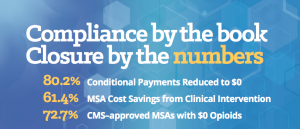
Our numbers speak for themselves. Challenging conventional methodologies, we pursue the best path to settlement with innovative solutions, like MSA Optimization, Simplified Medicare Conditional Payment Resolution, and Legacy Claim Settlement Initiatives.

Do you know your numbers?

What is the percentage of your CMS-approved MSAs which include prescription medication?

How often are opioids included in your MSAs?

What percentage of counter-higher MSAs are submitted for a re-review to CMS and how successful are those re-reviews?

What is the success rate for appealing Medicare conditional payment demands?

Without such benchmark analytics, it is difficult to measure the cost-effectiveness of your MSP compliance program and ways to better optimize your program.  Tower constantly defines, measures and manages the metrics that yield the best balance in care, cost, and compliance.

We have a variety of interventions that will optimize your claims outcomes — many at no additional charge. If the numbers above don’t convince you, then perhaps you need another number that will — 5420.

Visit us at Booth 5420 to learn more about what Tower MSA Partners can do for you. 


Apparent Change in CMS Policy Expands Inclusion of Lyrica in MSAs

October 26, 2018

Vial of pills illustrating MSA Reductions in RX costs

Lyrica is a brand name only medication which costs $8.91 per pill at 150mg. Over a 20-year life expectancy, this is close to $200K in an MSA allocation. Until recently, CMS largely excluded Lyrica from the MSA on the basis that the diagnosis for which it is being prescribed, typically neuropathic pain stemming from a lumbar injury, is considered non-Medicare-covered. Unfortunately, over the past three months, based upon MSA counter-highers received by Tower, CMS has seemingly begun to add Lyrica where a diagnosed condition of lumbar radiculopathy is present.

CMS Policy on Inclusion of “Medicare-covered” Medications in the MSA

Pursuant to the CMS WCMSA Reference Guide (Version 2.8), CMS will include causally related medications in the MSA under the following criteria:

Medically Accepted Indications and Off-Label Use

 For a drug to be covered under the Part D Benefit, and thus included in a WCMSA, it must be used for a medically accepted indication. A medically accepted indication is any use for a covered outpatient drug which is approved by the FDA or a use which is supported by one or more citations included or approved for inclusion in the recognized compendia.

Off-label use is when a drug is prescribed in a manner that is different from the FDA-approved product labeling. According to Medicare IOM 100-02 Chapter 15 Section, 50.4.2 – Unlabeled Use of Drug (Rev. 1, 10-01-03) B3-2049.3, “An unlabeled use of a drug is a use that is not included as an indication on the drug’s label as approved by the FDA. FDA approved drugs used for indications other than what is indicated on the official label may be covered under Medicare if the carrier determines the use to be medically accepted, taking into consideration the major drug compendia, authoritative medical literature and/or accepted standards of medical practice. In the case of drugs used in an anti-cancer chemotherapeutic regimen, unlabeled uses are covered for a medically accepted indication as defined in §50.5.” There are many off-label indications that are listed in recognized compendia and peer-reviewed sources; thus, they would be covered under the Part D Benefit, and should also be included in a WCMSA.

For example, trazodone is approved by the FDA for the treatment of major depressive disorder but is commonly given off-label to treat insomnia. So the WCRC would include trazodone in a WCMSA if used to treat insomnia if it is related to the workers’ compensation injury.

In summary, based upon this criteria, CMS’s practice has been to include medications in the MSA when either their use is for an FDA approved diagnosis or for a medically accepted indication as found in the “recognized compendia,” namely Micromedex’s DrugDex database or the American Hospital Formulary Service Drug. CMS cites the example of Trazadone which is FDA approved for major depressive disorder but is used off-label to treat insomnia. Insomnia is a medically accepted indication found in the DrugDex.

Inclusion of Lyrica in the MSA

In terms of Lyrica, the FDA approves its use for the following diagnoses:

  • Diabetic peripheral neuropathy
  • Fibromyalgia
  • Neuropathic pain from a spinal cord injury
  • Partial Seizure; Adjunct
  • Postherpetic neuralgia

If any of the above diagnoses are present in a claimant’s course of injury-related medical care, Lyrica would be included in the MSA, if prescribed. CMS would also include Lyrica if a medically accepted indication was found in one of the two compendia.

CMS’s recent inclusion of Lyrica where it is prescribed to treat lumbar radiculopathy does not fit into any of the FDA approved uses or the medically accepted indications found in the compendia. While an FDA approved use is neuropathic pain from a spinal injury, a spinal cord injury is typically defined as traumatic damage to the spinal cord resulting in permanent changes in strength and/or sensation and other bodily functions. This is very different than the intervertebral disc degeneration or post-laminectomy syndrome which may typically be causative factors for lumbar radiculopathy. Consequently, it is unclear why CMS has determined Lyrica should be included for a diagnosis of lumbar radiculopathy.

Tower MSA has submitted Re-Review requests to CMS, but the response has thus far been their restating of the policy on inclusion of “Medicare-covered” medications in the MSA. What CMS is not explaining is how the policy applied to the FDA-approved uses or compendia identified uses for Lyrica establish the basis for inclusion of the medication in the MSA. The National Alliance of Medicare Set-Aside Professionals (NAMSAP), for which Tower is a member, has reached out to the senior CMS management for clarification of CMS policy toward Lyrica. As of the date of this article, no response has been received.

Practical Implications

As highlighted at the top of this article, the inclusion of Lyrica in the MSA can add a significant sum to the allocation. While CMS has yet to provide a clear explanation as to their actions or issue an official policy statement, the trend from MSA counter-highers points to Lyrica being included in the MSA when lumbar radiculopathy is diagnosed. As detailed above, Tower does not believe this is an appropriate interpretation of CMS’s own rules for determining whether a medication is Medicare-covered and thus included in the MSA.

Until such time as CMS clarifies its policy, Tower will continue to exclude Lyrica from MSAs where we have not identified a medically accepted indication, either as an FDA-approved use or as found in the recognized compendia. As our client, we will advise you of the potential of a counter-higher from CMS, but will continue to challenge any counter-higher we believe inappropriately adds Lyrica.

In terms of options where an MSA includes a diagnosis of lumbar radiculopathy for which Lyrica is being prescribed, they are as follows:

  • Submit the MSA and risk a counter-higher;
  • Settle without CMS-approval of the MSA;
  • Await further challenges to CMS’s Lyrica policy to see if there is a rollback;
  • Consider alternatives to Lyrica use; or
  • Await Lyrica patent expiration for a price reduction when generics become available*

*While Pfizer’s patent on Lyrica was set to expire in December 2018, the FDA has extended it through June 2019 based on a program encouraging drug companies to demonstrate whether drugs have a pediatric use.

We will provide any updates which provide clarification as to CMS’s inclusion of Lyrica in MSAs. If you have any questions, please contact Dan Anders at (888) 331-4941 or Daniel.anders@towermsa.com.


 

Updated CMS Reference and User Guides Reveal Minor Changes

October 18, 2018

Tower MSA Partners explains CMS updates to ORM and NOINJ rules in the Section 111 reporting user guide.

On 10/1/2018, the Centers for Medicare and Medicaid Services (CMS) released updates to the Workers’ Compensation Medicare Set-Aside (WCMSA) Reference Guide, the Medicare Secondary Payer Recovery Portal (MSPRP) User Guide and the MMSEA Section 111 Medicare Secondary Payer Mandatory Reporting NGHP User Guide. These updates to the reference guide and user guides are all fairly minor, having minimal to moderate impact on the associated CMS MSP processes. A summary of the updates is provided below.

WCMSA Reference Guide

The WCMSA Reference Guide provides for most CMS policies pertaining to the review and approval of MSAs. Version 2.8 of the guide provides as follows:

HICN Replaced with MBI: As CMS explains:

As required by Section 501 of the Medicare Access and CHIP (Children’s Health Insurance Program) Reauthorization Act (MACRA) of 2015, CMS must discontinue all Social Security Number (SSN)-based Medicare identifiers and distribute a new 11-byte Medicare Beneficiary Identifier (MBI)-based card to each Medicare beneficiary by April 2019. All fields formerly labeled as “HICN” have been relabeled as “Medicare ID” and can accept either a HICN or the new MBI.

Updated CDC Life Expectancy Table Link: While with this Reference Guide update CMS is not presently changing the CDC Life Expectancy Table used for calculating life expectancy in the MSA, CMS is updating the link which was outdated.

Revised Tables Pertaining to Verifying Jurisdiction and Calculation Method: In states where the fee schedule provides for regional adjustments, for example, New York, the Reference Guide lists criteria for determining the correct fee schedule rates to use in the MSA. CMS added an additional level of criteria and revised the table (9-1) that provides what is called an “Order of Precedence” in determining the zip code to utilize for pricing. CMS also added a table (9-2) clarifying pricing rules when claims are filed with U.S. Department of Labor Office of Workers’ Compensation Programs and states where no fee schedule is applicable.

MSPRP User Guide

The MSPRP is a web-based portal providing online access for attorneys, Medicare beneficiaries, insurers and authorized representatives to Medicare conditional payment information, the ability to dispute and/or appeal conditional payments and initiate the Demand Letter process among other tasks. Version 4.3 of the User Guide includes the addition of two new columns to the Case Results page providing for Case Status and Contractor, news fields which provide more relevant and updated information for claims awaiting response from the BCRC and three new warning pages to ensure information related to submitting redetermination, compromise or waiver requests is complete.

A notable improvement comes with the submission of Letters of Authority or Proofs of Representation allowing for third-party representatives, such as Tower MSA Partners, to act on behalf of insurers and Medicare beneficiaries. The process has been once a Proof of Representation or Letter of Authority is submitted through the portal the submitter would be required to wait a few days for the authorization to be authenticated. Updates to the MSPRP now allow authorizations to be uploaded to the portal with immediate authentication. As a result, the cuts down on the time to obtain Medicare conditional payment information.

Section 111 NGHP User Guide

CMS released Version 5.4 of the NGHP User Guide, which provides both policy and technical updates for the Section 111 Mandatory Insurer Reporting process. Notable updates are as follows:

  • As a result of Angel Pagan replacing Jeremy Farquhar as the EDI Department Director, new contact information is provided.
  • To ensure updates are applied to recovery cases appropriately, RREs are asked to submit the policy number uniformly with a consistent format. When sending updates, enter the policy number exactly as it was entered on the original submission, whether zeros or a full policy number (Section 6.6.5). 
  • The excluded and no-fault excluded ICD-10 diagnosis codes have been updated for 2019 (Appendix I and Appendix J)

Practical Implications

We do not anticipate the changes to the WCMSA Reference Guide to have any impact on either increasing or decreasing allocations on CMS-approved MSAs. As noted above, the updates to the MSPRP authorization authentication process will improve the turnaround time for obtaining conditional payment information. Finally, the Section 111 User Guide updates are all minor in nature and have minimal impact on the reporting processes.

If you have any questions regarding these updates, please contact Dan Anders at (888) 331-4942 or Daniel.anders@towermsa.com.

Tower Publishes White Paper on Medicare and Future Medical Considerations in Liability Settlements

September 12, 2018

light blue car rear-ending a dark blue car

CMS has signaled its intent to expand its voluntary WCMSA review program to liability. While a liability review policy has yet to be announced, CMS has made clear it expects the burden of post-settlement medicals should not be shifted to the Medicare program. However, the measures settling parties must take to consider Medicare’s interests in these future medicals is anything but clear. Given the lack of guidance, how should liability parties address this issue so as to not run afoul of Medicare?

White Paper: Navigating Through the Fog: Medicare, Future Medicals & Liability Settlements

To provide background and guidance on Medicare Secondary Payer considerations in liability settlements–particularly future medicals–Tower has published a White Paper entitled, Navigating Through the Fog: Medicare, Future Medicals & Liability Settlements. In this paper, Tower Chief Compliance Officer, Dan Anders, Esq., provides:

  • Background on the incremental process CMS has taken in regard to a LMSA review policy,
  • Explanation of CMS authority to implement a LMSA review program, and
  • Guidance to settling parties on considering Medicare’s interests in future medicals at time of settlement and whether an LMSA is appropriate.

Liability Settlement Solutions

In addition to the White Paper, Tower provides a full suite of Liability Settlement Solutions for insurers, claimants and attorneys, both plaintiff and defendant:

  • Medicare Conditional Payment Investigation, Dispute and Resolution
  • Medicare Advantage Plan Investigation, Dispute and Resolution
  • Social Security Disability Verification/Medicare Entitlement Search
  • MSP Compliance Opinion Letter
  • Liability Medicare Set-Aside (LMSA) Report
  • Medical Cost Projection
  • Life Care Plan

Our compliance consultants are available to help alleviate the uncertainty and risks surrounding future medicals and Medicare. We will analyze your claim, recommend the best approach and implement the most effective settlement solution.

If you have any questions, please contact Dan Anders, Chief Compliance Officer, at 888.331.4941 or daniel.anders@towermsa.com.