PREMIER WEBINAR: Avoiding the Medicare Mandatory Reporting Penalty

June 29, 2020

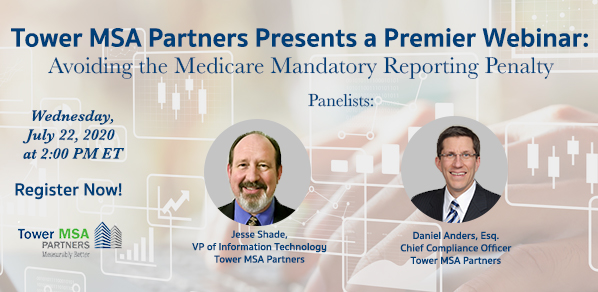
Avoiding the Medicare Mandatory Penalty webinar banner

Regulations for Medicare Mandatory Reporting Penalty are in the process of being formalized!

Under the threat of up to a $1,000 per-day, per-claim penalty, most insurers and self-insurers have implemented processes to ensure Medicare beneficiary claimants are reported to Medicare per Section 111 of the Medicare, Medicaid, and SCHIP Extension Act of 2007 (MMSEA).

Penalties have never been imposed as the SMART Act specified that the Centers for Medicare and Medicaid Services (CMS) must formalize regulations prior to issuing them.  This past February, CMS released proposed regulations, which we detailed in this article: CMS Issues Proposed Rule for Mandatory Insurer Reporting Penalties.  Comments on the proposal were due in April and now we await a final regulation.

In a timely webinar, a full analysis of CMS’s penalties proposal will be provided by Tower’s Chief Compliance Officer, Daniel Anders, Esq.  Joining Dan will be Jesse Shade, Tower’s VP of Information Technology, who will break down new user-friendly enhancements to Tower’s Mandatory Insurer Reporting platform that are designed specifically to avoid the penalties CMS seeks to impose.     

A Q&A session will follow the presentation.  Plan to attend the webinar on Wednesday, July 22,  at 2 pm ET.

Thank you,

Dan Anders
Chief Compliance Officer

WorkersCompensation.com’s Coverage of the Pharmacy/Legacy Claims Webinar

June 1, 2020

stethoscope and insurance claim form

“The older the claim, the higher the costs—especially for prescription drugs,” wrote WorkersCompensation.com’s Nancy Grover, in this excellent recap of A Prescription for Settling Legacy Claims webinar. 

The May 19 webinar was presented by Dan Anders, Tower MSA Partners’ Chief Compliance Officer, and Phil Walls, Chief Clinical and Compliance Officer of myMatrixx. 

They said that aging claims increase the likelihood that the injured worker may become a Medicare beneficiary.  “That means those higher drug costs must be included in a Medicare Set-Aside,” she wrote.

The fast-paced webinar explains how and why prescription drug costs increase during the life of a claim. Brand name drugs, compounds (yes, still), and “prescription cascade” (prescribing new meds to address the side effects of other meds) top the list of cost-drivers.

To gain CMS approval of an MSA, medications that may not be needed or even being used must be allocated in the MSA. What’s more, they are priced at Redbook’s lowest average wholesale price (AWP), eliminating discounts the pharmacy benefit manager (PBM) once provided. Side note: Phil describes issues with AWP in detail during the Q&A at the end of the webinar. 

Dan and Phil discussed ways an MSA provider and PBM can partner to identify and address unnecessary costs—without negatively impacting the injured worker’s treatment.  “We reach out to the treating physician for last dates of service to see what’s going on,” Dan said. “We also do drug reviews to see if there are alternatives that can be implemented.”

Presenters cited a case where an intervention reduced the total morphine equivalent dosage from a dangerous 480 mg per day to 120 mg per day.  The changes produced a savings of about $1 million. 

“Our goal is never to keep the injured worker from obtaining the therapy they need, but not to expose them to unnecessary prescribing,” Phil said.

To download the recording of this valuable webinar, please go to: https://register.gotowebinar.com/recording/7163259288372148492

Tower Premier Webinar: A Prescription for Settling Legacy Claims

April 20, 2020

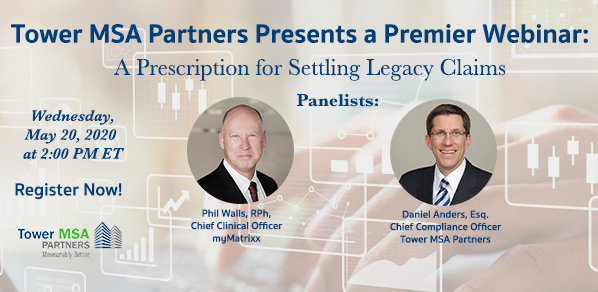
Banner for webinar on A Prescription for Settling Legacy Claims

As claims age, the percentage of spend for prescription drugs increases.  Further, as claims age, the likelihood that the injured worker becomes a Medicare beneficiary as a result of age or disability increases. The result, high prescription drug costs allocated in the Medicare Set-Aside (MSA) become a barrier to settlement of these legacy claims.

Tower has addressed this barrier through clinical interventions which have resulted in the majority of Tower’s CMS-approved MSAs containing no prescription drugs.  However, there remain legacy claims with high prescription drug spend which continue to stymie settlement.

Accordingly, Tower has partnered with the leading workers’ compensation pharmacy benefit manager, myMatrixx, to add its renowned clinical pharmacy team to the effort at breaking down the remaining barriers to settlement of these legacy claims.

What then can a PBM do to help with settling legacy claims?  How does a PBM work with an MSA company to settle these claims?

Tower is pleased to host a premier webinar panel with Phil Walls, RPh, Chief Clinical Officer for myMatrixx, and Dan Anders, Esq., Chief Compliance Officer for Tower on the following topics:

  • Define and quantify legacy claims with analytics
  • Identify factors driving up Rx costs in these claims
  • Explain how data can identify opportunities for clinical intervention
  • How to work effectively with PBM and MSA provider to reduce Rx and close claims
  • Provide examples/case scenarios demonstrating successful Rx intervention and settlement in legacy claims
  • Best practices for Rx management to prevent claims from becoming legacy claims

Please plan to attend the webinar on May 20 at 2 pm ET.

Thank you,

Dan Anders

Chief Compliance Officer

Everything You Wanted To Know About MSAs, But Were Afraid To Ask — Tower Premier Webinar – July 24, 2019 2PM ET

July 2, 2019

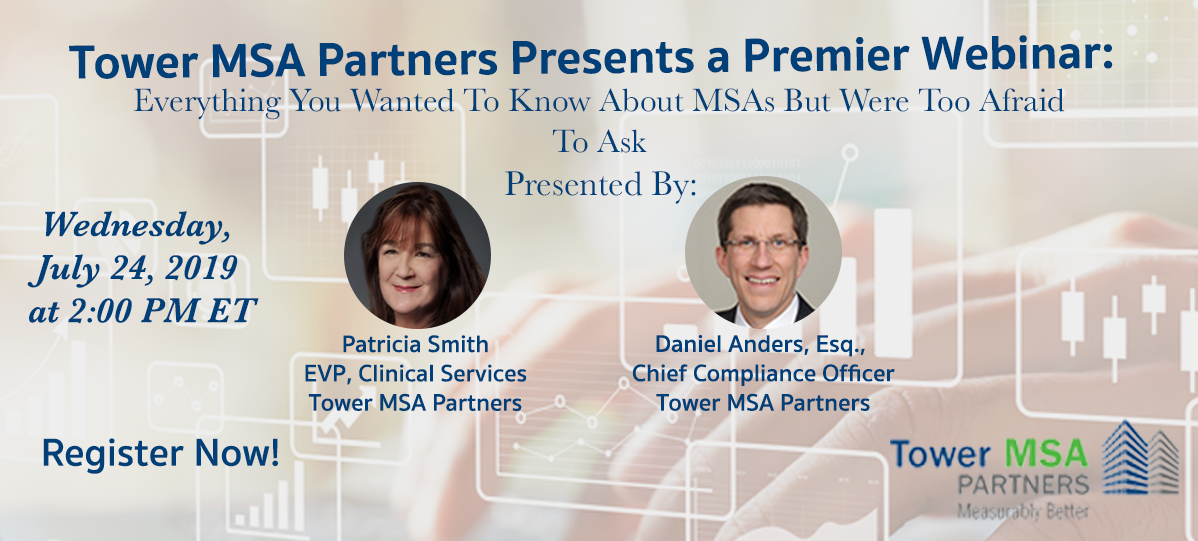
banner for 2019 tower msa partners webinar details

Why does CMS do what they do when it comes to MSAs? Many a claims professional and injured worker have probably pondered this question. Well, the wait for answers is over. On July 24, 2019 at 2 pm ET, Tower MSA Partners EVP of Clinical Services Patricia Smith and Chief Compliance Officer Dan Anders host an engaging hour-long webinar discussing all matters MSA.


With over 30 years of MSA experience between them, Pat and Dan will tackle some of the routine and unusual questions that arise when drafting an MSA and submitting it to CMS for approval, like:


  • Do I need an MSA?
  • What documentation is necessary to draft the MSA?
  • What does Medicare-covered or not Medicare-covered mean to the MSA?
  • Is the allocation different if the MSA isn’t submitted to CMS?
  • How are costs of treatment and prescription medication calculated?
  • How is life expectancy calculated and how does a rated age impact this calculation?
  • IMEs, AMEs, PQMEs, UR, and IMRs, oh my. What role do these play in the MSA calculation?
  • Rechargeable vs. non-rechargeable spinal cord stimulator, why does it matter?
  • When can I use an Amended Review?
  • Under what circumstances is a $0 MSA appropriate?


If you want to know more about the how and why of MSAs, this free webinar is for you. And, if there is something about MSAs you’ve always wondered about, ask us! When you click on the registration link below you will not only be able to register, but you can also submit a question to be answered during the webinar.


Hope you can join us on July 24 at 2 pm ET!


Dan Anders


Chief Compliance Officer


Register Here


Tower MSA Partners Presents a Premier Webinar: Leveraging Metrics and MSA Partner Relationship to Settle Claims

April 2, 2019

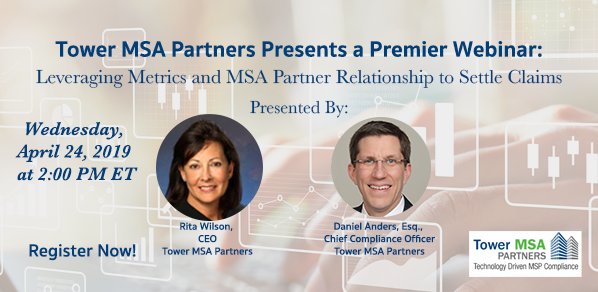
banner for 2019 tower msa partners webinar details

On April 24, Tower MSA Partners CEO Rita Wilson and Chief Compliance Officer Dan Anders will host a lively hour-long webinar that explains how to measure the performance of an MSA program and identifies the metrics needed. They also discuss ways to strengthen the payer/provider relationship in order to produce lower allocations on CMS-approved MSAs and quicker claims closures. Discussion points include:


  • How to measure your MSA program performance – what metrics should you use?
  • MSA drafting and review factors that impact MSA performance
  • Implement simple strategies to effectively work with your MSA partner and settle claims
  • Make your MSA provider part of your settlement team

The webinar also highlights how Tower’s key performance metrics compare to some national standards, giving examples of metrics that determine whether a program is successful. The free webinar will be held April 24 at 2 p.m. Eastern.


Hope you will join!


Dan Anders

Chief Compliance Officer


Register Here

CMS to Hold Webinar on Electronic Payment Enhancement to MSPRP

March 7, 2019

hands on a laptop sending an email with dollar sign icons spilling out

CMS recently announced it will hold a webinar on March 13, 2019 at 1:00 PM ET for the purpose of introducing an electronic payment functionality to the Medicare Secondary Payer Recovery Portal (MSPRP). This functionally will become available on April 1st.

For some time, payors have been asking CMS for an option which allows electronic payment of conditional payment demands and it looks like that day is finally here. Webinar information is as follows:

Webinar URL: https://engage.vevent.com/index.jsp?eid=5779&seid=1505


Conference Dial In: 877-251-0301

Passcode: 7556747


Note, there is no need to pre-register for the webinar.

The full CMS webinar invitation may be found here.

We encourage anyone that utilizes the MSPRP to attend CMS’s webinar. Tower will of course provide a summary of this new electronic payment functionality post-webinar.

Tower MSA Partners Launches Quarterly Webinar Series

January 18, 2019

Tower MSA Partners logo

Tower MSA Partners is launching a free, quarterly webinar series to help payers become more proficient in settling workers’ compensation claims, Medicare Secondary Payer compliance and Medicare Set-Asides.

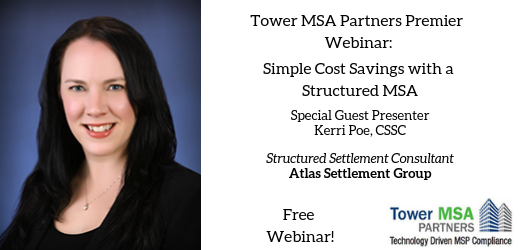
The first webinar on January 23 at 2 p.m. Eastern features a special guest instructor, Kerri Poe, CSCC, on the topic “Simple Cost Savings with a Structured MSA.”

Please see the News Release for full information:  https://www.businesswire.com/news/home/20190115005194/en/Tower-MSA-Partners-Launches-Quarterly-Webinar-Series

Simple Cost Savings with a Structured MSA Premier Webinar

December 27, 2018

Kerri Poe - webinar speaker portrait and event details

Wednesday, January 23, 2018 at 2:00 PM ET

One of the simplest ways to lower the cost of settlement is through a structured Medicare Set-Aside. Not only does this reduce the employer or insurer’s cost of funding the MSA, it also provides the injured worker a consistent stream of funds for injury-related medical care over his or her life expectancy. This hour-long webinar will show how structured MSAs help all the stakeholders involved in a settlement – the injured party, Medicare and the insurance carrier or employer.

On January 23rd Tower is pleased to host Kerri Poe of Atlas Settlement Group for an informative presentation on structured MSAs as part of settlement. This webinar is intended for anyone involved in the management or handling of workers’ compensation or liability claims and for plaintiff and defense attorneys. By attending this free webinar, you can expect to come away with the ability to:


  • Understand how structured MSAs work and recognize the benefits they provide to the injured worker/claimant, employer/insurer and Medicare
  • Explain the methodology by which CMS calculates a structured MSA
  • Convert a CMS-approved lump sum MSA to a structured MSA
  • Define the role of a structured settlement broker pre-settlement, during settlement negotiations and post-settlement.

Case Studies will be included, and attendees will have an opportunity to ask questions.

Hope to see you on January 23rd!

Dan Anders

Chief Compliance Officer



Background on Guest Presenter, Kerri Poe, CSSC:

Kerri Poe is head of Atlas Settlement Group’s Los Angeles office. Her experience spans Workers’ Compensation, Longshore and Harbor Workers’ Compensation Act, liability, and employment litigation nationwide. Kerri brings value to both sides of the negotiation by facilitating settlement and working as an advocate to the settlement process.

As part of the settlement team, Kerri assists with case evaluation, prepares settlement proposals, attends conferences and mediations and reviews legal documents to ensure the tax benefits of the structured settlement are preserved. Her extensive experience with Medicare Set-Asides and the integration of public benefits allow her to provide needs-based financial options for the injured party.

Her specialties include assisting with case evaluation, preparing settlement proposals, and attending settlement conferences and mediations. Kerri also performs file reviews and client trainings and has been a guest speaker at several claims associations, risk management groups, and settlement annuity seminars. In addition to being a member of the National Structured Settlement Trade Association, she is the Chairwoman of its Legislative Committee.

Kerri began her structured settlement career in 1997 as a Case Manager for a national structured settlement firm in Tampa, Florida and Houston, Texas. She also has experience as a Business Analyst and Project Manager for a prominent benefits administration firm and as the Regional Operations Manager for a large fund-raising company.

CMS to Keep $750 Recovery Threshold & Announces Upcoming Webinar on MSPRP Enhancement

November 29, 2018

$750 Threshold on Reporting and Conditional Payment Recovery Maintained

In a 11/15/2018 Alert, CMS announced that the 2019 recovery threshold for liability, no-fault and workers’ compensation settlements will remain at $750. Accordingly, Total Payment Obligations to the Claimant, TPOCs, in the amount of $750 or less are not required to be reported to CMS through the Section 111 Mandatory Reporting process, nor will CMS attempt to recover conditional payments for TPOCs of this amount.

By way of background, pursuant to the SMART Act of 2012, CMS is required to annually determine a threshold amount such that the cost of collection does not outstrip the amount recovered through such collection efforts. CMS’s calculations, which can be found here, resulted in the $750 threshold being maintained.

Upcoming Webinar on MSPRP Self-Reporting Enhancement

CMS also recently announced it will hold a webinar on 12/18/2018 at 1 p.m. ET to provide an overview of the self-reporting functionality that will be added to the Medicare Secondary Payer Recovery Portal (MSPRP) as of 1/7/2019. The webinar invite can be found here.

Self-reporting refers to reporting a no-fault, workers’ compensation or liability claim to CMS’s Benefits Coordination and Recovery Center (BCRC) which is typically the first step in identifying whether conditional payments have been made by Medicare in the claim. Presently, reporting can be done via phone, fax, mail or through the Section 111 mandatory insurer reporting process.

The so-called “lead” which results from this reporting is utilized by CMS’s recovery contractors, the BCRC or the Commercial Repayment Center (CRC) to investigate payments made by Medicare for the reported diagnosis and seek recovery for conditional payments made for the diagnosis. It is anticipated the expansion of self-reporting to the MSPRP will assist in expediting the Medicare conditional payment investigation process and perhaps improve the accuracy of charges identified as conditional payments.

Practical Implications

As CMS is keeping the $750 threshold for mandatory reporting and conditional payment recovery there are no changes to the reporting processes or determinations as to when conditional payment should be investigated or resolved.

In regard to the self-reporting enhancement to the MSPRP, as noted above, we believe this may improve the speed and accuracy of the Medicare conditional payment process. We will provide further information following the December 18 webinar.