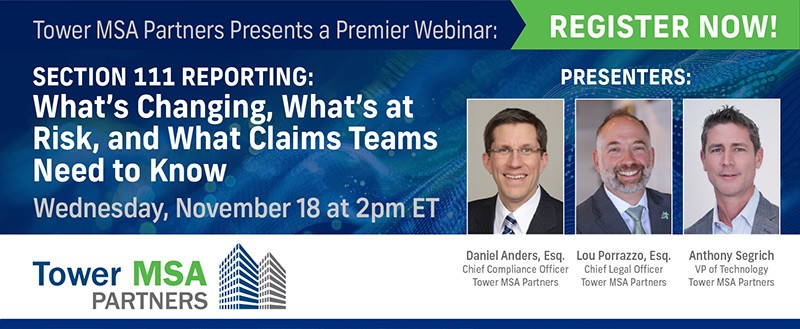
Tower MSA Partners Webinar: Section 111 Reporting: What’s Changing, What’s at Risk, and What Claims Teams Need to Know

November 4, 2026

Wednesday, November 18, 2026 | 2:00 p.m. ET

Section 111 reporting continues to evolve, and the stakes for claims organizations are increasing. With CMS moving forward on civil money penalty enforcement, WCMSA reporting requirements, and updates to its reporting guidance, now is the time for claims professionals to evaluate their reporting practices and understand where compliance risks may exist.

Section 111 Reporting Webinar Details

Join Tower MSA Partners on Wednesday, November 18, 2026, at 2:00 p.m. ET, for an informative webinar featuring Dan Anders, Chief Compliance Officer, Lou Porrazzo, Chief Legal Officer and Anthony Segrich, VP of Technology, as they discuss the latest Section 111 developments and what they mean for claims adjusters, supervisors, and managers.

Section 111 Reporting: Topics We’ll Cover

Topics will include:

  • The Section 111 Landscape: Key CMS developments, reporting expectations, and why they matter to claims teams.
  • Civil Money Penalties, From Rule to Reality: Enforcement status, reporting deadlines, the audit process, and what Responsible Reporting Entities (RREs) should be doing now.
  • WCMSA Reporting, What Adjusters Need to Get Right: New reporting fields, common errors, settlement data, and the connection between MSA preparation and Section 111.
  • CMS Reporting Updates and Common Problem Areas: Version 8.6, data accuracy, ORM termination, and reporting errors that can create downstream issues.
  • A Practical Compliance Checkup: Actionable steps for adjusters, supervisors, and managers to identify and address reporting risks.
  • How Tower Can Help: An overview of Tower’s Section 111 reporting, audit, and other services designed to support timely and accurate reporting.

The webinar will conclude with an audience Q&A, providing an opportunity to ask questions and discuss real-world Section 111 reporting challenges.

Register for the Section 111 Reporting Webinar

Four Years of WCMSA Data: 6 Numbers That Could Change Your MSA Strategy 

October 29, 2026

Four-year comparison of Tower MSA Partners’ CMS-approved WCMSA outcomes and CMS national averages from 2022 through 2025

One number can get your attention. Six numbers can change how you look at MSA strategy. 

For years, Tower MSA Partners has been tracking outcomes across Medicare Set-Aside preparation, clinical intervention, CMS review, pharmacy exposure, conditional payment resolution, and claim closure. 

The results raise some important questions. 

  • What if the first MSA isn’t necessarily the final MSA? 
  • What does it take to reduce an allocation while maintaining a defensible approach to CMS? 
  • How much can accurate pharmacy and clinical information change projected Medicare exposure? 
  • And what happens to settlement costs when Medicare’s interests are addressed early rather than at the end of the claim? 

Those are the questions behind Tower’s new Workers’ Compensation MSP Outcomes & Regulatory Insights Report and the blog series that follows. 

Tower MSA Partners’ four-year WCMSA data shows that early clinical intervention and strong Medicare Secondary Payer compliance can lower settlement costs without sacrificing CMS defensibility. From 2022 through 2025, Tower’s average CMS-approved WCMSA remained below the national average every year. 

In 2025, Tower’s average CMS-approved Workers’ Compensation Medicare Set-Aside was $18,477 lower than the CMS national average. Across 100 annual MSA submissions, that difference represents approximately $1.85 million in projected settlement exposure. 

 But the purpose of the Outcomes Report isn’t simply to highlight a difference between Tower’s results and a national benchmark. 

The more important question is why the results look the way they do. 

This blog series will move beyond the topline results to examine the decisions behind them and what claims leaders can apply to their own programs. 

What Four Years of WCMSA Data Show 

Tower’s average CMS-approved WCMSA remained below the CMS national average in each year reviewed: 

Year CMS Average WCMSA Tower Average Approved WCMSA
2022 $81,572 $59,051
2023 $86,453 $78,423
2024 $85,927 $69,867
2025 $86,169 $67,692

Source: Tower MSA Partners, Workers’ Compensation MSP Outcomes & Regulatory Insights Report, Section 2.3. Differences were calculated from the reported annual averages. 

The Six Numbers at a Glance 

  1. $18,477 lower: In 2025, Tower’s average CMS-approved WCMSA was $18,477 below the CMS national average. What does that difference tell us about MSA strategy—and what should claims professionals be asking before accepting an initial allocation? 
  1. 33% to 64% in clinical reductions: Tower’s average annual clinical reductions fell within this range. What can current clinical information reveal that may not be apparent from the records used to prepare an initial MSA? 
  1. 76% to 88% CMS alignment: Tower’s data showed substantial alignment between its reduced allocations and CMS outcomes. What does that tell us about the relationship between MSA savings and CMS defensibility? 
  1. 86% with $0 opioid allocation: In 2025, 86% of Tower’s CMS-approved WCMSAs contained no projected opioid cost., How do medication histories, physician engagement, and pharmacy oversight affect future Medicare exposure? 
  1. 82% of conditional payment demands reduced to $0: A Medicare conditional payment demand isn’t necessarily the final number that must be paid. What does Tower’s data tell us about the importance of investigating and resolving Medicare’s interests before settlement? 
  1. $9 million to $12 million in annual savings: Tower’s data shows the scale of savings associated with Physician follow-up and pharmacy optimization. What happens when these opportunities are considered across an entire claims portfolio rather than one claim at a time? 

The results are directional benchmarks, not promises for an individual claim or portfolio. Their value is showing where process and evidence can change an outcome. 

Why These WCMSA Findings Belong Together 

The first MSA can change settlement authority. Clinical intervention can change the allocation. CMS alignment indicates whether the approach remains defensible. Pharmacy decisions affect the long-term cost of a claim. Conditional payments and $0 MSA documentation influence risk at and after settlement. 

Looking at any one metric alone misses the larger point. The final financial outcome is shaped by how well these steps work together. 

That is the purpose of this series. Each article will take one decision point from the Outcomes Report and translate it into a practical question for claims, legal, compliance, and risk leaders. 

What the Outcomes Report Blog Series Will Cover 

1. Accepting the First MSA Is Often the Costliest Decision: What Four Years of CMS Data Reveals 

When should an initial MSA be accepted, and when do outdated medications, unsupported treatment, or incomplete records justify a second look? 

2. What the CMS Alignment Index Actually Tells You About Your MSA Strategy 

How can a program challenge preventable over-allocation without sacrificing predictable, defensible CMS outcomes? 

3. Opioid Exposure in MSAs: How 86% of Tower Cases Reached $0 and What It Takes to Get There 

What clinical documentation, physician engagement, and pharmacy oversight are required to ensure an MSA reflects the treatment actually expected? 

4. CMS No Longer Reviews $0 MSAs: What That Means for Your Post-Settlement Exposure 

CMS stopped accepting or reviewing $0 WCMSA proposals effective July 17, 2025. What does that change mean for documentation, governance, and post-settlement exposure? CMS outlines the policy on its official WCMSA What’s New page. 

5. 82% of Conditional Payment Demands Reduced to $0: The Post-Settlement Number Most Programs Ignore 

What should claims teams verify before treating a conditional payment demand as an amount that must be paid? 

6. MSP as Enterprise Risk: What 2022 to 2025 Performance Data Should Change About How You Budget for Settlements 

How should MSA, CMS, pharmacy, conditional payment, and reporting outcomes inform reserves, settlement authority, loss development, and capital planning? 

What Should Claims Leaders Do Now? 

Start by comparing Tower’s findings with your own program: 

  • Compare average and median approved WCMSAs with relevant CMS benchmarks. 
  • Measure how often clinical intervention changes an allocation and how much it saves. 
  • Track prescription drug and opioid exposure in approved WCMSAs. 
  • Review proposed-to-approved variance, development letters, and conditional payment outcomes. 
  • Determine whether Section 111 reporting and conditional payment work begin early enough to support settlement. 

Tower’s Medicare Set-Aside services and Medicare lien resolution connect these decisions through claim closure. 

Review the full Workers’ Compensation MSP Outcomes & Regulatory Insights Report and return to this page as each article is published. 

To compare your program with these benchmarks, submit a referral to Tower MSA Partners. 

About the Outcomes Report Data 

The report uses Tower MSA Partners’ aggregated, anonymized outcomes from WCMSAs and related MSP services between 2022 and 2025. CMS and market comparisons draw on published WCMSA statistics and related public information. The figures are intended to provide directional benchmarks and identify questions worth asking. They do not guarantee a particular reduction, approval, or settlement result for an individual claim or portfolio. 

Frequently Asked Questions About Four Years of WCMSA Data

What Is a WCMSA? 

A WCMSA allocates part of a workers’ compensation settlement for future Medicare-covered medical services related to the workers’ compensation injury, illness, or disease. 

What Is the Tower Outcomes Report Blog Series? 

This article introduces six follow-up posts examining what Tower’s 2022 through 2025 WCMSA and MSP outcomes mean for MSA cost, CMS alignment, pharmacy exposure, conditional payments, settlement strategy, and post-settlement risk. 

Does CMS Still Review $0 WCMSAs? 

No. Effective July 17, 2025, CMS stopped accepting or reviewing WCMSA proposals with a $0 allocation. However, CMS still allows $0 MSAs if they fit certain criteria. Parties should consult with Tower to determine whether their settlement fits into these guidelines. 

What are Medicare conditional payments? 

 A temporary payment made by Medicare for a beneficiary’s medical services when another primary insurance plan (such as liability insurance, no-fault auto insurance, or workers’ compensation) is responsible for paying but has not paid or will not pay promptly. 

Section 111 Reporting: Five Key Updates in CMS NGHP User Guide Version 8.6

October 28, 2026

Claims professional reviewing a Section 111 claim form at a desk with a laptop

The Centers for Medicare & Medicaid Services (CMS) released Version 8.6 of its Section 111 Reporting User Guide on October 5, 2026. The five biggest changes phase out the NOINJ diagnosis code, add an alert after six months without a Claim Input File and clarify how to correct TPOC and WCMSA errors. CMS also clarified when wrongful death settlements must be reported and when a Qualified Settlement Fund (QSF) can report. 

Section 111 of the Medicare, Medicaid, and SCHIP Extension Act of 2007 (MMSEA) requires liability, no-fault and workers’ compensation payers to report claims involving Medicare beneficiaries to CMS. For insurers, third-party administrators (TPAs), and other Responsible Reporting Entities (RREs), understanding these changes can help prevent reporting errors and ensure that claims are handled in accordance with Medicare Secondary Payer (MSP) requirements. 

What Changed in Section 111 User Guide Version 8.6? 

Below are five key updates and what they mean for claims professionals. 

UpdateWhere to Find ItWhat RREs Should Do
NOINJ diagnosis code phased outChapter IV, Section 6.2.5.2Identify valid ICD-10 codes for every claimed injury before the April 2027 hard error
Alert after six months with no Claim Input FileChapters II and IVInvestigate each alert and confirm reporting is current
New TPOC and WCMSA correction stepsChapters IV and VMatch the correction method to the error, effective April 2027
Wrongful death settlementsChapter III, Section 6.5.1.4Report unless documents and state law rule out medical expenses
QSF reporting exceptionChapter III, Section 6.5.1.8Confirm every condition is met before a QSF reports

1. Is CMS Eliminating the NOINJ Diagnosis Code?

Yes. Per Chapter IV, Section 6.2.5.2, CMS is eliminating the use of the NOINJ diagnosis code, which was originally created for situations in which an RRE could not identify a diagnosis when reporting a settlement (Total Payment Obligation to Claimant, or TPOC).

Historically, the code was intended for limited circumstances involving claims without an alleged physical injury, such as certain loss-of-consortium claims, errors and omissions claims, directors and officers liability claims, and employment-related wrongful action claims.

CMS has clarified that settlements in which no injury is alleged that could lead to Medicare-covered items or services generally do not need to be reported on that basis. However, when an injury or illness has been claimed and released, the inability to identify the exact diagnosis code does not excuse the RRE from reporting the settlement.

What does the NOINJ change mean for claims professionals?

RREs should not rely on NOINJ as a substitute for identifying the injuries associated with a claim. Reporting teams should exercise appropriate due diligence to identify the applicable injuries and the valid ICD-10 diagnosis codes.

The guide identifies April 2027 as the effective date for the anticipated hard error that would cause a submission containing NOINJ to be rejected. RREs should review their reporting procedures and work with their reporting agents to prepare for this change.

2. What Happens If an RRE Submits No Claim Input File for Six Months?

Per Chapters II and IV of the guide, CMS will send a notification email to an RRE’s Authorized Representative and Account Manager when no Claim Input File has been submitted within the preceding six months.

A Claim Input File is the file an RRE submits to CMS containing the claim information required for Section 111 reporting.

What should an RRE do after an inactivity alert?

The notification is intended to alert the RRE that reporting activity may have stopped or been missed. However, an extended period without submission does not automatically mean the RRE has failed to meet its reporting obligations.

Upon receiving an alert, the RRE should investigate the reason for the inactivity. This may include confirming whether there were reportable claims, whether reporting activity was expected during that period, and whether the reporting process is operating as intended.

If the RRE uses an outside reporting agent, it should coordinate with that partner to determine whether any action is necessary.

Practical takeaway: RREs should establish a process for reviewing CMS notifications and confirming that their Section 111 reporting remains current, even during periods of low claims activity.

3. How Do RREs Correct TPOC and WCMSA Reporting Errors?

It depends on the error: erroneous TPOC information on a claim with accepted ORM requires a delete followed by an add, while a WCMSA reported in error requires an update, effective April 2027.

CMS has updated its instructions in Chapters IV and V of the User Guide for correcting previously accepted Total Payment Obligation to Claimant (TPOC) and Workers’ Compensation Medicare Set-Aside Arrangement (WCMSA) information in certain workers’ compensation and no-fault claims involving Ongoing Responsibility for Medicals (ORM).

TPOC generally refers to a settlement, judgment, award, or other payment that must be reported to CMS. ORM refers to an RRE’s ongoing responsibility to pay for medical care related to an injury. For background, see our recap of key changes to ORM termination and TPOC reporting.

The revised instructions address two situations, with the specified changes effective April 2027.

Situation 1: TPOC information was reported incorrectly.

If TPOC information was erroneously reported on a claim with previously reported and accepted ORM, and at least one TPOC date is on or after the ORM termination date, the RRE must send a delete record followed by an add record.

The delete removes the previously submitted record. The add then reports the required claim information without the erroneous TPOC values.

Situation 2: A WCMSA was reported in error.

If a TPOC 1 record and associated MSA information were previously reported and accepted, but the MSA was reported in error, the RRE must submit an update. The WCMSA fields must be populated with zeroes or spaces, as applicable. An auxiliary record should also be included if one was previously submitted and its information remains applicable. Our summary of the CMS webinar clarifying WCMSA reporting rules covers related requirements.

What does this mean for TPOC and WCMSA corrections?

The appropriate correction method depends on what was reported and what needs to be corrected. Simply changing a field to zero may not be sufficient in every situation.

For example, an indemnity settlement may have been reported while medical benefits remained open and an MSA was still under review. If the original reporting was premature or incorrect, the RRE must follow the applicable CMS correction procedure.

RREs should work with their Section 111 reporting teams or reporting agents to identify the appropriate action type and ensure that corrections follow CMS requirements.

Practical takeaway: Review the original submission and the nature of the error before correcting a record. The delete-and-add process and the update process are not interchangeable.

4. Do Wrongful Death Settlements Require Section 111 Reporting?

In most cases, yes. CMS has clarified its policy on reporting wrongful death settlements, judgments, and awards in Chapter III, Section 6.5.1.4 of the user guide.

In some states, medical expenses may be recoverable from wrongful death settlement proceeds. In addition, the language in a complaint or settlement agreement may release medical expenses, even when the parties did not specifically intend to do so.

As a result, CMS generally requires RREs to report wrongful death settlements unless they can definitively determine that the relevant documents and applicable state law and common law do not permit recovery of medical expenses from the payment and that medical expenses were not released, either expressly or in effect.

What does this mean for wrongful death claims?

A wrongful death settlement should not automatically be treated as exempt from Section 111 reporting simply because the claim involves a death rather than an injured claimant receiving ongoing medical treatment.

The RRE should evaluate the settlement language and applicable law to determine whether medical expenses may be recovered or have been released as part of the settlement.

When the answer is unclear, the parties may need legal guidance before deciding whether reporting is required.

Practical takeaway: Review the settlement documents and applicable law before concluding that a wrongful death settlement falls outside Section 111 reporting requirements.

5. When Can a Qualified Settlement Fund Report as the RRE?

Only under a narrow exception: the QSF must elect to report, be funded by two or more entities, have no active ORM, operate under Section 468B in connection with a bankruptcy proceeding, and have sole authority over paying claims.

CMS has revised its guidance in Chapter III, Section 6.5.1.8, concerning when a Qualified Settlement Fund (QSF) may serve as the RRE for Section 111 reporting purposes.

A QSF is a settlement fund established under Section 468B of the Internal Revenue Code. In certain complex settlements, multiple entities may contribute money to a fund that distributes settlement proceeds to multiple claimants.

Under the revised guidance, a QSF may be permitted to assume the RRE’s reporting role for qualifying TPOCs paid into the fund after October 1, 2011, when it would otherwise be impossible to determine precisely how much each contributing entity’s funds were allocated to each claimant.

This is a limited exception. The conditions include:

  • The QSF elects to assume the RRE’s mandatory insurer reporting obligations.
  • There is no active ORM.
  • Two or more entities fund the QSF.
  • The QSF operates under Section 468B of the Internal Revenue Code in connection with a state or federal bankruptcy proceeding.
  • The QSF has sole responsibility for resolving and paying claims using the funds received and makes those decisions without review or approval by the entities that contributed the TPOCs.

An entity that contributes a TPOC but retains the right to adjudicate, review, or pay claims must report as an RRE and cannot rely on this exception.

CMS also retains a separate exception for qualifying TPOCs paid into a QSF before October 1, 2011, subject to the applicable conditions, including the absence of active ORM and the requirement that the funds were paid into the trust before that date.

What does the QSF exception mean for claims professionals?

The use of a QSF does not automatically transfer Section 111 reporting responsibility away from the entities that contributed settlement funds.

Before assuming that a QSF can report on behalf of the contributing entities, those entities should confirm that all applicable conditions are satisfied, including the QSF’s legal structure, its authority over claim resolution and payment, and the absence of retained decision-making rights.

Practical takeaway: Do not assume that a QSF eliminates an insurer’s or other RRE’s reporting obligations. Confirm that the specific arrangement qualifies for the CMS exception.

What Should RREs Do to Prepare for Version 8.6?

CMS’s Version 8.6 updates address both day-to-day reporting practices and more specialized settlement scenarios. RREs should consider taking the following steps:

  • Review diagnosis coding procedures. Prepare for the elimination of NOINJ and confirm that appropriate diagnosis codes are identified when reporting is required.
  • Monitor reporting activity. Establish a process for reviewing CMS notifications about periods without Claim Input File submissions.
  • Review correction procedures. Ensure that reporting staff and reporting agents understand when to submit a delete followed by an add versus an update.
  • Evaluate complex settlements carefully. Review wrongful death settlements and QSF arrangements before determining whether Section 111 reporting is required or an exception applies.
  • Coordinate with your reporting partner. Confirm that applicable CMS changes are reflected in reporting procedures and that your team understands which changes require action and when.

Section 111 reporting requirements can be complex, particularly when a settlement involves unusual circumstances or previously submitted information needs to be corrected. Staying informed about CMS guidance and maintaining a reliable reporting process can help RREs manage their Medicare Secondary Payer compliance responsibilities.

Frequently Asked Questions About Section 111 User Guide Version 8.6

What is the CMS NGHP Section 111 User Guide?

It is the CMS manual that explains how Responsible Reporting Entities report liability, no-fault and workers’ compensation claims involving Medicare beneficiaries. CMS updates it several times a year. Version 8.6 was released on October 5, 2026. Tower’s Section 111 services help RREs keep up with each update.

When does Section 111 User Guide Version 8.6 take effect?

CMS released Version 8.6 on October 5, 2026. The NOINJ hard error and the new TPOC and WCMSA correction steps take effect in April 2027. The wrongful death and QSF clarifications are part of the current guide.

Who has to report under Section 111?

Responsible Reporting Entities (RREs) must report. These include liability insurers, self-insured entities, no-fault insurers and workers’ compensation carriers. Many RREs use a Section 111 reporting agent or TPA to submit files, but the RRE stays responsible for compliance.

When will CMS reject Section 111 files that use NOINJ?

The technical chapter of the guide identifies April 2027 as the effective date for a hard error on NOINJ. After that, a submission containing NOINJ would be rejected. RREs should review their coding procedures before then, and a Section 111 audit can flag claims that still rely on NOINJ.

Does a six-month gap in Claim Input Files mean an RRE is out of compliance?

Not on its own. CMS will send an alert after six months without a Claim Input File, but a gap can happen when there are no reportable claims. The RRE should investigate the alert and confirm its reporting is current.

Are wrongful death settlements exempt from Section 111 reporting?

Generally, no. CMS policy guidance expects RREs to report wrongful death settlements unless they can confirm medical expenses cannot be recovered and were not released. Review the settlement documents and state law first. Our liability settlement solutions can help with complex cases.

What happens if an RRE misses Section 111 reporting requirements?

CMS can impose civil money penalties for Section 111 reporting failures. Learn more in our key takeaways from the CMS webinar on civil money penalties.

Need Help With Section 111 Reporting?

Tower MSA Partners’ Section 111 reporting and Section 111 audit services help RREs catch errors and stay compliant as CMS rules change. If you have questions about these updates or your Section 111 reporting obligations, contact Tower MSA Partners’ Chief Compliance Officer, Dan Anders, at daniel.anders@towermsa.com, or reach our team through the contact page.
Tower MSA Partners Premier Webinar: Medicare Conditional Payments: What Adjusters and Attorneys Need to Get Right 

October 7, 2026

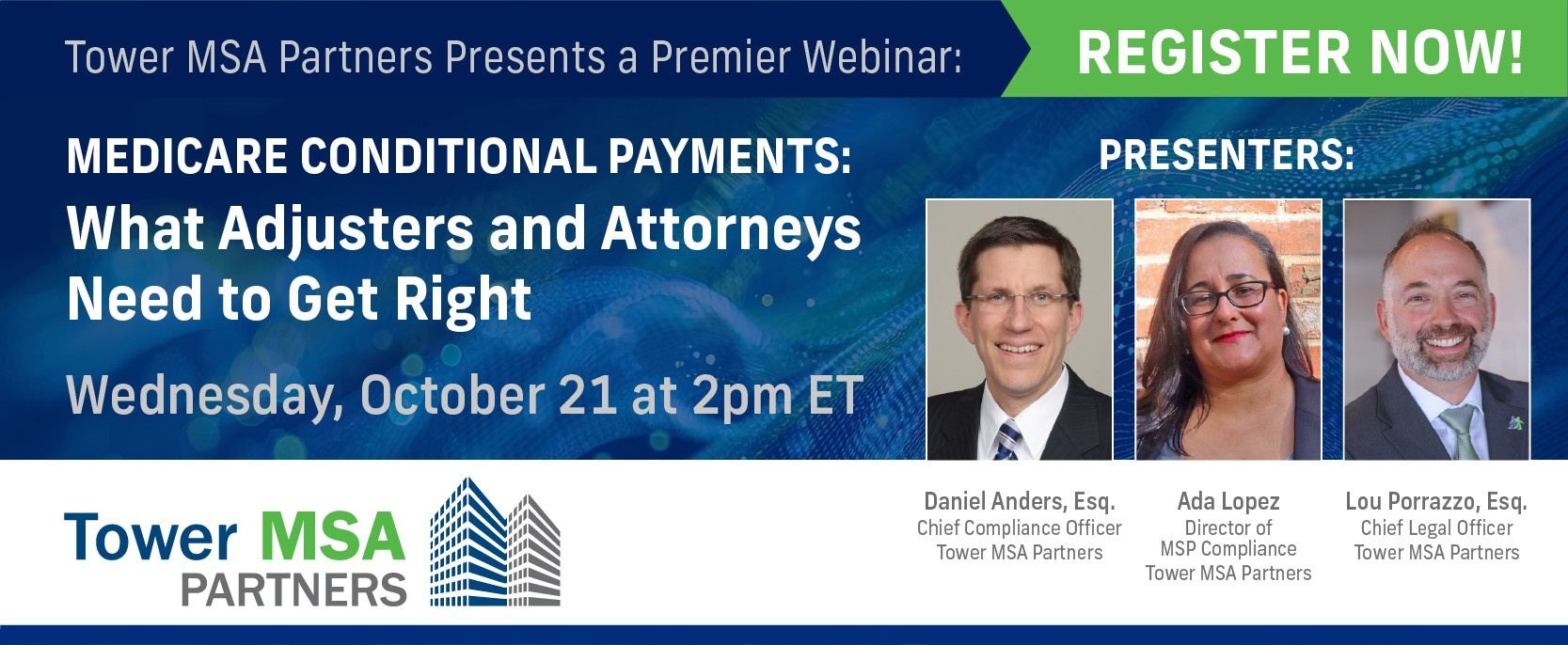
Tower MSA Partners Medicare conditional payments webinar featuring Dan Anders, Ada Lopez and Lou Porrazzo

From CMS conditional payment claims and Section 111 reporting to Medicare Advantage Plan recovery efforts, the Medicare recovery landscape has become increasingly complex. Mistakes can create problems long after a claim appears to be settled. 

Medicare Conditional Payments Webinar Details 

On Wednesday, October 21, 2026, at 2:00 p.m. ET, join Tower MSA Partners’s MSP Compliance Team, Dan Anders, Chief Compliance Officer, Ada Lopez, Director of MSP Compliance, and Lou Porrazzo, Chief Legal Officer, for a practical discussion of the Medicare recovery issues claims professionals need to understand today. This session will examine where problems arise and what adjusters and attorneys can do to address them before they delay settlement or remain unresolved after the claim is closed. 

Medicare Conditional Payment Recovery: Topics We’ll Cover 

• Background on Medicare conditional payment recovery processes in workers’ compensation and liability claims 

• How Section 111 reporting has changed Medicare’s ability to identify and pursue claims 

• Understanding Medicare recovery documents 

• How to review and dispute conditional payment amounts 

• The growing role of Medicare Advantage Plans and their recovery claims 

• What happens when a Medicare recovery claim surfaces after settlement 

• Practical steps adjusters and attorneys can take to address Medicare recovery before closing the file 

Register for the Medicare Conditional Payments Webinar 

A Q&A session will follow the presentation, and you can provide questions ahead of time at registration. Please click the link below and register today! 

Register for the Medicare Conditional Payments Webinar 

Top 10 Lessons from the Tower MSA Case Study Series 

October 1, 2026

Tower MSA Partners Top 10 Lessons from the MSA Case Study Series

Tower MSA Partners’ case study series reveals ten important lessons for claims professionals. Drawing from real-world cases, the series demonstrates how early intervention, clinical oversight, accurate documentation, and consistent review can improve Medicare Set-Aside and settlement outcomes. 

The cases have involved high-cost medications, outdated treatment plans, inaccurate allocations, conditional payment demands, amended reviews, and stalled legacy claims. 

Although every claim was different, one theme appeared repeatedly: meaningful MSA savings begin with accuracy. 

Here are the ten most important lessons from the series and what they mean for claims professionals. 

Lesson 1: Intervene Before MSA Preparation 

Early review can prevent unsupported treatment and pharmacy expenses from entering an allocation in the first place. 

In How Pre-MSA Triage Prevented $774K in Unnecessary Costs, Tower MSA Partners identified medical and pharmaceutical issues before the MSA was prepared. This early intervention prevented $774,583 in projected costs. 

What this means for claims teams:  

Do not wait until an MSA is ready for submission to question outdated treatment plans, medication histories, or unsupported projections. 

Lesson 2: Physician Peer Review Can Transform a High-Cost MSA 

Some medical questions require more than an administrative review. They require a qualified physician who can determine whether treatment remains clinically appropriate. 

In $1 Million Saved with Physician Peer Review, Tower identified overlapping therapies, high-cost medications, and treatment that had not been reevaluated for clinical necessity. Physician involvement, treatment changes, and supporting documentation ultimately produced more than $1 million in MSA savings. 

What this means for claims teams:  

Physician peer review can provide the clinical evidence needed to address complex, outdated, or duplicative treatment. 

Lesson 3: A Second Opinion Can Prevent an Expensive Mistake 

An MSA can look complete and still contain inaccurate information. 

In A $98K Mistake Avoided with a Second Opinion MSA Review, Tower found duplicate treatment, outdated information, and a discontinued high-cost medication in an allocation prepared by another vendor. Correcting these issues prevented approximately $98,000 in unnecessary funding. 

What this means for claims teams:  

Consider a second opinion MSA review when an allocation appears unusually high, includes substantial pharmacy exposure, or does not match the most recent medical records. 

Lesson 4: MSA Optimization Starts with Accuracy 

MSA optimization is not about cutting medically necessary care. It is about making sure every projected treatment, medication, frequency, and cost is supported by current evidence. 

In Trimming the Fat: $175K in Savings Through MSA Optimization, Tower identified duplicate entries, outdated treatment, replaced medications, and unsupported therapy projections. Correcting those discrepancies reduced the allocation by $175,000. 

What this means for claims teams:  

Sustainable MSA savings come from correcting inaccurate projections, not from targeting an arbitrary reduction. 

Lesson 5: Physician Follow-Up Can Fill Critical Information Gaps 

Medical records do not always clearly state whether a medication remains active, therapy is still recommended, or a treatment plan has changed. 

In $231K in Savings from Free Physician Follow-Up, Tower contacted the treating provider to confirm the claimant’s current treatment and medication needs. The resulting documentation supported a $231,487 reduction, and CMS accepted the revised allocation without development. 

What this means for claims teams:  

When the records do not answer an important clinical question, physician follow-up may provide the missing evidence. 

Lesson 6: Clinical Oversight Must Continue as Claims Change 

An MSA reflects the information available at one point in time, but claims continue to evolve. 

Medications are discontinued. Dosages change. Therapy frequency decreases. Providers revise their recommendations. Without continued review, an allocation can stop reflecting the claimant’s actual care. 

In $210K Saved: Why Clinical Oversight Is the Hidden MSA Advantage, Tower identified medications that were no longer prescribed, unsupported treatment, and frequencies that did not match current care. The review reduced the projected allocation by $210,143. 

What this means for claims teams:  

Clinical review should not be treated as a one-time event, especially when a claim has a long treatment history or multiple prescribing providers. 

Lesson 7: Updated Evidence Can Move Legacy Claims Forward 

 Legacy claims often remain open because the available information no longer provides an accurate picture of the claimant’s care. 

In From Backlog to Breakthrough: Reducing 43 Percent of Legacy Claims, Tower reviewed outdated treatment histories, discontinued medications, and old medical projections. By replacing outdated assumptions with current evidence, Tower helped move 43% of the payer’s legacy claim backlog toward resolution. 

What this means for claims teams: 

A claim that has been open for years is not necessarily impossible to settle. It may simply need an updated legacy claims settlement strategy. 

Lesson 8: Verify Every Conditional Payment Charge 

A Medicare conditional payment demand may include unrelated treatment, incorrect dates, duplicate charges, or services associated with broad diagnosis codes. 

In How Tower Reduced Conditional Payments to $0, Tower reviewed each charge against the claimant’s medical history and documented why unrelated services should be removed. Medicare accepted the dispute and reduced the conditional payment demand to zero. 

What this means for claims teams:  

Do not assume every charge listed in a conditional payment demand is the payer’s responsibility. Each line item should be reviewed and validated. 

Lesson 9: New Medical Evidence Can Support an Amended Review 

A CMS-approved MSA may no longer reflect the claimant’s medical needs if treatment changes after approval. 

In Amended Review Strategy Drops MSA by $101K, updated records showed that medications had been discontinued, therapy frequency had decreased, and previously projected testing was no longer recommended. Tower used this new evidence to support an amended review that reduced the MSA by $101,312. 

CMS allows for a one-time Amended Review MSA submission in situations like these, where medical costs have decreased since the original MSA was approved. 

What this means for claims teams:  

An existing approval should not end the review process when significant, documented treatment changes occur. 

Lesson 10: The Strongest Outcomes Come from a Coordinated Strategy 

The case study series shows that no single review method produces every result. The strongest outcomes came from combining early intervention, clinical oversight, current medical evidence, physician engagement, accurate documentation, and clear communication among everyone involved in the claim. 

Tower MSA Partners does more than identify potential errors or outdated treatment. Its clinical and compliance teams help translate those findings into documented, defensible actions that support cost containment and move claims toward settlement. 

What this means for claims teams:  

Better outcomes rarely come from one isolated step. They come from coordinating the clinical, compliance, claims, and settlement strategy from beginning to end. 

What These MSA Lessons Have in Common 

These cases involved different claims, medical histories, and settlement challenges. Yet the strongest outcomes shared several qualities: 

  • Claims were reviewed before outdated assumptions became permanent obstacles. 
  • Medical records were compared with projected future care. 
  • Clinical professionals evaluated treatment and pharmacy exposure. 
  • Treating providers were contacted when the records left important questions unanswered. 
  • Recommended changes were supported by documentation. 
  • Claims, clinical, legal, and compliance teams remained aligned. 
  • Savings resulted from accuracy, not from removing medically necessary care. 

This is the larger lesson from the series: MSA cost containment and Medicare compliance should not be treated as competing priorities. When an allocation accurately reflects current medical evidence, it can support both. 

Experience Behind the Results 

Tower MSA Partners provides Medicare Secondary Payer compliance and Medicare Set-Aside services to insurers, self-insured employers, third-party administrators, and attorneys. 

Tower’s clinical and compliance professionals combine medical review, regulatory knowledge, claims experience, and technology-enabled processes to help clients: 

  • Prepare accurate and defensible MSAs. 
  • Identify appropriate opportunities for MSA savings. 
  • Address complex treatment and pharmacy exposure. 
  • Resolve conditional payment demands and Medicare liens. 
  • Improve Section 111 reporting coordination. 
  • Move difficult and legacy claims toward settlement. 

The outcomes featured in this series reflect actual Tower MSA Partners case studies. Results vary based on each claim’s facts, medical evidence, documentation, and applicable CMS guidance. 

Explore the complete Tower MSA Partners case study library for more examples of these strategies in action. 

Put These MSA Lessons to Work 

If an inaccurate allocation, outdated treatment plan, conditional payment demand, or legacy claim is delaying settlement, the next step is to determine what the current evidence supports. 

Submit a referral or contact Tower MSA Partners to discuss the claim and identify the appropriate review strategy. 

Frequently Asked Questions About Medicare Set-Asides and Cost Savings 

What Is the Biggest Lesson from Tower MSA Partners’ Case Study Series? 

The biggest lesson is that MSA accuracy depends on current medical evidence. Early intervention, clinical oversight, physician input, and documentation validation can identify unsupported projections and produce a more accurate allocation. 

How Does Clinical Oversight Affect MSA Outcomes? 

Clinical oversight compares projected treatment and medications with the claimant’s documented medical needs. It can identify outdated, duplicative, discontinued, or unsupported care that may be inflating the allocation. 

When Should a Payer Request a Second Opinion MSA Review? 

A second opinion may be appropriate when an allocation appears unusually high, contains significant pharmacy exposure, conflicts with recent medical records, or was prepared before major treatment changes occurred. 

Can an Approved Medicare Set-Aside Be Changed? 

An approved WCMSA may qualify for an amended review when the claim meets current CMS requirements and significant changes are supported by updated medical or financial documentation. 

Why Is Documentation Important in an MSA Review? 

Documentation connects clinical findings to the final allocation. Clear, current medical evidence helps explain treatment changes, support accurate projections, and create a more defensible MSA. 

How Does Tower MSA Partners Help Reduce MSA Costs? 

Tower MSA Partners uses early claim review, clinical oversight, pharmacy analysis, physician engagement, documentation validation, and regulatory expertise to identify unsupported projections and prepare accurate, defensible MSAs. 

Who Does Tower MSA Partners Work With? 

Tower MSA Partners works with insurers, self-insured employers, third-party administrators, and attorneys to manage Medicare Secondary Payer compliance, reduce claim costs, and move complex claims toward settlement. 

Tower MSA Partners Premier Webinar: Five MSP Issues That Delay Settlement—and How to Solve Them

September 9, 2026

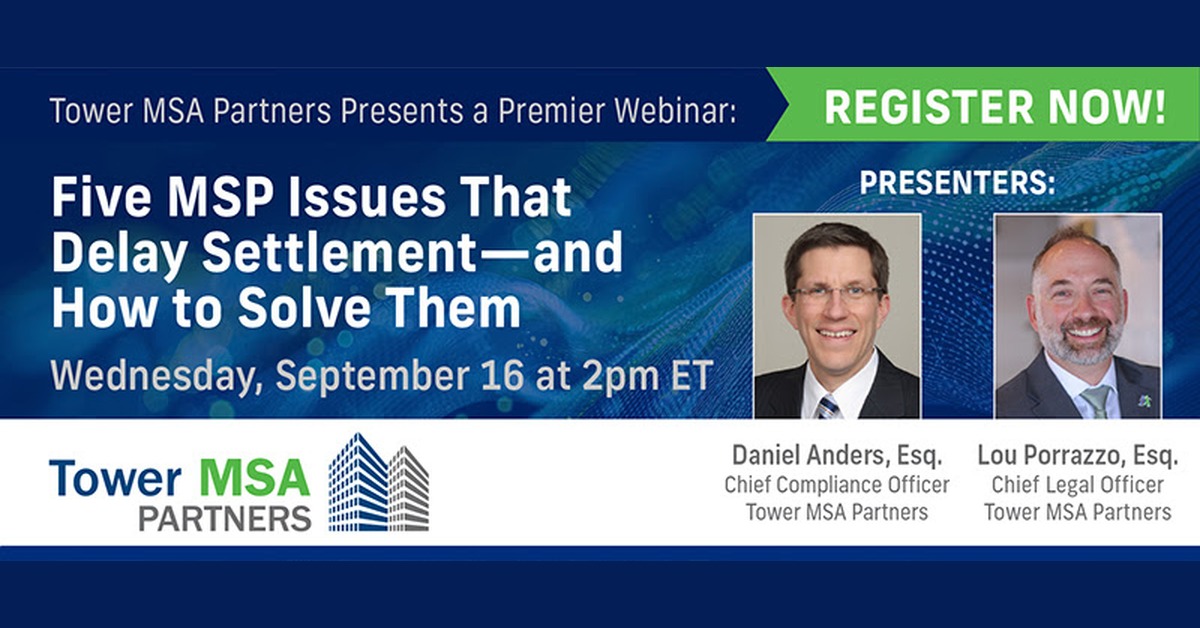
Tower MSA Partners webinar on five MSP issues that delay settlement, featuring Daniel Anders and Lou Porrazzo.

An MSA may be complete, approved, funded, and ready to go, but Medicare issues can still bring a workers’ compensation settlement to a halt.

Section 111 reporting inconsistencies. Unresolved conditional payments. ORM questions. Medicare-related issues that surface late in the process. And, too often, a lack of coordination among the parties.

These issues can turn a settlement that appears ready to close into a claim that sits unresolved for weeks or longer.

Webinar Details

On Wednesday, September 16, at 2:00 p.m. ET, join Tower’s Chief Legal Officer Lou Porrazzo and Chief Compliance Officer Dan Anders for a practical discussion of five MSP-related issues that commonly delay workers’ compensation settlements and what claims professionals can do to identify and resolve them earlier.

During This Webinar, We’ll Discuss

  • Section 111 Reporting Issues: How reporting inconsistencies can create problems at the settlement table and what should be addressed before settlement.
  • Conditional Payments: Why unresolved Medicare conditional payment claims can delay closing and how to resolve them proactively.
  • ORM Issues: How ongoing responsibility for medicals can complicate settlement and what needs to happen before ORM is terminated.
  • Coordination Among the Parties: How disconnects between the carrier, TPA, claimant, attorneys, MSA vendor, and other parties can create avoidable delays.
  • Late-Stage MSP Surprises: The issues that frequently emerge when everyone believes the claim is ready to settle and how to identify them earlier.

Register for the Webinar

A Q&A session will follow the presentation, and you can provide questions ahead of time at registration. Please click the link below and register today!

Register for the Five MSP Issues Webinar

Why Isn’t the Claim Settling? The MSP Issues Beyond the MSA that Can Derail a Settlement

September 2, 2026

By Louis Porrazzo, Esq., Chief Legal Officer, Tower MSA Partners and Claimify

For the past 25 years, the Medicare Set-Aside Arrangement (MSA) has been treated as the crown jewel of Medicare Secondary Payer (MSP) compliance. And rightfully so! An inappropriately high-dollar MSA can derail a settlement, an improperly prepared MSA may not survive review by the Centers for Medicare and Medicaid Services (CMS), and an insufficiently funded MSA can leave the injured worker in a Medicare quagmire.

During that same timeframe, the industry has become reasonably proficient at ensuring that an MSA is appropriately calculated, that an MSA submitted to Medicare has a strong likelihood of approval near the submitted amount, and that the MSA is properly funded and administered.

And yet, parties still routinely encounter MSP-related issues that prevent or delay settlement.  Even when an MSA has been prepared, submitted, approved or indemnified, and funding and administration have been arranged, the parties still carry ongoing MSP obligations that must be met.

Improper Section111 reporting, failure to properly address conditional payments, and inconsistent claim information can derail a settlement at the eleventh hour. Individually, each of these issues can be managed without much difficulty. The challenge is that they are rarely identified early enough to be handled as routine compliance work.

MSP compliance must be fully integrated into all aspects of claims handling. If the first meaningful discussion about Medicare occurs during settlement negotiations, the parties are already at a disadvantage.

Here are five MSP-related issues to address before the settlement becomes derailed:

1. Section111 Data is Inconsistent

The handling adjuster is responsible for maintaining accurate claim information, ensuring appropriate ICD codes are used, and paying only for treatment and services for which the payer is responsible. Defense counsel may be litigating the accepted body parts, correct date of injury, causal relationship, and other aspects of the claim. And some organizations have entire departments or outside vendors dedicated to Medicare reporting. Their efforts should be aligned. Too often, they are not.

Dates of injury, ICD codes, ORM (Ongoing Responsibility for Medicals) status and termination dates, TPOC (Total Payment Obligation to the Claimant) information, and other reporting data should accurately reflect the claim being settled. This has become even more important as CMS has expanded Section111 reporting requirements to include WCMSA information and increased its focus on reporting timeliness and accuracy. CMS began quarterly Section 111 reporting audits in the first quarter of 2026, sampling accepted records and assessing civil money penalties where ORM assumption or TPOC was reported outside the required timeframe. Reporting data that was merely untidy a year ago now carries a direct financial consequence.

Inconsistent data can create significant problems. Multiple Medicare records may be established or associated with a claim, potentially triggering unnecessary recovery activity. Inaccurate information can complicate settlement documentation and reporting. And improper coding may cause confusion regarding which injuries and medical treatment are actually related to the workers’ compensation claim.

Before the parties settle, they should ensure that what is reported under Section111 matches the claim that is about to close.

2. Ambiguity Surrounding ORM

When an accepted workers’ compensation claim is settled and the payer’s responsibility for medical treatment ends, ORM generally needs to be terminated, and applicable TPOC information reported under Section 111. The key question is whether ORM should have been accepted in the first place.

  • When did responsibility for medical treatment begin?
  • Was it ever accepted or denied?
  • Does it remain open?
  • Is there a legitimate basis for terminating ORM?
  • If so, when should the termination be reported?

These decisions should not be made automatically simply because a claim is established at the front end or the claim is settling on the back end. Inaccurately accepting ORM can create problems beyond Section111 reporting itself, including unnecessary conditional payment recovery efforts and confusion regarding accepted injuries.

Settlement is a good time to review Section111 and ORM activities, but it should not be the first time these questions are asked.

3. Forgotten Conditional Payments

Far too often, conditional payments are an afterthought.  The industry has become very good at knowing how to prepare an MSA, how to obtain approval when submission is appropriate, how to fund it, and how to administer it.  But conditional payments still go unaddressed until the last minute. 

CMS may seek reimbursement for payments it believes are related to the workers’ compensation claim, including charges that the payer believes are unrelated or otherwise not their responsibility. Failing to investigate and address those payments early can lead to unnecessary reimbursement demands and delays in bringing the claim to final resolution.

Organizations can save money by addressing conditional payments in a timely fashion. Just as importantly, accurate Section 111 reporting and proper conditional payment resolution can reduce confusion over responsibility for medical treatment. These issues can usually be resolved, but resolution takes time.  A conditional payment issue discovered months before settlement is a compliance task. The same issue discovered days before settlement can become a settlement problem.

4. When Everyone Owns MSP Compliance, No One Does

It is important for all parties to align on MSP-related activities and expectations.  The adjuster and defense attorney should be in lockstep when it comes to handling the MSA, conditional payments or Section 111 questions.  Both parties should have a working relationship with the MSP vendor of choice.  And the claimant’s counsel should understand their obligations in denied workers’ compensation cases.

MSP compliance involves multiple interconnected obligations, and treating each one as an independent transaction creates opportunities for things to be missed. Each party should know which tasks belong to them. Before settlement discussions begin, parties should understand:

  • What is accepted and what remains denied or disputed?
  • Is the claimant Medicare eligible or reasonably expected to become Medicare eligible?
  • Is §111 reporting accurate, including ORM status?
  • Who is responsible for resolving conditional payments?
  • What is the strategy for MSA preparation, funding, and administration?
  • If an MSA is appropriate, will the parties pursue CMS submission or utilize another risk-management approach such as indemnification?

While different people will be handling different aspects of MSP compliance, it is important to have one person or department leading the charge and bringing all parties together to ensure MSP compliance.

5. MSP Protocol vs. “Getting an MSA”

Every entity should have a defined MSP protocol in place to ensure compliance. The mindset should shift from “getting an MSA” to “complete MSP compliance.” Any settlement strategy should include Medicare from the beginning.

Is there a discrepancy in treatment? Address it during claims handling so it doesn’t become an issue at settlement.

Is the case denied? Do not automatically assume that ORM should be reported. Analyze whether responsibility for medical treatment has actually been accepted and report accordingly.

Is the claimant treating body parts unrelated to the injury? Do not pay for that treatment. Those payments can inflate the MSA and complicate CMS approval.

By the time everyone has agreed on a settlement number, expectations have been created and momentum matters. An unexpected Medicare issue at that stage does more than increase costs. It can destroy that momentum and prevent the settlement from closing.

Final Thoughts

MSP compliance should be built into the overall claims strategy from the beginning. Section 111 reporting, conditional payments, future medical exposure, and settlement all intersect, and problems in one area can quickly affect another. A well-defined MSP protocol gives the parties an opportunity to identify and resolve those issues while there is still time to keep the claim moving toward settlement.

The best time to discover a Medicare problem is when there is still time to do something about it. When the claimant wants to settle, counsel agrees to settlement terms, the adjuster has authority, and the MSA is complete, the last thing anyone wants to hear is “We still have a Medicare issue.” A well-built MSP Protocol is what keeps that sentence out of the room.

On Wednesday, September 16, at 2:00 p.m. ET, join Tower’s Chief Legal Officer, Lou Porrazzo, and Tower’s Chief Compliance Officer, Dan Anders, for a practical discussion of five MSP-related issues that commonly delay workers’ compensation settlements and what claims professionals can do to identify and resolve them earlier.

Register for the webinar today!

Frequently Asked Questions About MSP Issues That Delay Settlement

Why do workers’ compensation settlements get delayed by Medicare issues?

Most delays come from issues outside the Medicare Set-Aside itself. Inconsistent Section 111 data, unresolved conditional payments, and unclear ORM status surface late in negotiations, when the parties have already agreed on a number and have no time to fix them.

What Section 111 data should be verified before settlement?

Confirm that the date of injury, ICD codes, ORM status and termination date, and TPOC information all match the claim being settled. Since April 2025, WCMSA amounts must also be reported. Mismatched data can trigger duplicate Medicare records and unnecessary recovery activity.

When should ORM be terminated on a workers’ compensation claim?

ORM generally terminates when the payer’s responsibility for medical treatment ends, which usually coincides with settlement. The more important question is whether ORM should have been accepted in the first place, because accepting it in error creates conditional payment exposure that did not need to exist.

Who is responsible for resolving conditional payments in a settlement?

Responsibility should be assigned explicitly before settlement discussions begin, typically to the adjuster, defense counsel, or the MSP vendor. When no one owns it, conditional payments surface days before closing, at which point they become a settlement problem rather than a compliance task.

Does an approved MSA mean the claim is MSP compliant?

No. An approved and funded MSA addresses future medical exposure only. Section 111 reporting accuracy, ORM status, and conditional payment resolution are separate obligations that continue independently and can hold up a settlement on their own.

Louis Porrazzo, Esq. serves as Chief Legal Officer for Tower MSA Partners. A recognized authority on Medicare Secondary Payer (MSP) compliance, Lou is a frequent national speaker and author known for translating complex Medicare compliance issues into practical strategies for claims professionals, attorneys, insurers, and self-insured organizations. He is licensed to practice law in the Commonwealth of Massachusetts and brings extensive experience in MSP compliance, workers’ compensation, and general liability defense. Outside of his professional work, Lou chairs the Kids’ Chance of Massachusetts Fundraising Committee and is a CrossFit Level 2 Certified Trainer. He can be reached at Louis.Porrazzo@TowerMSA.com.

Tower MSA Partners and Claimify Announce the Addition of Louis Porrazzo to Executive Team

August 18, 2026

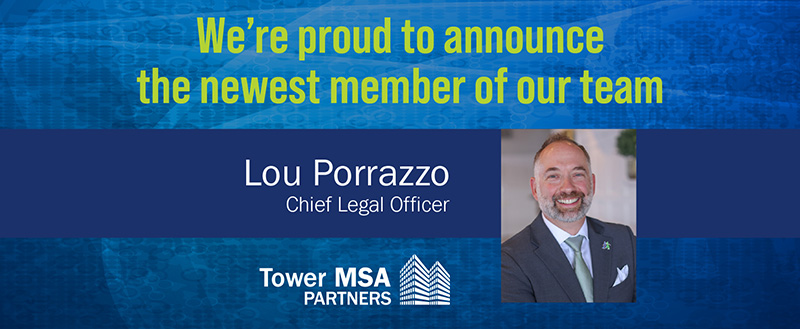
Louis Porrazzo, Chief Legal Officer of Tower MSA Partners and Claimify

Industry Veteran Brings Extensive MSP Compliance Experience

DELRAY BEACH, Fla. (August 18, 2026) – Tower MSA Partners (“Tower”), a technology-forward, industry-leading provider of Medicare Secondary Payer (“MSP”) compliance services and Claimify, the leading national provider of tech-enabled solutions to the disability insurance industry, announce the appointment of Louis (“Lou”) Porrazzo as Chief Legal Officer.

Leveraging over two decades of industry leadership experience, Porrazzo joins the leadership team of the combined organization to support Tower and Claimify’s ongoing commitment to exceptional thought leadership, technology-enabled regulatory compliance, client service, and operational excellence. He will work closely with the existing leadership team to provide thought leadership and help existing clients navigate complex Medicare Secondary Payer (MSP) and Social Security disability issues.

“Lou is one of the most respected professionals in the MSP compliance industry,” said Kristine Dudley, Tower’s Chief Operating Officer. “His extensive compliance experience, combined with his thoughtful approach to solving complex claims issues, makes him an outstanding addition to our executive team.”

Porrazzo is an attorney licensed to practice in the Commonwealth of Massachusetts, where he has represented employers, insurers, self-insured organizations, and third-party administrators in workers’ compensation and liability matters. Prior to joining Tower, Porrazzo served as Vice President of National Accounts at ExamWorks Compliance Solutions, where he worked with clients across the workers’ compensation and insurance industries.

“I am excited to join the leadership team of the combined organization. Tower is a market-leading provider of innovative solutions for the complex claims industry, focused on delivering outstanding MSP compliance and settlement solutions to self-insured enterprises, carriers, and TPAs, including Section 111 reporting, MSAs, and Conditional Payment solutions,” said Porrazzo. “Likewise, Claimify is a technology leader in transforming the complex Social Security process to benefit carriers, self-insured enterprises, TPAs, and claimants. The two companies perfectly complement each other.”  

In addition to his professional background, Porrazzo is actively involved in industry organizations such as The National MSP Network, the Massachusetts RIMS Chapter, and Kids’ Chance of Massachusetts, where he serves as the Chair of the Fundraising Committee. He is also a Medicare Set-Aside Certified Consultant.

“Lou has a remarkable ability to translate evolving MSP regulatory requirements into practical solutions for clients,” Dan Anders, Tower’s Chief Compliance Officer, said. “His leadership and industry knowledge will strengthen the counsel and guidance we provide while supporting our continued commitment to excellence.”

Earlier this summer, the company released the first-of-its-kind Workers’ Compensation Medicare Secondary Payer Outcomes & Regulatory Insights Report, demonstrating that MSP strategy can lead to significant benefits such as better control over allocated medications, quicker CMS MSA approval times, and an overall lower allocation for future medical care.

ABOUT TOWER MSA PARTNERS

Tower MSA Partners is an industry-leading provider of Medicare Secondary Payer (MSP) compliance and Medicare Set-Aside (MSA) services. The company partners with insurers, self-insured employers, third-party administrators (TPAs), and attorneys to reduce claim costs, mitigate risks, and expedite workers’ compensation and liability settlements.

Tower uses a proprietary MSP Automation Suite technology platform to help claims teams navigate complicated government regulations. Core service areas include CMS-compliant MSA allocations and cost-reduction strategies; resolving conditional payment demands and Medicare Advantage plan liens; assisting clients with mandatory CMS Section 111 reporting; and working to settle stagnant legacy claims.

To learn more, visit towermsa.com or follow us on LinkedIn.

ABOUT CLAIMIFY

Claimify, LLC is a leading provider of Social Security Disability, Benefit Validation, Settlement Facilitation, and Overpayment technology solutions to the country’s largest disability insurance carriers, third-party administrators, and self-insured employers. Claimify’s technology-driven solutions enable it to deliver value to disability and general liability communities. To learn more about Claimify, please visit: https://www.claimify.com.

Amended Review Strategy Drops MSA by $101K

July 20, 2026

Tower MSA Partners amended review case study showing $101,312 in Medicare Set Aside savings

In Tower MSA Partners’ last post, How Tower Reduced Conditional Payments to $0, we explained how Tower reduced Medicare conditional payments to zero through detailed review and accurate documentation. This month, we focus on a case where an amended review dramatically changed the outcome of an already CMS-approved MSA. A payer requested help after receiving an unexpectedly high counter-higher from CMS. Through an amended review supported by updated medical records and clinical oversight, Tower corrected outdated projections and reduced the MSA by $101,312. This case shows how persistence and accuracy create better settlement outcomes.

Identifying the Problem

After an MSA had been submitted and approved by CMS, new medical records revealed important changes in the claimant’s treatment plan. Several medications had been discontinued, therapy frequency had decreased, and previously projected diagnostic testing was no longer recommended. As a result, the approved allocation no longer reflected the claimant’s current treatment needs and overstated projected future medical costs.

The allocation no longer aligned with the claimant’s current medical condition or ongoing treatment plan. Moving forward with settlement based on outdated projections would have resulted in funding medical expenses that were no longer supported by the available clinical evidence. The payer needed an amended review to ensure the MSA accurately reflected current medical.

Turning New Medical Evidence Into $101K in Savings

Tower MSA Partners conducted a comprehensive amended review to evaluate the newly available medical information and determine its impact on future medical cost projections.

The clinical team analyzed updated medical records, treatment histories, prescription information, and provider recommendations. During the review, several medications included in the original allocation were confirmed as discontinued and no longer medically necessary. Therapy projections were adjusted to reflect the claimant’s current treatment frequency, and future diagnostic testing recommendations were updated based on the most recent provider documentation.

Using this information, Tower prepared an Amended Review Medicare Set Aside allocation supported by detailed clinical rationale and updated medical evidence. The amended submission clearly demonstrated why the original projections no longer reflected the claimant’s current treatment needs and how the revised allocation more accurately represented future medical exposure.

CMS reviewed the amended Medicare Set Aside submission and accepted the updated allocation, resulting in a reduction of $101,312.

Outcome

  • MSA Reduction: $101,312
  • Strategy: Amended Review
  • Key Findings: Discontinued medications, reduced therapy frequency, and updated diagnostic recommendations
  • CMS Result: Revised allocation accepted
  • Impact: More accurate funding and lower settlement costs

Collaboration and Communication

Successful amended reviews require more than updated medical records. They also depend on clear communication among stakeholders involved in the settlement process.

Tower MSA Partners worked closely with the claims professional to review the updated treatment information and ensure the rationale behind each amendment was thoroughly documented. When necessary, providers and defense counsel were consulted to verify treatment changes and eliminate potential discrepancies before resubmission.

This collaborative approach helped streamline the review process and provided CMS with a well-supported allocation backed by current medical evidence. Because the documentation was complete and clearly explained, CMS accepted the revised allocation without requesting additional information.

Why Amended Reviews Matter

Workers’ compensation claims are dynamic. Treatment plans change, medications are discontinued, and providers adjust recommendations based on a claimant’s progress. When those changes occur after an MSA has been prepared or submitted, failing to update the allocation can result in unnecessary funding and inflated settlement costs.

Amended reviews help ensure that Medicare Set Aside allocations remain accurate, defensible, and aligned with current medical evidence. By incorporating updated treatment information before settlement, payers can avoid overfunding future medical expenses while maintaining compliance with CMS requirements.

The amended review identified treatment projections that no longer reflected the claimant’s current medical status. Without the review, the payer would have funded more than $101,000 in projected medical costs that were no longer supported by the treatment record.

Key Takeaways

  • Amended reviews help ensure Medicare Set Aside allocations reflect current medical necessity.
  • Updated medical records can reveal opportunities to reduce future medical cost projections.
  • Discontinued medications and changes in treatment frequency can have a significant impact on MSA allocations.
  • CMS accepts amended submissions when the changes are supported by credible medical evidence and documentation.
  • Proactive clinical oversight helped reduce this allocation by $101,312 while maintaining compliance and settlement readiness.

Frequently Asked Questions About Amended Reviews

What is an amended review?

An amended review updates a previously CMS-approved MSA allocation when new medical information becomes available that affects future medical cost projections.

Why are amended reviews necessary?

Claims evolve over time. Updated medical records may reveal discontinued medications, reduced treatment frequency, or changes in provider recommendations that should be reflected in the allocation.

How does an amended review create savings?

 An amended review corrects outdated projections and aligns the allocation with current medical necessity. This can reduce unnecessary funding while maintaining compliance with CMS guidelines.

Can an MSA be changed after it has been approved by CMS?

Yes. If significant medical updates occur after submission, an amended review may be appropriate. Updated medical records, physician recommendations, and treatment changes can justify a revised Medicare Set Aside allocation.


How Tower Reduced Conditional Payments to $0

June 23, 2026

Image of Tower MSA Partners Why Case Studies Matter series, Blog 9 Conditional Payments Reduced to Zero

In Tower MSA Partners’ last post, From Backlog to Breakthrough, Reducing 43 Percent of Legacy Claims, we explored how structured review helped a payer resolve 43% of its legacy claim backlog. This month, we focus on a different but equally important component of Medicare compliance. A payer requested Tower MSA Partners’ assistance with Medicare conditional payments after receiving an unexpectedly high reimbursement demand. Through detailed investigation, clinical review, and strategic communication with Medicare, Tower reduced the conditional payment amount to zero. This case shows how expertise in documentation and compliance protects payers from unnecessary financial exposure.

Identifying the Problem

Medicare conditional payments arise when Medicare covers medical treatment that may be related to a worker’s compensation or liability claim. In this case, Medicare issued a demand letter listing charges that totaled several thousand dollars. Tower’s analysts reviewed the itemized charges and immediately identified discrepancies. Many of the listed treatments were unrelated to the claimed injury, some were incorrectly dated, and others were duplicates. Without intervention, the payer would have reimbursed Medicare for services that were not their responsibility.

The Conditional Payment Resolution Solution

Tower MSA Partners performed a complete conditional payment review. Analysts compared each charge to the claimant’s medical history, verified diagnoses, and confirmed which treatments were causally related to the claimed condition. The review found multiple services that did not match the injury, unrelated emergency visits, and unrelated diagnostic imaging. Tower prepared a detailed dispute package explaining why each unrelated charge should be removed. Medicare accepted the documentation and eliminated every disputed line item, reducing the conditional payment amount to zero.

Collaboration and Communication

Tower communicated closely with the claims professional throughout the process, providing updates on findings and ensuring that the payer understood the basis of each dispute. The clinical team also prepared clear documentation for Medicare that supported the request for removal of unrelated charges. This level of communication helped streamline the review process and ensured the payer had complete visibility of the findings. Because the documentation was thorough and aligned with Medicare standards, the dispute was accepted without further development.

Why Oversight Makes the Difference

Conditional payments require precise evaluation because even a single unrelated treatment can create unnecessary financial exposure. Many payers reimburse Medicare due to uncertainty about which charges apply. Tower’s clinical oversight identifies unrelated treatment, strengthens dispute documentation, and prevents avoidable reimbursement. This case shows how expert review transforms a costly demand into a compliant resolution that protects the payer and ensures accurate reporting.

Lessons Learned

  1. Conditional payment reviews must be detailed to identify unrelated charges.
  2. Accurate documentation leads to successful Medicare disputes.
  3. Collaboration with claims professionals ensures clarity and confidence.
  4. Strategic oversight prevents unnecessary reimbursement. This case resulted in a zero-dollar conditional payment demand.

Results That Reflect Expertise

Through thorough review and precise documentation, Tower reduced Medicare conditional payments to zero. The payer avoided unnecessary expenses and gained confidence that the claim was handled accurately and compliantly. Tower MSA Partners continues to demonstrate the importance of clinical insight, administrative precision, and regulatory expertise in managing Medicare related obligations.

FAQs

What are Medicare conditional payments?

Medicare conditional payments occur when Medicare pays for treatment that may be related to a compensable claim and seeks reimbursement from the responsible payer.

Why do conditional payment demands include unrelated charges?

Medicare often uses broad diagnosis codes, which can pull in unrelated treatment unless each line item is reviewed.

How does Tower reduce conditional payments?

Tower verifies each charge, identifies unrelated services, and prepares detailed dispute documentation for Medicare.

Can Medicare reduce conditional payments to zero?

Yes. When documentation proves that charges are unrelated to the claim, Medicare may remove the items entirely.