CMS to Host Webinar on PAID Act Implementation and Upcoming Testing

August 12, 2021

Tower MSA Partners covers CMS new guide on Medicare conditional payment appeals and the upcoming Section 111 reporting webinar.

On Thursday, September 9, 2021, at 1 p.m. ET the Centers for Medicare and Medicaid Services (CMS) will be hosting a second webinar on the implementation of the Provide Accurate Information Directly (PAID) Act.  Per the notice:

CMS will be hosting a second webinar regarding the impacts to Section 111 Non-Group Health Plan (NGHP) Responsible Reporting Entities (RREs) related to the PAID Act, which was signed into law on December 11, 2020. The intention of the PAID Act is to help NGHP RREs better coordinate benefits by providing beneficiary Part C and Part D enrollment information via updates to the Section 111 Query Response File. These changes will go into effect on December 11, 2021. This webinar will offer important PAID Act reminders and focus on the details of the upcoming testing period, which will begin on September 13, 2021. The webinar presentation will be followed by a live question and answer session with staff from CMS and the Benefits Coordination & Recovery Center.

Check out slides from the first CMS Provide Accurate Information Directly Act webinar.

If you are a Tower Section 111 reporting client, we recently provided a draft query response file layout.  This layout incorporates the additional fields required to receive Part C and Part D enrollment information and Part A and Part B effective and termination (if applicable) dates.  Tower will initiate testing with the BCRC in September and make changes, if any, to the final file layout before the December 2021 implementation.  Additionally, Tower’s next quarterly webinar (date and time to be announced soon), will address PAID Act implementation and best practices for resolving reimbursement claims from Part C Medicare Advantage and Part D Prescription Drug Plans.

We encourage anyone involved in the Section 111 reporting process to attend the CMS webinar.

If you have any questions, please contact Tower’s Chief Compliance Officer, Dan Anders, at daniel.anders@towermsa.com or 888.331.4941.

Related Prior Posts:

CMS: PAID Act Implementation Guidance & New ORM Termination Option

PAID Act Becomes Law


The Patel Memo Launched the Medicare Set-Aside Review Process

July 28, 2021

The Patel Memo Launched the Medicare Set-Aside Review Process

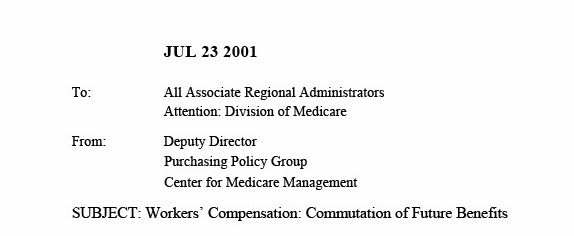
Last week, July 23, 2021, to be precise, marked the 20th anniversary of the Patel Memo, which set the stage for the Medicare Set-Aside industry as we know it. Released under the name of Parashar B. Patel, Deputy Director, Purchasing Policy Group for the Centers for Medicare and Medicaid Services (CMS), the memo was directed to the CMS Associate Regional Administrators on the subject of “Workers Compensation: Commutation of Future Benefits.”

It addressed questions sent to CMS regional offices from attorneys who were settling workers’ compensation cases and submitting MSAs to regional offices for review and approval. Although there were some MSAs before this time, the Patel Memo of July 23, 2001, had a pivotal impact and led to the start of several MSA and MSP compliance companies, including Tower MSA Partners 10 years ago.

The memo cited regulatory authority and gave a green light for the regional office review and approval process for submitted MSAs, including criteria and thresholds for review for non-Medicare beneficiary claimants.  It established instructions for the regional office to add the MSA to the CMS common working file and annual accounting requirement for the MSA administrator once the MSA was funded.  The memo also acknowledged structured set-aside arrangements, confirmed that an MSA should be allocated over life expectancy and allowed for fee schedules as a basis for allocating care.

Some of its provisions did not stand the test of time and were eliminated by subsequent CMS memos. These included a prohibition on the use of the MSA funds before Medicare entitlement, indexing the MSA for inflation, and regional office review of the administrative fee and expenses to be charged to the arrangement.

Although the WCMSA Reference Guide officially supplanted the Patel Memo, the memo laid the foundation for the WCMSA review process.

If you’d like to know more about the man behind the memo, listen to this interview conducted by Shawn Deane, General Counsel of our professional administration partner Ametros.

CMS: PAID Act Implementation Guidance & New ORM Termination Option

June 11, 2021

book marked by sticky notes illustrating changes Section 111 reporting on ORM

The Centers for Medicare and Medicaid Services (CMS) has issued guidance for the implementation of the PAID Act.  The agency also announced criteria for an additional option for the termination of Ongoing Responsibility for Medicals (ORM) in the Section 111 reporting process.

PAID Act Implementation

On June 8, 2021, CMS issued a Technical Alert on the implementation of the PAID Act.  The PAID Act (See Paid Act Becomes Law) will provide Responsible Reporting Entities (RREs), namely liability insurance (including self-insurance), no-fault insurance and workers compensation plans and insurers, Medicare Part C and D enrollment information for claimants identified as Medicare beneficiaries.  Starting December 11, 2021, the following information will be provided in the NGHP Section 111 Query Response File where CMS responds to a query about a claimant’s status as a Medicare beneficiary:

  • Contract number
  • Contract name
  • Plan benefit package number
  • Plan address
  • Effective dates for the previous 3 years (up to 12 instances each for Part C and for Part D)

CMS also released an updated NGHP User Guide, Version 6.4, which provides the technical information for the query response file layout additions that will be required to receive this information through the query process.

Our Section 111 reporting team is reviewing the technical changes and will provide guidance to our reporting clients regarding system updates that need to be made before December 11, 2021, to enable receipt of the new field data.  We will also participate in testing, which CMS says will be available by this coming September 13.  Finally, we will attend CMS’s June 23 webinar on the PAID Act implementation and provide a summary of any relevant information.

Additional Option for ORM Termination

Besides the PAID Act, the updated Section 111 User Guide provides a new option for ORM termination.  Per Section 6.3.2 of the Section 111 User Guide (Policy Guidance), once ORM is accepted on a claim it can only be terminated if certain criteria are met:

  • Where there is no practical likelihood of associated future medical treatment, an RRE may submit a termination date for ORM if it maintains a statement (hard copy or electronic) signed by the beneficiary’s treating physician that no additional medical items and/or services associated with the claimed injuries will be required;
  •  Where the insurer’s responsibility for ORM has been terminated under applicable state law associated with the insurance contract;
  •  Where the insurer’s responsibility for ORM has been terminated per the terms of the pertinent insurance contract, such as maximum coverage benefits.

CMS has now provided additional criteria which allow ORM termination:

Where there is no practical likelihood of associated future medical treatment, which is reflected by meeting ALL of the following:

  • No claims were paid with any diagnoses codes related to alleged ingestion, implantation, or exposure; and
  • No claims were paid, for any medical item or service related to the case, within five (5) years of the date of service of any such claim; and
  • Treatment did not include, nor were any claims paid related to, a medical implantation or prosthetic device; and
  • The total amount paid by the insurer, for all medical claims related to the case, did not exceed $25,000.

Note: If, at any time, any of the parameters set forth above should no longer be applicable, the insurer must then update the ORM record to reflect that they, once again, have ongoing responsibility for medicals (i.e., update the termination date to all zeroes). Should the case once again fall under these parameters (for example, if five years elapse from the last relevant date of service), then ORM for that case may once again be terminated in accordance with the criteria above.

This policy gives RREs the ability to terminate ORM or not report ORM in the first place on minor medical claims.  We recommend a review of all outstanding claims with an open ORM that could fit these criteria to decide whether an ORM termination date should be entered.

For example, a Medicare beneficiary claimant has a traumatic injury on February 1, 2014.  Acceptance of ORM was reported through the Section 111 reporting process.  The last medical paid was for a date of service of March 1, 2016, where the total paid on the claim was $10,000.  On March 1, 2021, five years have passed and ORM may be terminated. Note, if the claim is later settled, the settlement amount would still need to be reported as Total Payment Obligation to the Claimant (TPOC) through the Section 111 reporting process.

In addition to claims where ORM is currently open, this policy would apply to claims where potential ORM acceptance reporting was triggered because a claimant was identified as a Medicare beneficiary.

For example, the last medical paid in a traumatic injury was for a date of service of March 1, 2016, where the total paid on the claim was $10,000.  Medical remains open on the claim per state law.  The claimant became a Medicare beneficiary on June 1, 2021.  Per this policy, ORM acceptance would not need to be reported because all criteria have been met.  Note, like in the example above, if the claim were to settle, the settlement amount would need to be reported as Total Payment Obligation to the Claimant (TPOC) through the Section 111 reporting process.

If you have questions about the PAID Act or the changes to ORM reporting, please let me know.  Contact me at daniel.anders@towermsa.com or 888.331.4941

 Related Prior Posts:

CMS to Host Paid Act Webinar

CMS to Host PAID Act Webinar

May 25, 2021

Tower MSA Partners covers CMS new guide on Medicare conditional payment appeals and the upcoming Section 111 reporting webinar.

On Wednesday, June 23 at 1 p.m. ET the Centers for Medicare and Medicaid Services (CMS) will be hosting a webinar on the implementation of the Provide Accurate Information Directly (PAID) Act.  Per the notice:

CMS will be hosting a webinar to discuss upcoming impacts to Section 111 Non-Group Health Plan (NGHP) Responsible Reporting Entities (RREs) related to the PAID Act, which was signed into law on December 11, 2020. The intention of the PAID Act is to help NGHP Responsible Reporting Entities better coordinate benefits by providing additional beneficiary Part C and Part D enrollment information. This webinar will cover what the PAID Act is, details of the NGHP Section 111 Query Response File changes, information on the scheduled testing period and implementation timeframes. The webinar will also be followed by a live question and answer session with staff from CMS and the Benefits Coordination & Recovery Center.

Further background on the PAID Act can be found in Tower’s article: PAID Act Becomes Law

We encourage anyone involved in the Section 111 reporting process to attend the webinar.  Tower will provide a post-webinar summary.

If you have any questions, please contact Tower’s Chief Compliance Officer, Dan Anders, at daniel.anders@towermsa.com or 888.331.4941.

CMS to Host Reporting and Medicare Conditional Payment Recovery Town Hall

March 2, 2021

Tower MSA Partners covers CMS new guide on Medicare conditional payment appeals and the upcoming Section 111 reporting webinar.

The Centers for Medicare and Medicaid Services (CMS) recently announced it will be hosting a town hall on April 1, 2021 at 1 pm ET to discuss common Non-Group Health Plan topics.  Specifically, representatives from CMS, the Benefits Coordination and Recovery Center (BCRC) and the Commercial Repayment Center (CRC) will be on hand to answer questions related to Section 111 mandatory insurer reporting and Medicare conditional payment recovery.

Complete information can be found here.

In follow-up to Tower’s Medicare Conditional Payment Tune-up webinar, which will be held on March 18, CMS is providing an excellent opportunity to directly address questions with both the policymakers and the recovery contractors.

If your responsibilities touch on Section 111 reporting and/or Medicare conditional payment recovery, we encourage you to attend the town hall.

CMS Releases Technical Updates to Section 111 User Guide

January 26, 2021

Tower MSA Partners explains CMS updates to ORM and NOINJ rules in the Section 111 reporting user guide.

The Centers for Medicare and Medicaid Services (CMS) has begun the new year with some updates to its MMSEA Section 111 NGHP User Guide.  This guide provides everything and anything you ever wanted to know about mandatory insurer reporting by non-group health plans.  Version 6.2 provides the following updates:
 
$750 Reporting Threshold
 
In follow-up to its November 2020 announcement that it will be maintaining the $750 TPOC threshold for reporting and Medicare conditional payment recovery, CMS states:
 
As of January 1, 2021, the threshold for physical trauma-based liability insurance settlements will remain at $750. CMS will maintain the $750 threshold for no-fault insurance and workers’ compensation settlements, where the no-fault insurer or workers’ compensation entity does not otherwise have ongoing responsibility for medicals (Sections 6.4.2, 6.4.3, and 6.4.4).
 
Key takeaway:  Maintaining the $750 threshold means there are no changes to the reporting processes, determinations of claims that should be reported, or when conditional payments should be investigated or resolved.
 
Reporting Future ORM Termination Date
 
Per CMS:
 
To address situations where Responsible Report Entities (RREs) can identify future ORM termination dates based on terms of the insurance contract, RREs can now enter a future Ongoing Responsibility for Medicals (ORM) Termination Date (Field 79) up to 75 years from the current date (Section 6.7.1)
 
Key takeaway:  A future ORM termination date can only be submitted if it is certain, e.g., the date is specified in an insurance contract or a statutory limitation provides for its exact determination. The prior policy only allowed the reporting of an ORM termination date that was six months into the future.  The expansion to 75 years should allow for most date certain ORM terminations to be reported.
 
Data Exchange Update
 
Per CMS:
 
As part of CMS’ commitment to the modernization of the Coordination of Benefits & Recovery (COB&R) operating environment, changes are being implemented to move certain electronic file transfer data exchanges to the CMS Enterprise File Transfer (EFT) protocol. As part of this change the exchange of data with the COB&R program via Connect:Direct to GHINY SNODE will be discontinued. The final cutover is targeted to occur in April 2021. File naming conventions and other references have been updated in this guide. Contact your EDI Representative for details (Sections 10.2 and 10.3).
 
Key takeaway:  Right now, CMS offers four methods of data transmission that Section 111 RREs or their reporting agents can use to submit and receive electronic files.  CMS is discontinuing the Connect:Direct method, and since Tower does not communicate with CMS via this method there will be no impact to our reporting processes.
 
Policy Number Now a Key Field
 
Per CMS:
 
To support previous system changes, Policy Number (Field 54) has been added as a key field. If this field changes, RREs must submit a delete Claim Input File record that matches the previously accepted add record, followed by a new add record with the changed information (i.e., delete/add process) (Sections 6.1.2, 6.6.1, 6.6.2, and 6.6.4).
 
Key takeaway:  Previously, if a claim input file was updated with a different policy number for the same claim it would create two records with the BCRC.  This could duplicate Medicare conditional payment recovery efforts.  CMS’s solution is to have the RRE delete the prior record with the old policy number and add a new record with the new policy number.
 
Retraction of Soft Code Error
 
Per CMS:
 
In Version 6.1, we announced that several input errors will become “soft” errors starting April 5, 2021. However, CP03 will not become a soft edit. The Office Code/Site ID (Field 53), which triggers CP03, is used to identify correspondence addresses, and if incorrect, could result in mail being sent to the wrong place. Therefore this error will continue to reject the record (Appendix F).
 
Key Takeaway:  An error in Office Code/Site ID (Field 53) will not be considered a soft edit and will result in file rejection. An earlier Tower article, November CMS Mandatory Reporting and Conditional Payment Updates, explained these so-called “soft” code errors.
 
If you have any questions on these updates to the Section 111 User Guide, please reach out to Tower’s Chief Compliance Officer, Dan Anders, at daniel.anders@towermsa.com or 888.331.4941.
 

Three Medicare Secondary Payer (MSP) Predictions for 2021

January 14, 2021

rainbow over a highway with the year 2021 painted, illustrating predictions for Medicare Secondary Payer in 2021

We take a look at what’s in the crystal ball for Medicare Secondary Payer (MSP) short-term issues in the year ahead.

This year marks the 20th anniversary of the famous —or infamous, depending on your perspective— “Patel Memo” that formally launched CMS’s Workers’ Compensation Medicare Set-Aside review process.  It was probably safe to assume that a government program like this would still be around two decades later. However, the expansion of CMS’s authority to require mandatory reporting along with stepped up efforts to recover conditional payments by both Medicare and Medicare Advantage plans was less predictable.

I won’t hazard a guess on what Medicare Secondary Payer compliance will be like 20 years from now but will predict the outcomes of some short-term issues.

Liability MSAs

In June 2012 CMS issued an Advanced Notice of Proposed Rulemaking (ANPRM) with ideas as to how Medicare’s interests could be considered in the settlement of future medicals in a liability case.  Ultimately, the ANPRM was withdrawn in October 2014.

Nothing further was heard from CMS management until December 2018 when it indicated proposed rules would be issued in September 2019.  Subsequent notices postponed the date to March 2021.

Prediction:  Since CMS will have new leadership and its attention has turned to vaccine distribution, I suspect we will not see proposed rules on LMSAs this year.  Even if CMS proposes regulations, they would not be implemented until after a comment period followed by revisions, which would likely stretch into 2022.

Section 111 Penalties

On February 18, 2020, CMS issued its proposed regulations specifying how and when it would impose civil money penalties if Non-Group Health Plans fail to meet Section 111 Mandatory Insurer Reporting responsibilities.  A comment period ended on April 20, 2020 (Please see CMP Comments Submitted for Tower’s comments on the proposal).

Prediction:  Since CMS completed the process of releasing the proposed rule and receiving comment and the issuance of this regulation is statutorily required by the SMART Act of 2012 prior to issuing any penalties, I expect the final rule will be issued in 2021.  Once issued, it will likely become effective within 60 days.

PAID Act

On December 11, 2020, President Trump signed into law HR 8900, Further Continuing Appropriations Act, 2021, which included the provisions of the Provide Accurate Information Directly Act or PAID Act.

The PAID Act requires CMS to provide applicable plans (liability insurance, no-fault insurance and workers’ compensation laws or plans) access to Medicare beneficiary enrollment status in Medicare Advantage and Part D Prescription Drug plans through the Section 111 Mandatory Insurer Reporting process. (Please review PAID Act Becomes Law for a full explanation of the law and its implications.)

Prediction:  Per the law, CMS must provide access to Medicare Advantage and Part D plan information by December 11, 2021 (one year from the date of enactment).  As CMS must implement technical changes to the Section 111 reporting platform to provide such access, it may not be ready by that date.

Beyond these three predictions, some issues to watch in the coming year: 

  • Continued trend toward non-submit MSAs
  • More professional administration of MSAs
  • Cases affecting Medicare Advantage plan recovery rights
  • Per proposal from President-elect Biden, lowering of Medicare eligibility age to 60
  • “New” MSA reform legislation

A happy and safe new year to you and your families.

WorkCompCentral Explains the PAID Act

January 4, 2021

Tower MSA Partners covers CMS new guide on Medicare conditional payment appeals and the upcoming Section 111 reporting webinar.

The recently enacted PAID Act fixes long-term annoyances for MSA companies in securing accurate information about beneficiaries’ Medicare Advantage prescriptions drugs plans.

Right now, the Centers for Medicare and Medicaid Services (CMS) can tell payers which workers’ compensation claimants are Medicare beneficiaries. However, the agency has historically said that privacy concerns prevent it from sharing which Medicare Advantage Plans or Prescription Drug Plans these beneficiaries have joined.  This means Medicare Set Aside (MSA) companies and insurers have to ask claimants or their attorneys and the information was sketchy at best, leading to conditional payment demands – and some lawsuits – post settlement.  

In mid-December, the Provide Accurate Information Directly (PAID) Act was passed and signed into law, enabling Medicare to respond to queries by providing the name and address of beneficiary’s Medicare Advantage or prescription drug plans.  The law should help end years of aggravation over Medicare Advantage Plan identification, according to Tower MSA Partners’ Dan Anders, who was interviewed for  WorkCompCentral’s article on the law: Medicare Set-Aside Firms Applaud Passage of PAID Act Provisions

Related:

CMS: PAID Act Implementation Guidance & New ORM Termination Option

PAID Act Becomes Law

Business Insurance: New law clears air on Medicare reimbursements for comp insurers

December 29, 2020

Tower MSA Partners Submit vs Non-Submit MSA Debate

Medicare Set Aside (MSA) companies and insurers will soon get help accessing accurate information necessary for Medicare reimbursements and settling workers compensation and liability claims.

Business Insurance’s Louise Esola wrote a nice article on a new law – the PAID Act – that clarifies expenses that workers’ comp insurers  may have to reimburse. The article quotes Tower’s Chief Compliance Officer, Dan Anders, who explains how a new law would  make it easier for workers’ compensation and liability insurers to determine if Medicare eligible claimants are or were members of Medicare Advantage and Part D Rx Drug Plans.  Anders says:

“When preparing to settle a comp claim “everybody thinks we are hunky-dory, and they go and settle the case and a few months later (Medicare) Advantage comes in and sends in a reimbursement claim,” said Mr. Anders, who applauded the change. “This gives (insurers) better information that when the case is settled there won’t be any surprises. … They can investigate any claims for reimbursement and make sure that is resolved, so there are no issues months, years down the road.”

For the full article, see: New law clears air on Medicare reimbursements for comp insurers

Related matter:

CMS: PAID Act Implementation Guidance & New ORM Termination Option

PAID Act Becomes Law

Proposed PAID Act Intends to ID Medicare Part C, Part D and Medicaid Enrollees for Insurers


PAID Act Becomes Law

December 16, 2020

US Capitol dome

The recently enacted PAID Act ensures that insurance carriers have access to Medicare Advantage plan enrollment information

On December 11, 2020, President Trump signed into law HR 8900, Further Continuing Appropriations Act, 2021, which included the provisions of the Provide Accurate Information Directly Act or PAID Act (It is named Transparency of Medicare Secondary Payer Reporting Information in Section 1301 of the law). 

What does all this mean?  In short, the PAID Act requires the Centers for Medicare and Medicaid Services (CMS) provide applicable plans (liability insurance, no-fault insurance and workers compensation laws or plans) access to Medicare beneficiary enrollment status in Medicare Advantage and Part D Prescription Drug plans.  Currently, this information can only be obtained from claimants which impedes the applicable plans’ efforts at mitigating their exposure to reimbursement claims from these Medicare Advantage and Part D plans.

Background on PAID Act

CMS has consistently asserted that Medicare Advantage and Part D plans have the same or similar rights of recovery under the Medicare Secondary Payer (MSP) Act as CMS itself.  Federal courts have largely agreed with CMS’s position, notably finding Medicare Advantage plans can seek post-settlement reimbursement against applicable plans, including double damages.

Presently, the applicable plans do not have access to Medicare Advantage and Part D plan enrollment information. CMS claims statutory privacy limitations prevent it from providing access. Plans are forced to rely on claimants to voluntarily share their Medicare Advantage plan or Part D plan enrollment, an inconsistent and unreliable method.

To address this problem, a group of industry stakeholders, through the Medicare Advocacy Recovery Coalition (MARC), advocated for the PAID Act. The National Medicare Secondary Payer Network (formerly NAMSAP), in which Tower is a corporate partner and member, endorsed the bill in 2018.

The bill, now law, provides that if through the Section 111 query process the claimant is identified as a Medicare beneficiary, then CMS must also respond with the following:

Whether a claimant subject to the query is or during the preceding 3-year period has been, entitled to benefits under the program under this title on any basis; and

to the extent applicable, the plan name and address of any Medicare Advantage plan under part C and any prescription drug plan under part D in which the claimant is enrolled or has been enrolled during such period.

In other words, if the claimant has been enrolled in a Medicare Advantage or Part D plan in the prior three years, the applicable plan will have access to that information through the Section 111 Mandatory Insurer Reporting query process.

Practical Implications

We applaud the passage of the PAID Act, which will make it easier for payers to proactively identify and then investigate and resolve Medicare Advantage and Part D Prescription Drug plan reimbursement claims.  As a result, claims can be settled with confidence that a reimbursement claim or lien will not pop-up weeks, months or years later.

CMS has one year after the date of enactment, that is December 11, 2021, to have the enhanced Section 111 query process in place. When Tower receives technical guidance on how this change will be incorporated into the current Medicare beneficiary query process, we will update our Section 111 reporting clients. 

As always, if you have any questions, contact Dan Anders, Tower’s Chief Compliance Officer, at daniel.anders@towermsa.com or 888.331.4941.

Related:


CMS: PAID Act Implementation Guidance & New ORM Termination Option

WorkCompCentral Explains the PAID Act