Why “Whoops, I Forgot to Terminate ORM” Can Lead to Big Problems

September 25, 2019

People using laptop and mobile phones to update Section 111 Reporting

The famed University of Alabama head coach, Paul “Bear” Bryant said, “when you make a mistake, there are only three things you should ever do about it: admit it, learn from it, and don’t repeat it.”  These wise words are particularly applicable to termination of Ongoing Responsibility for Medicals (ORM) in the Medicare Section 111 Mandatory Insurer Reporting process.  Failure to properly report ORM termination can yield unnecessary Medicare conditional payment demands, costing time and expense to resolve.  When such an error is made, admit it to CMS, correct it, and learn from the experience so it is not repeated.

Background on ORM Reporting

Since October 5, 2015, the CRC has had responsibility for the recovery of conditional payments where the insurer or employer (including self-insured entities) is the identified debtor, known in CMS terms as the “applicable plan.” The CRC learns of opportunities to recover through the Section 111 Mandatory Insurer Reporting process. In other words, the applicable plan’s reporting is the catalyst for Medicare conditional payment recovery.

The mandatory reporting provisions of the Medicare Secondary Payer Act require the applicable plan to report to Medicare in three instances – the acceptance of ORM, the termination of ORM and issuance of a Total Payment Obligation to the Claimant (TPOC), settlement judgment, award or other payment.

ORM Termination Key to Cutting Off Liability to Medicare

Once ORM is accepted, CMS claims the right to recover against the applicable plan through the date of ORM termination. That means CRC’s recovery efforts may happen years after the ORM was first reported. Further, if the applicable plan fails to terminate ORM when appropriate, then the plan may receive CRC repayment demands for time periods in which it has no liability to pay for medical treatment.

Accordingly, terminating ORM when appropriate is vital to cutting off liability to Medicare.  An applicable plan may terminate ORM through the Section 111 Reporting process under the following situations:

  • Settlement with a release of medicals
  • No-fault policy limit reached
  • Complete denial of the claim
  • Statute of limitations has run, or medical benefits have otherwise been exhausted pursuant to state law
  • Judicial determination after a hearing on the merits finds no liability
  • Signed statement from the injured individual’s treating physician that the injured party will require no further medical items or services associated with the claim related injuries.

Providing CMS with the ORM termination date gives a bookend to recovery by the CRC. If no termination date is provided, then CRC assumes the applicable plan remains liable for injury-related payments indefinitely.

Unfortunately, workers’ compensation claims systems do not always prompt the submitter when a settlement amount is entered to confirm whether ORM is also being terminated.  As a result, the TPOC amount and date are reported to CMS, ORM remains at a “Y,” and the ORM termination date is left blank.  This not treated as an error when CMS processes the submission as CMS allows for multiple TPOC amounts. 

Consequently, unreported ORM termination dates can continue for years, and the RRE may only become aware of the oversight only when a conditional payment notice is received for the previously settled claim. 

Case Study

Tower’s client received a Medicare Conditional Payment Notice and then a demand from the CRC in the amount of $125,554.  A review of the demand revealed many of the charges related to the injury which would typically present a challenge to requesting their removal from the demand.  However, all the dates of service itemized in the demand were after the settlement date of 8/5/2014.

Upon further investigation it was learned that while a TPOC or settlement date of 8/5/2014 had been reported, ORM termination had not (Tower was not the Section 111 reporting agent for this client).  Consequently, the CRC assumed that the primary plan was still accepting medical on the claim and asserted a demand for recovery of conditional payments.

Our client updated their Section 111 report with the correct termination date, and Tower was able to obtain CRC’s agreement to withdraw the demand.

In the end, our client was fortunately not held liable for repayment of $125,554 to Medicare. Nonetheless, the error of not reporting ORM termination concurrently with TPOC took several months to resolve.

Key Takeaway: Training, quality assurance and a reliable reporting agent are critical to avoiding ORM reporting errors. 

  • Train Adjusters on ORM Reporting: If an adjuster is responsible for inserting the data required for ORM reporting, then they require training as to when ORM acceptance and termination should be reported and how to determine the appropriate diagnosis codes to report.  Significantly, anytime a TPOC (settlement) is reported, the adjuster should determine if medicals are closed as part of the settlement and whether the ORM termination date should also be reported.
  • Effective Quality Assurance of ORM Reporting: Even with training, errors will occur. Additional resources placed into quality assurance of ORM reporting, such as double checking claims for proper ORM termination and appropriate diagnosis code choices avoids the expenditure of additional resources at a later date to correct errors in reporting and address unnecessary recovery demands from the CRC. If you are an employer or carrier relying upon a TPA to report, it is especially important to have a QA process in place to check the data entered by the TPA.
  • Ensure Reporting Platform is Accurately Reporting: Section 111 Reporting is electronically based and requires a data exchange with Medicare. Errors can and will occur in this data exchange. Ensure you have a trusted and reliable reporting agent, like Tower, who will not only identify CMS submission errors, but also capture issues like a missing ORM termination date, and work with you to have them corrected prior to reporting to Medicare.

For questions stemming from this article or to inquire how Tower’s Section 111 Reporting platform can meet your compliance needs, please contact Dan Anders at (888) 331-4941 Daniel.anders@towermsa.com.

PATRICIA SMITH & DAN ANDERS TO SPEAK AT NAMSAP

September 13, 2019

banner for 2019 NAMSAP Educational Conference

Tower’s Executive Vice President of Clinical Operations, Patricia Smith, RN, BSN, MSCC, CDMS, CLCPwill be on the “Sources Right at Your Fingertips” panel of the National Alliance for Medicare Professionals (NAMSAP) 2019 Educational Conference. Scheduled for the morning of September 18, the presentation focuses on the resources used to determine pricing, coverage, and evidence-based medicine when preparing MSA allocations.  Patricia will discuss the reference tools needed to analyze Medicare Coverage of medications, treatment, and durable medical equipment. 

Then, on the afternoon of September 19, our Chief Compliance Officer, Dan Anders, will co-host the MSP Myths, Legends and Misconception Challenge.  This will be an interactive Quiz Bowl to test the skills and knowledge of competing teams through serious and humorous questions. 

Designed for professionals who are involved in Medicare Secondary Payer compliance and Medicare Set-Aside allocation and preparation as well as payers and attorneys who manage settlements, the 2019 conference will feature CMS contractors and present a wide spectrum of MSP and MSA topics, including reimagining the MSA Program, MSP policy activity, the current regulatory environment and recent case law.

The conference will be held at the recently reopened LIVE! Casino in Baltimore, Maryland, September 18-20.  For registration options and other information, go to NAMSAP.org 

Tower’s Dan Anders to Speak at NWCDC

August 26, 2019

National Workerrs Compensation & Disability Conference logo

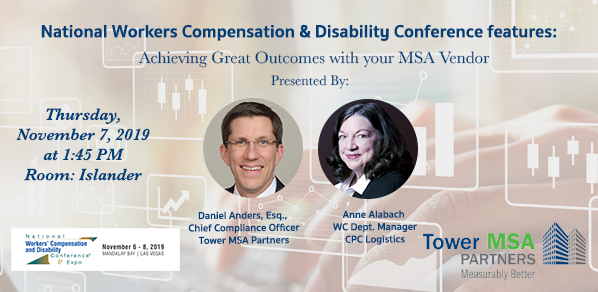
Here’s another great reason to go to NWCDC this year.  Tower’s Chief Compliance Officer Dan Anders and Anne Alabach, Workers’ Compensation Department Manager for CPC Logistics, will discuss the art of partnering for optimal MSA outcomes.  You may not realize how much your MSA vendor relationship affects MSA allocation amounts and the time it takes to settle and close a claim.  Dan and Anne will give you valuable advice on ways to improve your relationship with your MSA partner and achieve optimal outcomes. 

Plan to attend the session at NWCDC (Nov. 6-8) and visit our Booth #2517 to find out how Tower can help you improve your MSP compliance program.  The conference will be held at Mandalay Bay in Las Vegas and more details can be found at the National Workers Compensation and Disability Conference.

Tower-Sponsored WCI-TV: “Metrics for Success”

August 8, 2019

WCI TV logo for ads on Data analytics

Attending WCI this year? Be sure to watch WCI-TV, which Tower is sponsoring for the 5th year. Representatives from American Airlines, Sedgwick, MedRisk, AMAXX, Safety National, and Tower will share the ways they measure the performance of their programs, including the metrics used and what they do with the results. For details, click here: Workers’ Compensation Experts Will Share Their “Metrics for Success” on Tower MSA Partners’ WCI-TV at WCI2019 #WCI2019.

What Does Generic Lyrica Mean for MSAs?

July 31, 2019

rubber stamp approving a prescription

On July 19, 2019, the Food and Drug Administration (FDA) approved multiple applications for the first generics of Lyrica (pregabalin). This follows the expiration of Pfizer’s patent on Lyrica at the end of June. The generic is expected to be available at pharmacies in the coming weeks.


Lyrica remains FDA approved for the following indications:

  • Diabetic peripheral neuropathy
  • Fibromyalgia
  • Neuropathic pain associated with spinal cord injury
  • Adjunct therapy for the treatment of partial-onset seizures
  • Postherpetic neuralgia

If a claimant is being prescribed Lyrica for any of the above indications and such indication is related to the workers’ compensation injury, then it will be included in the MSA. In workers’ compensation injuries, Lyrica is most frequently prescribed for neck or back pain. For years, CMS considered Lyrica non-Medicare-covered for neck or back pain unless such treatment stemmed from a traumatic spinal cord injury. However, CMS recently expanded its interpretation of what is considered a spinal cord injury, explaining in the updated WCMSA Reference Guide released this past January:


Lyrica is considered acceptable for pricing as a treatment for WCMSAs that include diagnoses related to radiculopathy because radiculopathy is a type of neuropathy related to peripheral nerve impingement caused by injury to the supporting structures of the spinal cord.


As a result, MSAs have included Lyrica more frequently.


Red Book currently prices brand-name Lyrica in the range of at $9.36 to $10.30 per pill depending upon the dosage. The MSA for a person taking Lyrica 50mg three times a day over a 20-year life expectancy would allocate $222,580 for the medication. Red Book shows a generic price range of $7.58 to $8.43 per pill depending on the dosage. While not a significant per-pill decrease, the generic switch over the 20-year life expectancy produces an allocation of $163,728 – a $58,752 reduction. The good news is with multiple manufacturers approved to sell the generic; we expect the per-pill price to drop even further.


Practical Questions


Will CMS automatically allocate the Lyrica in the MSA at the generic price?


As with any medication, including Lyrica, it is important to keep in mind that CMS will not automatically use the generic price when the treatment records and/or prescription history document brand name use. Instead, it must be proven to CMS typically, through prescription payment history, that the claimant has been switched to the generic. One fill documenting the switch to generic should be sufficient.


What is Tower doing for MSA referrals which include brand-name Lyrica?


If the claim prescription history documents brand Lyrica, we will advise you that a generic version of Lyrica has been approved and is or will soon be available.  Tower will show you the price difference between brand and generic and recommend working with the treating physician and your pharmacy benefit manager to make the switch.  If a statement from the treating physician is required to authorize the switch, Tower can obtain it from the physician (although we will still need prescription history documenting at least one fill of the generic).


If the MSA was previously approved by CMS with brand-name Lyrica can it be re-priced to generic?


CMS will not consider an MSA Re-Review or Amended Review based solely upon a prescription medication pricing change. An Amended Review MSA would need to document not only the switch to generic Lyrica but other changes as well, such as a previously allocated medication having been discontinued.


If you have any questions, please contact Tower’s Chief Compliance Officer, Dan Anders, at (888) 331-4941 or daniel.anders@towermsa.com.



NAMSAP Provides Unique Opportunity to Expand Your Medicare Compliance Knowledge

July 29, 2019

banner for 2019 NAMSAP Educational Conference

Through our quarterly webinars and in-person trainings, Tower offers our partners recent and relevant information combined with best practices in Medicare Secondary Payer compliance. However, once a year, a unique opportunity is presented by the National Alliance of Medicare Set-Aside Professionals (NAMSAP) at its educational conference.

This annual conference, which is sponsored by Tower, brings together the best industry minds, including representatives from CMS and its contractors for presentations and discussions on the latest in Medicare compliance. It is designed for professionals who are involved in all aspects or any aspect of MSP compliance, such as, adjusters and managers and claimant and defense attorneys.

A wide spectrum of MSP and MSA topics will be presented, including reimagining the MSA Program, MSP policy activity, the current regulatory environment and recent case law. Notable conference panelists include John Albert, a Senior Technical Advisor from CMS’s Division of MSP Operations, Jim Brady, Program Director of the Benefits Coordination and Recovery Center (BCRC) and Rose Arellano, Director of Outreach Recovery for the Commercial Repayment Center (CRC)

The conference will be held at the recently reopened LIVE! Casino in Baltimore, Maryland, September 18-20. For early registration options and other information, go to NAMSAP.org

We encourage you to attend and expand your knowledge of MSP compliance. If you have any questions about the conference, please contact Dan Anders at daniel.anders@towermsa.com or (888) 331-4941.


METRICS, MSAS & SETTLEMENT STRATEGIES AT WCI2019

July 26, 2019

Tower’s Dan Anders and American Airline’s Kris Sallee will present during two panels at the Workers’ Compensation Institute (WCI) Workers’ Compensation Educational Conference (WCI2019) this year.

Starting at 9 a.m. on Aug. 14, “Optimizing Settlement Outcomes by Measuring and Managing MSA Costs” stresses the importance of determining and using metrics to evaluate and improve your MSA program. The session will be moderated by Michael Stack, CEO of AMAXX, and Kris and Dan will also describe how clinical interventions produce MSAs that balance care, cost, and compliance. Then at 10:15, “Allaying the MSA Fear at Time of Settlement” Ametros CEO Marques Torbert and Structured Settlement Consultant Joe Bornstein join the panel to examine reasons employers and injured workers avoid settling claims.

For more information, see Tower MSA Partners’ Dan Anders to Discuss Metrics for MSAs and Claims Settlement Strategies at WCI 2019.

WCI2019 will be held August 11-14, 2019.

Everything You Wanted To Know About MSAs, But Were Afraid To Ask — Tower Premier Webinar – July 24, 2019 2PM ET

July 2, 2019

banner for 2019 tower msa partners webinar details

Why does CMS do what they do when it comes to MSAs? Many a claims professional and injured worker have probably pondered this question. Well, the wait for answers is over. On July 24, 2019 at 2 pm ET, Tower MSA Partners EVP of Clinical Services Patricia Smith and Chief Compliance Officer Dan Anders host an engaging hour-long webinar discussing all matters MSA.


With over 30 years of MSA experience between them, Pat and Dan will tackle some of the routine and unusual questions that arise when drafting an MSA and submitting it to CMS for approval, like:


  • Do I need an MSA?
  • What documentation is necessary to draft the MSA?
  • What does Medicare-covered or not Medicare-covered mean to the MSA?
  • Is the allocation different if the MSA isn’t submitted to CMS?
  • How are costs of treatment and prescription medication calculated?
  • How is life expectancy calculated and how does a rated age impact this calculation?
  • IMEs, AMEs, PQMEs, UR, and IMRs, oh my. What role do these play in the MSA calculation?
  • Rechargeable vs. non-rechargeable spinal cord stimulator, why does it matter?
  • When can I use an Amended Review?
  • Under what circumstances is a $0 MSA appropriate?


If you want to know more about the how and why of MSAs, this free webinar is for you. And, if there is something about MSAs you’ve always wondered about, ask us! When you click on the registration link below you will not only be able to register, but you can also submit a question to be answered during the webinar.


Hope you can join us on July 24 at 2 pm ET!


Dan Anders


Chief Compliance Officer


Register Here


MSA Amended Reviews Promote Case Closures

June 3, 2019

Signed agreement in foreground, handshake in backgrount to illustrate MSA Amended Reviews Promote Case Closures

Two years ago, CMS rolled out a policy that enabled submission of a new MSA even if an MSA had previously been approved for the same date of injury. The purpose of this “Amended Review” is to provide parties who have not settled the case an opportunity to update the MSA to better reflect the current and future course of medical care. Since its implementation, this policy has allowed many parties in workers’ compensation cases to move forward with a settlement and closure of medicals.

Does your MSA qualify?

CMS provides the following base criteria for an Amended Review:

Where the following criteria are met, CMS will permit a one-time request for re-review in the form of a submission of a new cover letter, all medical documentation related to the settling injury(s)/body part(s) since the previous submission date, the most recent six months of pharmacy records, a consent to release information, and a summary of expected future care.

  • CMS has issued a conditional approval/approved amount at least 12 but no more than 48 months prior,
  • The case has not yet settled as of the date of the request for re-review.
  • Projected care has changed so much that the submitter’s new proposed amount would result in a 10% or $10,000 change (whichever is greater) in CMS’ previously approved amount.

If you think your case may qualify, contact Tower to determine whether current medical records support a change in the MSA. Proper medical documentation is critical to ensuring CMS will agree to the Amended MSA. CMS requires an affirmative statement from a treating physician or physicians confirming the originally allocated treatment or medication has changed or is no longer necessary. The following case study illustrates how it works.

Amended Review Case Study

CMS approved an MSA on 5/7/2015 for $147,483. The parties were unable to settle the workers’ compensation case at that time. Nearly four years later, the parties were again ready to consider settlement, but the 2015 MSA no longer reflected the injured worker’s course of medical care.

A review of recent medical records caused Tower to suspect that a supplemental oxygen delivery system was no longer used and that the injured worker could switch from brand-name Crestor to generic. Tower’s Physician Follow-Up service obtained the treating physician’s signed statement regarding the discontinuation of the oxygen system and the injured worker’s current use of the generic, which enabled us to revise the MSA down to $46,171. It was submitted shortly before the Amended Review deadline and approved by CMS on 5/13/2019 for a $101,312 reduction from the previously approved MSA.

Key Takeaways

CMS will agree to a change in the previously approved MSA amount when the medical documentation supports the change. Since the Amended Review is a one-time opportunity, it is vital to conduct the review well before the deadline and to obtain proper medical documentation to support MSA modifications.

Finally, keep in mind that while the CMS Amended Review policy allows for an MSA that better reflects the current and future course of care, CMS does not require the settling parties to submit a new MSA, even when the criteria are met. Per our understanding of CMS WCMSA rules, the original approved MSA does not expire or otherwise become invalid.

This is another way Tower delivers on its promise of Compliance by the book, closure by the numbers.

Tower MSA Partners will Present 2x at WCI

May 31, 2019

WCI Logo

WCI comes a little earlier this year (August 11-14), so make plans to attend now. Tower will present in two back-to-back sessions on August 14. Starting at 9 a.m., “Optimizing Settlement Outcomes by Measuring and Managing MSA Costs” stresses the importance of determining which metrics to use and how to use them to evaluate and improve your MSA program. Moderated by Michael Stack, CEO of AMAXX, the session features American Airline’s Kris Sallee and Tower’s Chief Compliance Officer Dan Anders who will also describe how clinical interventions produce MSAs that balance care, cost, and compliance.

Then, at 10 a.m., “Allaying the MSA Fear at Time of Settlement” examines reasons employers and injured workers avoid settling claims. Employers anticipate the MSA cost will be too high; injured workers worry that the funds will be too low, or they won’t be able to properly administer the MSA. Marques Torbert, CEO of the professional administration firm Ametros, and Joe Bornstein, a structured settlement consultant with Arcadia Settlements Group, join Kris, Dan, and Michael in a lively discussion of these challenges and their solutions and share case studies that resulted in a win-win for the employer and the injured worker.

For more information and to register for the conference, see https://www.wci360.com/conference/