Tower MSA Partners Premier Webinar: Five MSP Issues That Delay Settlement—and How to Solve Them

September 9, 2026

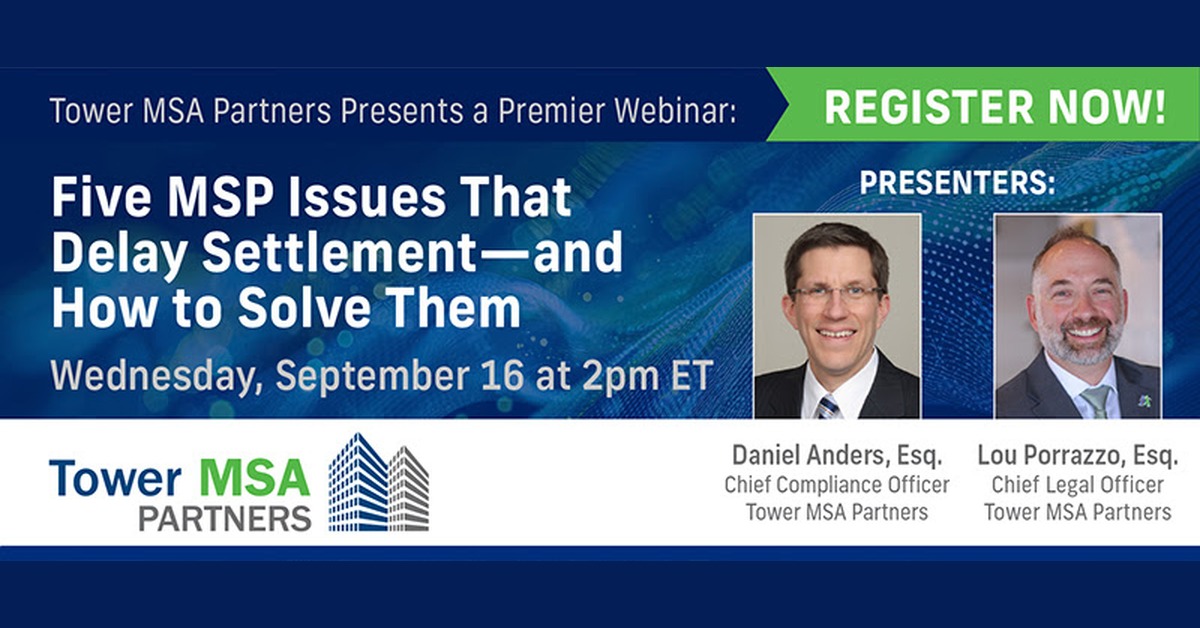
Tower MSA Partners webinar on five MSP issues that delay settlement, featuring Daniel Anders and Lou Porrazzo.

An MSA may be complete, approved, funded, and ready to go, but Medicare issues can still bring a workers’ compensation settlement to a halt.

Section 111 reporting inconsistencies. Unresolved conditional payments. ORM questions. Medicare-related issues that surface late in the process. And, too often, a lack of coordination among the parties.

These issues can turn a settlement that appears ready to close into a claim that sits unresolved for weeks or longer.

Webinar Details

On Wednesday, September 16, at 2:00 p.m. ET, join Tower’s Chief Legal Officer Lou Porrazzo and Chief Compliance Officer Dan Anders for a practical discussion of five MSP-related issues that commonly delay workers’ compensation settlements and what claims professionals can do to identify and resolve them earlier.

During This Webinar, We’ll Discuss

  • Section 111 Reporting Issues: How reporting inconsistencies can create problems at the settlement table and what should be addressed before settlement.
  • Conditional Payments: Why unresolved Medicare conditional payment claims can delay closing and how to resolve them proactively.
  • ORM Issues: How ongoing responsibility for medicals can complicate settlement and what needs to happen before ORM is terminated.
  • Coordination Among the Parties: How disconnects between the carrier, TPA, claimant, attorneys, MSA vendor, and other parties can create avoidable delays.
  • Late-Stage MSP Surprises: The issues that frequently emerge when everyone believes the claim is ready to settle and how to identify them earlier.

Register for the Webinar

A Q&A session will follow the presentation, and you can provide questions ahead of time at registration. Please click the link below and register today!

Register for the Five MSP Issues Webinar

Why Isn’t the Claim Settling? The MSP Issues Beyond the MSA that Can Derail a Settlement

September 2, 2026

By Louis Porrazzo, Esq., Chief Legal Officer, Tower MSA Partners and Claimify

For the past 25 years, the Medicare Set-Aside Arrangement (MSA) has been treated as the crown jewel of Medicare Secondary Payer (MSP) compliance. And rightfully so! An inappropriately high-dollar MSA can derail a settlement, an improperly prepared MSA may not survive review by the Centers for Medicare and Medicaid Services (CMS), and an insufficiently funded MSA can leave the injured worker in a Medicare quagmire.

During that same timeframe, the industry has become reasonably proficient at ensuring that an MSA is appropriately calculated, that an MSA submitted to Medicare has a strong likelihood of approval near the submitted amount, and that the MSA is properly funded and administered.

And yet, parties still routinely encounter MSP-related issues that prevent or delay settlement.  Even when an MSA has been prepared, submitted, approved or indemnified, and funding and administration have been arranged, the parties still carry ongoing MSP obligations that must be met.

Improper Section111 reporting, failure to properly address conditional payments, and inconsistent claim information can derail a settlement at the eleventh hour. Individually, each of these issues can be managed without much difficulty. The challenge is that they are rarely identified early enough to be handled as routine compliance work.

MSP compliance must be fully integrated into all aspects of claims handling. If the first meaningful discussion about Medicare occurs during settlement negotiations, the parties are already at a disadvantage.

Here are five MSP-related issues to address before the settlement becomes derailed:

1. Section111 Data is Inconsistent

The handling adjuster is responsible for maintaining accurate claim information, ensuring appropriate ICD codes are used, and paying only for treatment and services for which the payer is responsible. Defense counsel may be litigating the accepted body parts, correct date of injury, causal relationship, and other aspects of the claim. And some organizations have entire departments or outside vendors dedicated to Medicare reporting. Their efforts should be aligned. Too often, they are not.

Dates of injury, ICD codes, ORM (Ongoing Responsibility for Medicals) status and termination dates, TPOC (Total Payment Obligation to the Claimant) information, and other reporting data should accurately reflect the claim being settled. This has become even more important as CMS has expanded Section111 reporting requirements to include WCMSA information and increased its focus on reporting timeliness and accuracy. CMS began quarterly Section 111 reporting audits in the first quarter of 2026, sampling accepted records and assessing civil money penalties where ORM assumption or TPOC was reported outside the required timeframe. Reporting data that was merely untidy a year ago now carries a direct financial consequence.

Inconsistent data can create significant problems. Multiple Medicare records may be established or associated with a claim, potentially triggering unnecessary recovery activity. Inaccurate information can complicate settlement documentation and reporting. And improper coding may cause confusion regarding which injuries and medical treatment are actually related to the workers’ compensation claim.

Before the parties settle, they should ensure that what is reported under Section111 matches the claim that is about to close.

2. Ambiguity Surrounding ORM

When an accepted workers’ compensation claim is settled and the payer’s responsibility for medical treatment ends, ORM generally needs to be terminated, and applicable TPOC information reported under Section 111. The key question is whether ORM should have been accepted in the first place.

  • When did responsibility for medical treatment begin?
  • Was it ever accepted or denied?
  • Does it remain open?
  • Is there a legitimate basis for terminating ORM?
  • If so, when should the termination be reported?

These decisions should not be made automatically simply because a claim is established at the front end or the claim is settling on the back end. Inaccurately accepting ORM can create problems beyond Section111 reporting itself, including unnecessary conditional payment recovery efforts and confusion regarding accepted injuries.

Settlement is a good time to review Section111 and ORM activities, but it should not be the first time these questions are asked.

3. Forgotten Conditional Payments

Far too often, conditional payments are an afterthought.  The industry has become very good at knowing how to prepare an MSA, how to obtain approval when submission is appropriate, how to fund it, and how to administer it.  But conditional payments still go unaddressed until the last minute. 

CMS may seek reimbursement for payments it believes are related to the workers’ compensation claim, including charges that the payer believes are unrelated or otherwise not their responsibility. Failing to investigate and address those payments early can lead to unnecessary reimbursement demands and delays in bringing the claim to final resolution.

Organizations can save money by addressing conditional payments in a timely fashion. Just as importantly, accurate Section 111 reporting and proper conditional payment resolution can reduce confusion over responsibility for medical treatment. These issues can usually be resolved, but resolution takes time.  A conditional payment issue discovered months before settlement is a compliance task. The same issue discovered days before settlement can become a settlement problem.

4. When Everyone Owns MSP Compliance, No One Does

It is important for all parties to align on MSP-related activities and expectations.  The adjuster and defense attorney should be in lockstep when it comes to handling the MSA, conditional payments or Section 111 questions.  Both parties should have a working relationship with the MSP vendor of choice.  And the claimant’s counsel should understand their obligations in denied workers’ compensation cases.

MSP compliance involves multiple interconnected obligations, and treating each one as an independent transaction creates opportunities for things to be missed. Each party should know which tasks belong to them. Before settlement discussions begin, parties should understand:

  • What is accepted and what remains denied or disputed?
  • Is the claimant Medicare eligible or reasonably expected to become Medicare eligible?
  • Is §111 reporting accurate, including ORM status?
  • Who is responsible for resolving conditional payments?
  • What is the strategy for MSA preparation, funding, and administration?
  • If an MSA is appropriate, will the parties pursue CMS submission or utilize another risk-management approach such as indemnification?

While different people will be handling different aspects of MSP compliance, it is important to have one person or department leading the charge and bringing all parties together to ensure MSP compliance.

5. MSP Protocol vs. “Getting an MSA”

Every entity should have a defined MSP protocol in place to ensure compliance. The mindset should shift from “getting an MSA” to “complete MSP compliance.” Any settlement strategy should include Medicare from the beginning.

Is there a discrepancy in treatment? Address it during claims handling so it doesn’t become an issue at settlement.

Is the case denied? Do not automatically assume that ORM should be reported. Analyze whether responsibility for medical treatment has actually been accepted and report accordingly.

Is the claimant treating body parts unrelated to the injury? Do not pay for that treatment. Those payments can inflate the MSA and complicate CMS approval.

By the time everyone has agreed on a settlement number, expectations have been created and momentum matters. An unexpected Medicare issue at that stage does more than increase costs. It can destroy that momentum and prevent the settlement from closing.

Final Thoughts

MSP compliance should be built into the overall claims strategy from the beginning. Section 111 reporting, conditional payments, future medical exposure, and settlement all intersect, and problems in one area can quickly affect another. A well-defined MSP protocol gives the parties an opportunity to identify and resolve those issues while there is still time to keep the claim moving toward settlement.

The best time to discover a Medicare problem is when there is still time to do something about it. When the claimant wants to settle, counsel agrees to settlement terms, the adjuster has authority, and the MSA is complete, the last thing anyone wants to hear is “We still have a Medicare issue.” A well-built MSP Protocol is what keeps that sentence out of the room.

On Wednesday, September 16, at 2:00 p.m. ET, join Tower’s Chief Legal Officer, Lou Porrazzo, and Tower’s Chief Compliance Officer, Dan Anders, for a practical discussion of five MSP-related issues that commonly delay workers’ compensation settlements and what claims professionals can do to identify and resolve them earlier.

Register for the webinar today!

Frequently Asked Questions About MSP Issues That Delay Settlement

Why do workers’ compensation settlements get delayed by Medicare issues?

Most delays come from issues outside the Medicare Set-Aside itself. Inconsistent Section 111 data, unresolved conditional payments, and unclear ORM status surface late in negotiations, when the parties have already agreed on a number and have no time to fix them.

What Section 111 data should be verified before settlement?

Confirm that the date of injury, ICD codes, ORM status and termination date, and TPOC information all match the claim being settled. Since April 2025, WCMSA amounts must also be reported. Mismatched data can trigger duplicate Medicare records and unnecessary recovery activity.

When should ORM be terminated on a workers’ compensation claim?

ORM generally terminates when the payer’s responsibility for medical treatment ends, which usually coincides with settlement. The more important question is whether ORM should have been accepted in the first place, because accepting it in error creates conditional payment exposure that did not need to exist.

Who is responsible for resolving conditional payments in a settlement?

Responsibility should be assigned explicitly before settlement discussions begin, typically to the adjuster, defense counsel, or the MSP vendor. When no one owns it, conditional payments surface days before closing, at which point they become a settlement problem rather than a compliance task.

Does an approved MSA mean the claim is MSP compliant?

No. An approved and funded MSA addresses future medical exposure only. Section 111 reporting accuracy, ORM status, and conditional payment resolution are separate obligations that continue independently and can hold up a settlement on their own.

Louis Porrazzo, Esq. serves as Chief Legal Officer for Tower MSA Partners. A recognized authority on Medicare Secondary Payer (MSP) compliance, Lou is a frequent national speaker and author known for translating complex Medicare compliance issues into practical strategies for claims professionals, attorneys, insurers, and self-insured organizations. He is licensed to practice law in the Commonwealth of Massachusetts and brings extensive experience in MSP compliance, workers’ compensation, and general liability defense. Outside of his professional work, Lou chairs the Kids’ Chance of Massachusetts Fundraising Committee and is a CrossFit Level 2 Certified Trainer. He can be reached at Louis.Porrazzo@TowerMSA.com.
How Pre-MSA Triage Prevented $774K in Unnecessary Costs

November 4, 2025

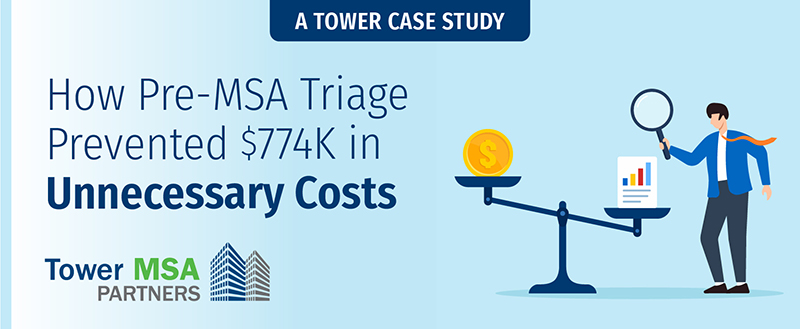
Image of Tower MSA Partners Why Case Studies Matter series: Blog 2 How Pre-MSA Triage Prevented $774K in Unnecessary Costs

In Tower MSA Partners’ recent blog post, “Why Case Studies Matter: Real-World Proof of MSA Savings,” we introduced this 12-month series demonstrating how Tower MSA Partners turns complex Medicare Set-Aside challenges into measurable savings and compliance wins.

Now, we’re diving into one of the most overlooked, and powerful, steps in the process: Pre-MSA Triage.

Before an MSA is ever submitted to CMS, Tower’s clinical and compliance teams perform an in-depth review that identifies unnecessary treatments, outdated medications, and questionable recommendations that inflate costs.

This early intervention isn’t just smart, it’s transformative. In one recent case, it prevented $774,000 in unnecessary costs before an MSA ever reached submission.

The Challenge: When “Wait and See” Becomes Expensive

For many payers, MSA management doesn’t begin until after a settlement is nearly complete. By then, most treatment plans and prescriptions have been in place for years, leaving little room to make meaningful changes.

Unfortunately, waiting too long can cause costs to spiral. We often see:

  • Outdated medical regimens that no longer reflect the claimant’s current condition
  • Duplicate or overlapping treatments prescribed by multiple providers
  • Inconsistent medical documentation that increases CMS scrutiny
  • Unnecessary or long-term opioid use that drives future cost projections

When these red flags go unaddressed, the resulting MSA can balloon to unrealistic levels, delaying settlements and unnecessarily tying up reserves.

Pre-MSA Triage changes that narrative.

Tower’s Approach: The Power of Early Insight

At Tower MSA Partners, Pre-MSA Triage is a strategic intervention process led by clinicians, compliance specialists, and pharmacists working collaboratively.

Here’s how it works:

  1. Early Case Identification
    As soon as a claim is identified as a settlement candidate, Tower’s team reviews the medical and pharmacy history to identify risk factors likely to inflate MSA costs.  This includes duplicative and open-ended medications.
  2. Clinical Analysis & Pre-MSA Triage Report
    A clinical expert examines treatment appropriateness, drug utilization, and long-term projections and provides a Pre-MSA Triage report.
  3. Claimant & Provider Communication
    Tower facilitates direct communication with physicians to update treatment plans, discontinue unnecessary therapies, or substitute safer, more cost-effective options.
  4. Final MSA Report
    These clinical changes are incorporated into the full MSA report.   The report gives adjusters and settlement teams actionable insights, providing a roadmap for CMS MSA submission and approval and settlement.

This proactive approach ensures that MSA allocations reflect actual, reasonable future medical needs, not inflated or outdated care plans.

Real-World Results: $774,000 Saved Before Submission

In one case, Tower MSA Partners was engaged to evaluate a complex workers’ compensation claim that had been open for years.

The initial Pre-MSA projection exceeded $900,000 due to:

  • High-cost brand-name medications
  • Redundant pain management treatments
  • Ongoing prescriptions that no longer matched clinical reality

Through Pre-MSA Triage, Tower’s team:

  • Identified outdated prescriptions no longer medically necessary
  • Coordinated with the treating physician to adjust the regimen
  • Applied evidence-based medical guidelines to revalidate care
  • Recalculated the MSA using corrected medical data

The result? A $774,000 reduction in projected future medical costs — achieved before the MSA was ever submitted.

The claim settled smoothly, with full CMS compliance and no delays.

This outcome demonstrates the power of collaboration, early action, and data-driven oversight. It also illustrates why Pre-MSA Triage is one of the most effective tools for balancing cost containment with patient care.

Lessons for Claims Professionals

The takeaway for insurers, TPAs, and self-insured employers is clear:
the earlier you intervene, the more control you have, both financially and clinically.

Key lessons include:

  • Start early. Integrating Pre-MSA Triage into claims workflows helps identify and correct costly issues before they compound.
  • Use clinical expertise. Medical professionals provide the insight needed to align treatment with guidelines and compliance requirements.
  • Collaborate often. Open communication among payers, providers, and Tower’s team ensures settlements move forward efficiently.
  • Document everything. A clear, defensible record of intervention builds confidence with CMS reviewers and reduces the risk of rejections or delays.

By applying these principles, payers gain greater control over outcomes, not just cost savings, but also improved accuracy, defensibility, and claimant satisfaction.

What’s Next: The Power of Peer Review

Pre-MSA Triage sets the stage for the next layer of cost containment, Physician Peer Review.

In our upcoming blog, “$1 Million Saved with Physician Peer Review: Here’s How,” we’ll explore how Tower’s network of medical specialists helped identify excessive treatment recommendations and achieve over $1 million in verified savings while maintaining full CMS compliance.

Stay tuned to see how medical oversight continues to transform outcomes for complex claims.

The Takeaway

Pre-MSA Triage isn’t just an optional step, it’s the foundation of effective MSA management.

By identifying risks early, Tower MSA Partners helps clients avoid inflated settlements, streamline CMS submissions, and achieve measurable cost reductions.

Each case tells a story of strategic collaboration and clinical excellence, and this $774K success is just the beginning.

Frequently Asked Questions

What is Pre-MSA Triage?

An early review that identifies outdated treatments and medications before an MSA is created.

Why does timing matter?

Starting early prevents inflated projections and costly surprises at settlement.

How does Pre-MSA Triage lower costs?

By removing unnecessary therapies and correcting medical or pharmacy issues that drive MSA totals up.

Do you contact treating physicians?

Yes, Tower works with providers to update treatment plans and discontinue unnecessary care.

Does this improve CMS approval?

Yes, cleaner medical records and updated care plans lead to smoother CMS submissions.

Is this only for big claims?

No, both routine and complex claims benefit from early clinical review.

How much can it save?

Savings vary, but reductions like the recent $774,000 example are common when outdated care is corrected.

Is this the same as Physician Peer Review?

No, Peer Review is the next level of clinical oversight used when specialty input is needed.

Why is Pre-MSA Triage important?

It sets the foundation for accurate, defensible, and cost-effective MSA outcomes.


Why Case Studies Matter: Real-World Proof of MSA Savings

October 7, 2025

Image of Tower MSA Partners Why Case Studies Matter series: Blog 1 Real-World Proof of MSA Cost Savings.

While Medicare Set-Asides (MSAs) are essential for compliance in certain workers’ compensation settlements, they can also lead to inflated costs if not carefully managed. Without proper oversight, unnecessary treatments, duplicate services, or overly conservative assumptions can cause MSA totals to rise dramatically. These inflated amounts not only delay settlements but also tie up resources that could be better used elsewhere.

At Tower MSA Partners, we help insurers, self-insured employers, and third-party administrators (TPAs) navigate this complex process with precision and cost control, ensuring settlements are compliant, efficient, and fair.

This kickoff blog launches a 12-month series of real-world case studies demonstrating how proactive strategies, clinical expertise, and deep regulatory knowledge deliver measurable savings and smoother claim resolutions.

Common MSA Challenges

For many claims professionals, MSAs can feel like a “black box.” The process often seems like paperwork sent off to CMS, followed by a waiting game for approval. This lack of transparency can lead to missed opportunities for cost savings and compliance improvements.

Here are a few recurring challenges we see: – Unnecessary treatments or duplicate costs included in MSA submissions – – inconsistent and contradictory treatment patterns – Lack of early intervention to address treatment plans before they escalate – Missed opportunities to optimize claims for both cost control and compliance

These issues affect everyone involved—from injured workers to payers. Through detailed case studies, this series will show how a strategic, proactive approach prevents these challenges and leads to better settlement outcomes.

Real Savings, Real Impact

The strength of this series is in real numbers and real results. In the coming months, we’ll highlight outcomes such as: – $774,000 saved by identifying and resolving issues before MSA submission – $1 million saved through a physician peer review that corrected unnecessary treatment recommendations – $98,000 saved with a second-opinion MSA review before finalizing settlement

These results represent actual cases handled by Tower MSA Partners. They demonstrate how compliance and cost containment can work together to protect Medicare’s interests while avoiding overfunding.


Why Case Studies Matter

Every claim is unique, yet the challenges surrounding MSAs are surprisingly consistent across the industry. Factors like rising medical costs, evolving CMS guidelines, and the push to close claims quickly create a complex balancing act.

Through these case studies, Tower MSA Partners aims to: – Improve the quality and defensibility of MSA submissions – Speed up settlements by eliminating preventable delays – Lower claim costs without compromising care – Provide clarity and confidence for claims professionals handling complex cases

When payers understand why certain costs are included and how they can be managed, they make smarter, more informed decisions that benefit their organization and the injured workers they serve.

What’s Ahead in the Series

Each month, we’ll release new content focusing on a specific area of MSA management, including: – Early Intervention Strategies – Preventing inflated costs before an MSA is created – Physician Peer Review – Validating treatment plans and prescriptions – Compliance Best Practices – Reducing the risk of CMS penalties and rejections – Ongoing Claim Management – Preventing cost creep over time – Legacy Claim Resolution – Closing backlogged claims to free reserves and improve efficiency – Case Optimization and Review – Streamlining processes to improve accuracy and outcomes

The series will conclude with a Top 10 Lessons Learned wrap-up blog summarizing a year’s worth of data and insights for claims professionals and legal teams.

The Takeaway

MSAs don’t have to be overwhelming or overly expensive. With the right approach, organizations can achieve compliance, control costs, and resolve claims efficiently. This series will provide real-world proof of how Tower MSA Partners helps clients reach these goals, step by step.

Stay tuned for our first in-depth case study, where we’ll explore how early intervention prevented nearly $800,000 in unnecessary costs and paved the way for a smooth, compliant settlement.

Frequently Asked Questions

What causes Medicare Set-Asides to become inflated?

Inflated MSAs often come from unnecessary treatments, duplicate services, outdated prescriptions, or conservative medical assumptions that were never updated.

Why do MSA case studies matter?

They show real savings and real outcomes so payers can understand how proactive MSA strategies improve accuracy, compliance, and cost control.

What are the most common challenges in MSA preparation?

Unnecessary care, inconsistent documentation, lack of early intervention, and missed opportunities to correct treatment plans.

How does Tower MSA Partners reduce MSA costs?

Through early clinical review, pharmacy analysis, physician communication, and regulatory expertise that remove unnecessary or inaccurate costs.

Who benefits from proactive MSA management?

Claims adjusters, TPAs, self-insured employers, risk managers, and injured workers all benefit through faster, cleaner, and more cost-effective settlements.

How much can proactive MSA strategies save?

Savings vary, but real cases show reductions such as $774,000 saved before MSA submission and $1 million saved via physician peer review.

Does improving MSA accuracy slow down settlements?

No. Addressing medical and documentation issues early creates smoother CMS approvals and eliminates preventable delays.

What topics will this 12-month case study series cover?

Early intervention, physician peer review, compliance best practices, legacy claim resolution, and prevention of medical cost creep.

How does this series help claims professionals?

It provides transparent examples, clearer processes, and actionable steps for improving accuracy, compliance, and settlement outcomes.


Premier Webinar: Easy MSA Cost Savings Through Structured Settlements

May 18, 2023

Tower MSA Partners webinar on structured settlements for Medicare Set-Asides cost savings and compliance.

One of the easiest ways to lower the settlement cost is through a structured Medicare Set-Aside. Not only does this reduce the payer’s cost of funding the MSA, but it also provides the injured worker a consistent stream of funds for injury-related medical care over their lifetime.

 On June 7 at 2 pm (EDT) Tower will present an informative session on structured settlements for MSAs. Tower’s Chief Compliance Officer will moderate a special guest panel from Arcadia: Alisa Hofmann, Vice President – Workers’ Compensation and Medicare Practices and Lori Vaughn, Director of Arcadia Client Programs. This hour-long webinar will show how structured MSAs can benefit all stakeholders in a settlement – the injured party, Medicare and the insurance carrier or employer.

Attendees will learn:

  • How to work with a structured settlement provider to incorporate an MSA structure into settlement.
  • The methodology CMS uses to calculate a structured MSA.
  • Rules around converting a CMS-approved lump sum MSA into a structured MSA.
  • The role of a structured settlement broker pre-settlement, during settlement negotiations and post-settlement.

A Q&A session will follow the presentation, and you can provide questions you’d like to have answered when you register. Please click the link below and register today!

Please note that there is no CEU credit offered for this webinar.

Register here.

About Alisa Hofmann:

Alisa is the Vice President of Workers’ Compensation and Medicare Practices at Arcadia Settlements Group and currently works on the Business Development team. She has been handling and overseeing Workers’ Compensation claims for almost three decades with various national carriers.  Alisa obtained her BA in Organizational Communication at Otterbein University. She maintains her adjuster licensing in many states, also holds Life, Health, and Accident Licensing, and many Insurance Accreditations. Alisa has been an active member of the National Structured Settlement Trade Association since 2019, and a member of The MSP Network where she serves on the Professional Administration and Structure-Education Committee.

About Lori Vaughn:

Lori Vaughn has 15+ years of experience in the structured settlement industry and currently oversees structured settlement programs for multiple workers’ compensation and private insurance carrier clients. She leads teams of consultants, case managers, and corporate employees, and is the primary point of contact for the corporate management team for each client. Lori obtained her BS in Kinesiology from California State University, Fresno, and her MS in Kinesiology from California Baptist University. She holds her Life, Health, and Accident licenses in many states and is a member of the National Structured Settlements Trade Association.

Tower’s Dan Anders Reviews MSP Policies and Predicts 2022 Actions

January 20, 2022

Dan Anders reviews MSP policy updates and Medicare Set-Aside trends in this article

WorkersCompensation.com’s Nancy Grover captured the thoughts of Tower MSA Partners Chief Compliance Officer Dan Anders on a variety of Medicare Secondary Payer and Medicare Set-Aside issues from 2021 and 2022 in a recent article.

WorkersCompensation.com Features Dan Anders on MSP Policy Updates

The article reviews several important MSP and MSA developments. MSAs cost less than many stakeholders think, opioid allocations are down, and the PAID Act makes obtaining Medicare Advantage Plan data easier.

Key Medicare Secondary Payer and MSA Issues Reviewed

The article also notes that the Centers for Medicare & Medicaid Services said MSAs that are not approved by CMS could be viewed as “a potential attempt to shift financial burden” to Medicare.

Read the Full WorkersCompensation.com Article

The article, “MSA Policy Updates, Changes Likely in Store for 2022, Expert Predicts,” can be read here. Remember it’s just a one-time process of subscribing to this free section of Workerscompensation.com.