CMS Updates Section 111 Model Language Form

April 26, 2021

Man signing a document to illustrate CMS updates to Section 111 Model Language Form

Recently, the Section 111 Model Language form was updated by the Centers for Medicare and Medicaid Services (CMS), The form is used by Responsible Reporting Entities (RREs) to collect the Medicare Beneficiary Identifier (MBI) and/or a Social Security Number (SSN) from claimants.  The SSN or MBI, along with the claimant’s First and Last Name, Gender, and Date of Birth, are needed by the RRE to query CMS to determine whether the claimant is a Medicare beneficiary for Section 111 Mandatory Insurer Reporting purposes.

The most notable change to the form is that the Section I language was revised from “Are you presently, or have you ever been, enrolled in Medicare Part A or Part B?” to “Are you presently, or have you ever been, enrolled in Medicare?” We assume this language was modified because the claimant’s enrollment in Parts A, B, or C (which isn’t even mentioned) is irrelevant for purposes of Section 111 reporting. The simpler language, just asking for Medicare enrollment status, should avoid confusion that may have arisen from the prior language.

Practical Implications of the Section 111 Model Language form

As we wait for CMS to issue final rules around mandatory insurer reporting penalties, it is important for RREs and those administering claims for RREs to collect this identifying information or document their efforts to collect it by using this model language.  As we discussed in CMS Issues Proposed Rule for Mandatory Insurer Reporting Penalties, RREs will have a safe harbor from reporting penalties if they document good faith efforts to attempt to obtain an MBI or SSN from the claimant, and this model form will help document those efforts.

Please contact Dan Anders at Daniel.anders@towermsa.com or (888) 331-4941 with comments or questions.

Related Posts

Section 111 Reporting

Dan Anders in WorkCompWire: Avoiding Section 111 Reporting Penalties


CMS Section 111 Mandatory Insurer Reporting Webinar Recap

April 7, 2021

man on keyboard for Section 111 Mandatory Insurer Reporting

Leaders from the Centers for Medicaid and Medicare Services (CMS) Division of MSP Program Operations, Commercial Repayment Center (CRC), and Benefits Coordination and Recovery Center (BCRC) held an April 1 webinar on the intersection of the BCRC and CRC in Section 111 Mandatory Insurer Reporting and the resolution of Medicare conditional payments.

While mostly a Q&A format, the webinar unveiled a new CMS/BCRC policy for reporting partial settlement of medical when Ongoing Responsibility for Medical (ORM) ends for certain diagnoses and continues for others. Set to rollout in June, the new reporting policy provides for three scenarios:

  • Partial settlement of medical prior to initial reporting

Scenario:  Claimant is identified as a Medicare beneficiary which triggers the requirement to report ORM and/or Total Payment Obligation to the Claimant (TPOC) through the Section 111 reporting process.  Both ORM and TPOC are for the same insurance type, policy, and claim number.  The only difference is the accepted and denied diagnoses on the claim.  The parties agree to a partial settlement for the denied diagnoses and leave the accepted diagnoses open on the claim.

Problem:  How to report a partial settlement of the denied diagnoses and still report ORM for the accepted diagnoses.

 CMS Solution:  CMS’s solution is to submit two add records. Specifically, one record will be added for ORM that will describe all of the diagnoses that have been accepted for ORM.  ORM will be ‘Y’ with no TPOC date or amounts.  A second record will be added for TPOC which will describe all of the denied diagnoses that are being settled.  ORM will be ‘N’ with a TPOC date and amount.

  • Partial settlement of medical post initial reporting

Scenario:  A claim with multiple diagnoses was reported for ORM through the Section 111 Mandatory Insurer Reporting process.  The parties agree to a settlement for certain diagnoses while keeping ORM open for other diagnoses.

Problem:  How to report a partial settlement for certain diagnoses while keeping ORM open for the non-settled diagnoses.

CMS Solution:  CMS’s solution is to submit one update record and one add record.  The update record will remove the diagnoses that are subject to the partial settlement and keep the diagnoses codes where ORM continues.  Then, an add record with the TPOC date, amount and diagnoses codes that are subject to the partial settlement will be submitted.  ORM will remain “N” in the add record.

  • Partial ORM closure with no settlement

Scenario:  Acceptance of ORM is initially reported though the Section 111 Mandatory Insurer Reporting process with multiple diagnoses.  Subsequent to this initial report, there is a basis to terminate one or more of the initially accepted diagnoses, but not all of the diagnoses.  This is not a situation where a partial settlement has occurred, rather there is a basis to terminate one or more diagnoses absent a settlement.  For example, a claimant’s cardiac condition was exacerbated as a result of a fall and the medical providers confirm resolution of the exacerbation. While the carrier continues to accept the orthopedic condition, the ORM can end for the cardiac diagnosis.

Problem:  How to end ORM for one or more diagnoses while keeping it open for other diagnoses.

CMS Solution:  CMS’s solution is to send an update record that removes the diagnosis or diagnoses where ORM has ended. In this situation a TPOC date is not submitted, rather this is only submitted when ORM is completely terminated for all diagnoses.

The purpose behind these new policies is to improve coordination of benefits such that a Medicare beneficiary’s medical care is not denied when unrelated to a claim and prevent the recovery contractors from attempting to seek reimbursement for Medicare payments unrelated to a claim.

While we thank CMS and the BCRC for identifying solutions to the above reporting problems, we believe RREs may face some technical challenges in the ability to, for example, report two add records on the same claim.  We await issuance of the formal policy from CMS and will review how this policy change can best be incorporated into the Section 111 reporting process.

In addition to announcing the new reporting policy, CMS and the contractors provided the following advice:

Respond to correct contractor – Carefully review the correspondence and make sure to respond to the contractor that sent the letter, whether it’s to obtain further information, dispute/appeal charges, or to make payment.

As a reminder, CMS noted, the BCRC is generally recovering conditional payments when the identified debtor is the Medicare beneficiary while the CRC is recovering conditional payments when the insurer/WC carrier is the identified debtor.

CMS provided the following guidance regarding key timeframes:

  • Interest accrues from the date of the demand letter and is assessed on debt if not resolved within 60 days.
    • When CMS issues a demand letter directly to the applicable plan, the applicable plan has formal administrative appeal rights.
    • The applicable plan has 120 days from the date the applicable plan receives the demand letter to file a redetermination (first level of appeal). Interest will still accrue during this time.
    • If the appeal is not filed within 120 days, and “good cause” for untimely filing is not provided, the appeal will be dismissed.
    • Failure to resolve the debt will result in referral to treasury at 180 days.

Note:  When you are appealing to the ALJ please be sure to cc the CRC so that they can appropriately place a hold on a case so that it is not referred to treasury while the appeal is in process.

During the Q&A portion of the webinar CMS and its contractors addressed varied questions; some are summarized below:

  • What can be done if we cannot obtain a Social Security number from the claimant? CMS advised them to document their efforts at obtaining the SSN.  It was noted CMS has model language found on the CMS website which can be used to document claimant’s refusal to provide SSN.
  • In response to a question concerning the many charges found on conditional payment notices and demands that are unrelated to the injury, CMS/CRC acknowledged that it is not a perfect process. The CRC explained that when conditional payment information is requested what is sent to the requestor may have only been produced through an automated search of charges related to the injury.  CRC did advise that when it comes to actual issuance of a demand that there is a human validating process.
  • In response to a question concerning why in response to a dispute of a Conditional Payment Notice, one might receive another CPN with new charges, the CRC explained that this is the result of the system constantly reviewing for additional charges deemed related to the injury.
  • There were several questions regarding problems with the CRC recognizing out-of-pocket reimbursements to claimants in a no-fault/med-pay claim as counting towards the exhaustion of the no-fault maximum amount. CRC’s response was to advise entities to provide plan documents and proof of payment to the claimant along with a reason for the payment.  Its leader said, “We are aware that no-fault payors have run into problems with CRC rejecting out-of-pocket expenses as included within the no-fault exhaustion amount.”

If you have any questions, please contact Tower’s Chief Compliance Officer, Dan Anders, at daniel.anders@towermsa.com or 888.331.4941.

Related prior posts:

CMS RELEASES TECHNICAL UPDATES TO SECTION 111 USER GUIDE

Tower MSA Partners Ready to Steer Clients Through Pending Section 111 Civil Money Penalties

April 1, 2021

View from Dashboard over highway to illustrate Section 111 Civil Money Post

Last year the Centers for Medicare and Medicaid Services (CMS) proposed regulations on Section 111 civil money penalties (CMPs). See Tower MSA Partners’ detailed prior post, CMS issues Proposed Rule for Mandatory Insurer Reporting Penalties related to inaccurate or untimely Section 111 Medicare Mandatory Insurer Reporting. Some of these are shocking – up to $1,000 per day per claimant in some cases.  Tower and others in the Medicare Secondary Payer (MSP) industry collaborated on comments to CMS’s proposal.

Then, Tower went well beyond simply responding to CMS.  We took proactive measures to prepare our clients for the eventual penalties. We educated clients with a webinar focused specifically on the subject matter, and we have communicated frequently.

Tower’s proprietary tech tools help prevent Section 111 Civil Money Penalties

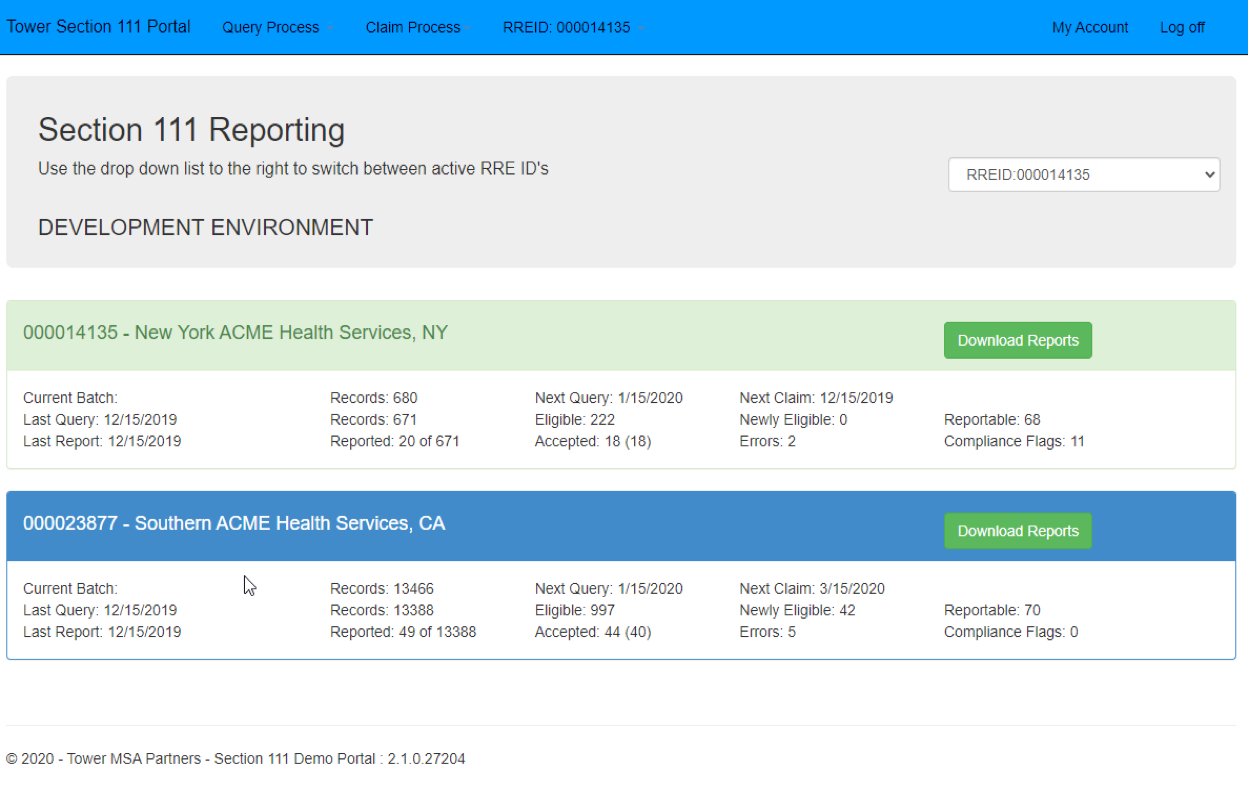
In addition to education and communication, with Tower’s focus on technology to measure, manage and drive results, we built a dashboard to steer our clients through MSP compliance so they can avoid CMPs when they go into effect.  See our news release for details: Tower MSA Partners Releases Medicare Mandatory Reporting Dashboard.

Our S111 Management Dashboard gives you the 24/7 data and reporting oversight for every aspect /of the reporting process.  Workers’ compensation and liability payers usually have limited visibility into claims history through their Section 111 providers’ reporting systems.  They may receive compliance error reports but aren’t able to quickly verify compliance accuracy.  Few systems remind responsible reporting entities to update the ongoing responsibility for medicals (ORM) termination dates when claims are settled.

The dashboard gives clients full visibility into their claims from a global level all the way down into the details of a specific claim.  You can manage the accuracy of data, such as ICD 10 codes or ORM to avoid unnecessary conditional payment or MSA exposure in addition to avoiding CMPs.

“The dashboard is intuitive and simple to use,” said Todd Venneri, Business Intelligence Project Manager for BETA Healthcare Group, who tested its features. “The ability to quickly access and verify claim information is invaluable.”

While our intuitive S111 Management Dashboard was being developed, we also updated our client portal and MSP Automation Suite. Keep in mind, Tower’s system was built specifically by us for this industry.  It seamlessly manages Section 111 reporting, conditional payments, Medicare Set-Aside triage, clinical and legal interventions, MSA preparation, and CMS submission activities that take clients through settlement and closure.

We don’t know when CMPs will be announced or how Section 111 civil money penalties will be assessed.  What we do know, however, is that our clear, concise dashboard has replaced uncertainty with knowledge and information.

We are ready and we want you to be ready, too.  If you have not used the dashboard yet, take it for a spin.  Get in touch with Hany Abdelsayed at hany.abdelsayed@towermsa.com or 916-878-8062 for a demo.

CMS Releases Technical Updates to Section 111 User Guide

January 26, 2021

Tower MSA Partners explains CMS updates to ORM and NOINJ rules in the Section 111 reporting user guide.

The Centers for Medicare and Medicaid Services (CMS) has begun the new year with some updates to its MMSEA Section 111 NGHP User Guide.  This guide provides everything and anything you ever wanted to know about mandatory insurer reporting by non-group health plans.  Version 6.2 provides the following updates:
 
$750 Reporting Threshold
 
In follow-up to its November 2020 announcement that it will be maintaining the $750 TPOC threshold for reporting and Medicare conditional payment recovery, CMS states:
 
As of January 1, 2021, the threshold for physical trauma-based liability insurance settlements will remain at $750. CMS will maintain the $750 threshold for no-fault insurance and workers’ compensation settlements, where the no-fault insurer or workers’ compensation entity does not otherwise have ongoing responsibility for medicals (Sections 6.4.2, 6.4.3, and 6.4.4).
 
Key takeaway:  Maintaining the $750 threshold means there are no changes to the reporting processes, determinations of claims that should be reported, or when conditional payments should be investigated or resolved.
 
Reporting Future ORM Termination Date
 
Per CMS:
 
To address situations where Responsible Report Entities (RREs) can identify future ORM termination dates based on terms of the insurance contract, RREs can now enter a future Ongoing Responsibility for Medicals (ORM) Termination Date (Field 79) up to 75 years from the current date (Section 6.7.1)
 
Key takeaway:  A future ORM termination date can only be submitted if it is certain, e.g., the date is specified in an insurance contract or a statutory limitation provides for its exact determination. The prior policy only allowed the reporting of an ORM termination date that was six months into the future.  The expansion to 75 years should allow for most date certain ORM terminations to be reported.
 
Data Exchange Update
 
Per CMS:
 
As part of CMS’ commitment to the modernization of the Coordination of Benefits & Recovery (COB&R) operating environment, changes are being implemented to move certain electronic file transfer data exchanges to the CMS Enterprise File Transfer (EFT) protocol. As part of this change the exchange of data with the COB&R program via Connect:Direct to GHINY SNODE will be discontinued. The final cutover is targeted to occur in April 2021. File naming conventions and other references have been updated in this guide. Contact your EDI Representative for details (Sections 10.2 and 10.3).
 
Key takeaway:  Right now, CMS offers four methods of data transmission that Section 111 RREs or their reporting agents can use to submit and receive electronic files.  CMS is discontinuing the Connect:Direct method, and since Tower does not communicate with CMS via this method there will be no impact to our reporting processes.
 
Policy Number Now a Key Field
 
Per CMS:
 
To support previous system changes, Policy Number (Field 54) has been added as a key field. If this field changes, RREs must submit a delete Claim Input File record that matches the previously accepted add record, followed by a new add record with the changed information (i.e., delete/add process) (Sections 6.1.2, 6.6.1, 6.6.2, and 6.6.4).
 
Key takeaway:  Previously, if a claim input file was updated with a different policy number for the same claim it would create two records with the BCRC.  This could duplicate Medicare conditional payment recovery efforts.  CMS’s solution is to have the RRE delete the prior record with the old policy number and add a new record with the new policy number.
 
Retraction of Soft Code Error
 
Per CMS:
 
In Version 6.1, we announced that several input errors will become “soft” errors starting April 5, 2021. However, CP03 will not become a soft edit. The Office Code/Site ID (Field 53), which triggers CP03, is used to identify correspondence addresses, and if incorrect, could result in mail being sent to the wrong place. Therefore this error will continue to reject the record (Appendix F).
 
Key Takeaway:  An error in Office Code/Site ID (Field 53) will not be considered a soft edit and will result in file rejection. An earlier Tower article, November CMS Mandatory Reporting and Conditional Payment Updates, explained these so-called “soft” code errors.
 
If you have any questions on these updates to the Section 111 User Guide, please reach out to Tower’s Chief Compliance Officer, Dan Anders, at daniel.anders@towermsa.com or 888.331.4941.
 

Three Medicare Secondary Payer (MSP) Predictions for 2021

January 14, 2021

rainbow over a highway with the year 2021 painted, illustrating predictions for Medicare Secondary Payer in 2021

We take a look at what’s in the crystal ball for Medicare Secondary Payer (MSP) short-term issues in the year ahead.

This year marks the 20th anniversary of the famous —or infamous, depending on your perspective— “Patel Memo” that formally launched CMS’s Workers’ Compensation Medicare Set-Aside review process.  It was probably safe to assume that a government program like this would still be around two decades later. However, the expansion of CMS’s authority to require mandatory reporting along with stepped up efforts to recover conditional payments by both Medicare and Medicare Advantage plans was less predictable.

I won’t hazard a guess on what Medicare Secondary Payer compliance will be like 20 years from now but will predict the outcomes of some short-term issues.

Liability MSAs

In June 2012 CMS issued an Advanced Notice of Proposed Rulemaking (ANPRM) with ideas as to how Medicare’s interests could be considered in the settlement of future medicals in a liability case.  Ultimately, the ANPRM was withdrawn in October 2014.

Nothing further was heard from CMS management until December 2018 when it indicated proposed rules would be issued in September 2019.  Subsequent notices postponed the date to March 2021.

Prediction:  Since CMS will have new leadership and its attention has turned to vaccine distribution, I suspect we will not see proposed rules on LMSAs this year.  Even if CMS proposes regulations, they would not be implemented until after a comment period followed by revisions, which would likely stretch into 2022.

Section 111 Penalties

On February 18, 2020, CMS issued its proposed regulations specifying how and when it would impose civil money penalties if Non-Group Health Plans fail to meet Section 111 Mandatory Insurer Reporting responsibilities.  A comment period ended on April 20, 2020 (Please see CMP Comments Submitted for Tower’s comments on the proposal).

Prediction:  Since CMS completed the process of releasing the proposed rule and receiving comment and the issuance of this regulation is statutorily required by the SMART Act of 2012 prior to issuing any penalties, I expect the final rule will be issued in 2021.  Once issued, it will likely become effective within 60 days.

PAID Act

On December 11, 2020, President Trump signed into law HR 8900, Further Continuing Appropriations Act, 2021, which included the provisions of the Provide Accurate Information Directly Act or PAID Act.

The PAID Act requires CMS to provide applicable plans (liability insurance, no-fault insurance and workers’ compensation laws or plans) access to Medicare beneficiary enrollment status in Medicare Advantage and Part D Prescription Drug plans through the Section 111 Mandatory Insurer Reporting process. (Please review PAID Act Becomes Law for a full explanation of the law and its implications.)

Prediction:  Per the law, CMS must provide access to Medicare Advantage and Part D plan information by December 11, 2021 (one year from the date of enactment).  As CMS must implement technical changes to the Section 111 reporting platform to provide such access, it may not be ready by that date.

Beyond these three predictions, some issues to watch in the coming year: 

  • Continued trend toward non-submit MSAs
  • More professional administration of MSAs
  • Cases affecting Medicare Advantage plan recovery rights
  • Per proposal from President-elect Biden, lowering of Medicare eligibility age to 60
  • “New” MSA reform legislation

A happy and safe new year to you and your families.

New Section 111 Dashboard Can Help You Avoid Penalties

September 1, 2020

Section 111 Dashboard example

Tower MSA Partners has created an intuitive, easy-to-use Section 111 dashboard to help you avoid CMS’s penalties for non-compliance with Section 111 reporting. Once in effect, the penalties can amount to up to $1,000 per day per claimant for things like failing to accurately ORM and TPOC.

Our new Section 111 dashboard provides 24/7 access to your claims data and reporting oversight for all aspects of the reporting process. It will even remind you to update ORM Term Dates when claims settle. You can run all kinds of reports and correct errors on the fly.

For details, please see the news release: Tower MSA Partners Releases Medicare Mandatory Reporting Dashboard. And, for a quick refresher on CMS’s proposed penalties, see Tower’s Feb. 18 and April 27 posts:

CMS Issues Proposed Rule for Mandatory Insurer Reporting Penalties

CMP Comments Submitted


CMS Releases Updated Section 111 and MSPRP User Guides – Schedules Reporting Webinar

July 17, 2020

Tower MSA Partners explains CMS updates to ORM and NOINJ rules in the Section 111 reporting user guide.

New CMS User Guides released.

The Centers for Medicare and Medicaid Services (CMS) recently released updated user guides for Non-Group Health Plan MMSEA Section 111 Mandatory Insurer Reporting and the Medicare Secondary Payer Recovery Portal (MSPRP).  CMS also just announced an August webinar on Section 111 reporting matters.

CMS User Guides: Updated MMSEA Section 111

On June 29, CMS released Version 5.9 of the NGHP MMSEA Section 111 User Guide.  Highlights of the updated user guide:

  • A reminder has been added that while the threshold for physical trauma-based liability insurance settlements remains at $750, this threshold does not apply to non-trauma liability reporting for alleged ingestion, implantation, or exposure cases. Any settlement, regardless of amount, should be reported for these types of cases. (Sections 6.4.2, 6.4.3, and 6.4.4).
  • The limit dollar amount that triggers a threshold error has been adjusted from $99,999,999 to $99,999,999.99. This error occurs any time the No-Fault Insurance Limit amount or the cumulative value of all reported TPOCs (detailed and auxiliary records) exceed this limit. Additionally, the No-Fault Insurance Limit field number has been corrected under “Exceptions.” (Section 7.3.2).
  • When considering the requirements for the Ongoing Responsibility for Medicals (ORM), remember, per current policy, that the dollar limit for No-Fault Insurance Limits (Field 61) represents a combined total of Med-Pay and Personal Injury Protection (PIP) (Section 6.7.1).
  • When considering the requirements for the Ongoing Responsibility for Medicals (ORM), remember, per current policy, that the dollar limit for No-Fault Insurance Limits (Field 61) represents a combined total of Med-Pay and Personal Injury Protection (PIP) (Appendix A).
  • The CR02 claim response file error code field number has been corrected (Appendix F) (Table F-4).

CMS User Guides: Updated MSPRP

On July 13, CMS released Version 4.9 of its MSPRP User Guide.  The MSPRP is a web-based application which allows authorized users to, among other tasks, investigate, dispute and resolve Medicare conditional payments.  Updates can be found on page 1-1 of the user guide.  Significantly, users can now view and print outgoing correspondence from the MSPRP.  This is correspondence that has been received or letters that have been sent related to a BCRC or CRC case.

Section 111 Reporting Webinar

CMS will be hosting a Section 111 NGHP webinar on August 13, 2020 at 1:00 PM ET.  According to the notice, “the format will be opening remarks by CMS followed by a presentation that will include NGHP reporting best practices and reminders.”  The webinar notice can be found here.

If you have any questions regarding the updates, please contact Dan Anders, Chief Compliance Officer at daniel.anders@towermsa.com or 888.331.4941.

CMS Provides Notices on Section 111 Reporting and Conditional Payment Processes

June 17, 2020

People using laptop and mobile phones to update Section 111 Reporting

CMS has recently issued two notices, one pertaining to mandatory Section 111 reporting and one relevant to Medicare conditional payment recovery.

First, in a “teaser” notice, CMS announced that on July 13, 2020 the Medicare Secondary Payer Recovery Portal (MSPRP) is scheduled to be enhanced to allow authorized users to view and print correspondence.

According to the notice,

MSPRP users who log in using Multi Factor Authentication will be able to view and print CMS mailed correspondence that is displayed on the Letter Activity tab. Additional information on how to use this new functionality will be available in Section 14.1.1.4 of the July version of the MSPRP User Guide.

Second, in an alert entitled “Reporting No-Fault Insurance Limit on Non-Group Health Plan (NGHP) Claim Input Files,” CMS reminds Responsible Reporting Entities (RREs) that they must combine both Med Pay and Personal Injury Protection (PIP) coverage limits for Section 111 reporting purposes.  This would be under circumstances where separate Med Pay and PIP coverages are being paid out on claims for the same injured party and incident under a single policy.

CMS also reminded RREs that ORM cannot be terminated until both Med Pay and PIP coverage limits are exhausted.  Further, that when providing the dollar amount for the policy limit, that it must accurately reflect two decimal places.  For example, a policy limits of $5,000 should be reported as 500000.

Practical Implications

In regard to the MSPRP enhancement to print documents, while we will have to see the specific guidance in the July update, this may prove quite useful in not having to wait for correspondence to come in the mail, print letters that were not received via the mail or reprint letters.

As for the alert to remind No-Fault carriers to report Med Pay and PIP coverage limits as a combined amount, while this guidance is already included in the NGHP User Guide, there was apparently some confusion that led CMS to provide this alert as a reminder of how such coverage must be reported.

If you have any questions, please contact Dan Anders, Chief Compliance Officer at daniel.anders@towermsa.com or 888.331.4941.

Proposed Rules on LMSAs and Section 111 Penalties Again Delayed

November 25, 2019

US Capitol dome

Almost a year ago the U.S. Office of Management and Budget posted two rulemaking notices from the Centers for Medicare and Medicaid Services (CMS) entitled Civil Money Penalties and Medicare Secondary Payer Reporting Requirements and Miscellaneous Medicare Secondary Payer Clarifications and Updates.  Per our understanding, the purpose of this rulemaking is to provide proposals for how and when penalties will be imposed in Section 111 Mandatory Insurer Reporting and for a Liability Medicare Set-Aside review process.

When issued in December 2018, both notices indicated the proposed rules would be issued in September 2019.  Subsequent notices moved the date to October 2019 and we now have notices moving the date for issuing the proposed rule on penalties to December 2019 and for rules on LMSAs to February 2020.

Practical Implications

The lesson here is these are not hard and fast dates as they have already been moved twice and we assume may be moved again.  At some point we expect the proposed rules to be issued which will be followed by comment periods (likely a 60-day period each).  CMS will take public comments under review and then issue final rules with effective dates.  As such, we are looking at a rulemaking process that will stretch well into 2020 and possibly into 2021.

For more background on these rules please read our prior article, CMS Rulemaking Notices Provide Possible Timeline on LMSAs and Reporting Penalties.

If you have any questions, please contact Dan Anders at (888) 331.4941 or daniel.anders@towermsa.com.

Updated Section 111 User Guide Provides for Transition to MBIs, ORM Termination Defined

January 3, 2018

Pursuant to the Medicare Access and CHIP Reauthorization Act (MACRA) of 2015, CMS is required to transition all Medicare beneficiaries from the Social Security Number based Health Insurance Claim Numbers (HICNs) to a new identification number called a Medicare Beneficiary Identifier (MBI). The primary purpose of this initiative is to reduce identify theft associated with use of Social Security Numbers in HICNs.

Accordingly, starting in April 2018 CMS will begin to mail new cards with the new Medicare numbers to Medicare beneficiaries. The goal is to issue all new cards by April 2019. For medical providers, there will be a transition period from 4/1/2018 through 12/31/2019 in which either the HICN or MBI will be accepted for processing of payments by Medicare.

Minimal Impact on Section 111 Reporting

Unlike medical providers which must exclusively use the MBI by 1/1/2020, as explained in the updated Section 111 NGHP User Guide, CMS has exempted its Medicare Secondary Payer Reporting processes from exclusive use of the MBI. Consequently, we can continue to report to CMS using a Social Security Number, a HICN or an MBI. In announcing this policy, CMS indicates it has renamed fields labeled “HICN” to “Medicare ID.”

While allowing for continued reporting of HICNs in its Section 111 reporting processes, CMS states that if an MBI has been issued to the claimant, it will return the MBI in the Section 111 response files. We expect then that while not requiring submission of MBIs, CMS nonetheless expects a natural transition to their use for MSP matters over time.

Medicare Conditional Payment Recovery Correspondence to Include Either HICN or MBI

As part of this update, CMS states that its recovery contractors, the Benefits Coordination and Recovery Center (BCRC) and the Commercial Repayment Center (CRC), will use either an HICN or MBI in its correspondence based upon the most recent information provided by the Responsible Reporting Entity (RRE) when creating or updating the MSP record. Again, we expect a natural transition from use of HICNs to MBIs in correspondence from the recovery contractors over the next few years.

The Tower MSP Automation Suite is fully capable of accepting SSNs, HICNs or MBIs for purposes of Section 111 Mandatory Insurer Reporting.

ORM Termination Defined

In addition to updating its User Guide to address the transition to MBIs, CMS also added language to its Section 111 “Policy Guidance” User Guide specifically defining under what circumstances Ongoing Responsibility for Medical (ORM) may be terminated. The revised Section 6.3.2 states as follows:

6.3.2 ORM Termination

When ORM ends, the RRE should report the date that ORM terminated and should NOT delete the record. Please note that a TPOC amount is not required to report an ORM termination date. An ORM termination date should not be submitted as long as the ORM is subject to reopening or otherwise subject to an additional request for payment. An ORM termination date should only be submitted if one of the following criteria has been met:

  • Where there is no practical likelihood of associated future medical treatment, an RREs may submit a termination date for ORM if it maintains a statement (hard copy or electronic) signed by the beneficiary’s treating physician that no additional medical items and/or services associated with the claimed injuries will be required;
  • Where the insurer’s responsibility for ORM has been terminated under applicable state law associated with the insurance contract;
  • Where the insurer’s responsibility for ORM has been terminated per the terms of the pertinent insurance contract, such as maximum coverage benefits.

While now formalized, this ORM termination guidance had previously been provided by CMS, either in other sections of the User Guide or in guidance provided outside the guide, such as through CMS Townhall calls.

Notably, advocacy efforts have been made with CMS to request an expansion of the ORM termination criteria. Such expansion would, for example, provide for ORM termination if no medical has been paid on a claim over a certain number of years. The benefit of allowing for a greater number of claims to terminate ORM would be less of an administrative burden for employers and carriers and a reduction in denials of payment by Medicare for charges completely unrelated to reported claims.

Unfortunately, CMS has thus far been unresponsive to expanding its definition of ORM termination, choosing instead to work out improper denial of payments and unwarranted conditional payment recovery efforts on the back-end rather than addressing the quality of the data reported to CMS on the front-end.

The Updated Section 111 User Guide, Version 5.3, may be found here.

Please contact Dan Anders at Daniel.anders@towermsa.com or (888) 331-4941 with any questions regarding the updated guide.