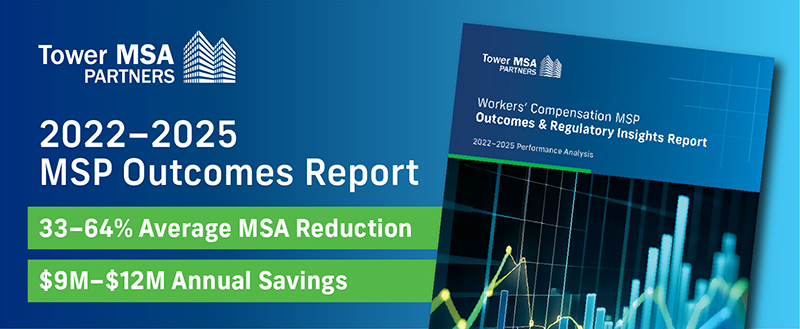
Workers’ Compensation MSP Outcomes & Regulatory Insights Report

June 16, 2026

2022-2025 Performance Analysis

One of the most comprehensive multi-year MSP outcome analyses available in the workers’ compensation industry.

Executive Summary

Tower MSA Partners is pleased to provide this first-of-its-kind report, offering one of the most comprehensive multi-year MSP outcome analyses available in the industry. The report provides wide-ranging data points and key metrics across MSA services, conditional payment programs, and CMS-published benchmarks.

These outcomes reflect an integrated model that combines clinical engagement, disciplined allocation methodology, CMS alignment controls, pharmacy mitigation strategies, and aggressive conditional payment resolution.

This report presents aggregated, anonymized performance metrics from 2022 through 2025 to serve as directional benchmarks for workers’ compensation stakeholders evaluating their Medicare Secondary Payer strategy.

Key Findings

Between 2022 and 2025, Tower MSA Partners delivered measurable, repeatable reductions in Medicare-related settlement exposure while maintaining disciplined alignment with CMS expectations.

Across this four-year period:

  • 33% to 64% annual reduction in projected MSA amounts through clinical intervention
  • $9 million to $12 million in annual MSA-related savings generated through physician and pharmacy optimization
  • 23% lower CMS-approved MSAs compared to CMS national averages
  • 84% to 90% of submissions avoided development letters
  • 82% of conditional payment demands reduced to $0 in 2025
  • Three-day average turnaround time once documentation is complete

In 2025 alone:

  • Average CMS-approved Tower WCMSA: $67,692
  • CMS national average WCMSA: $86,169
  • Average savings differential per file: $18,477

Why This Matters

Medicare Secondary Payer strategy is no longer simply a compliance requirement. It directly impacts settlement velocity, reserve accuracy, pharmacy exposure, and overall financial predictability.

The outcomes presented in this report demonstrate that a disciplined MSP framework can materially improve both operational and financial performance. Organizations that combine clinical oversight, pharmacy management, documentation discipline, and regulatory expertise are better positioned to achieve compliant and cost-effective settlement outcomes.

What’s Included in the Report

  • Multi-year MSP performance benchmarks
  • Medicare Set-Aside outcome analysis
  • CMS approval and development metrics
  • Pharmacy and opioid mitigation outcomes
  • Conditional payment resolution trends
  • Regulatory developments impacting workers’ compensation
  • Settlement optimization insights
  • Industry benchmark data from 2022-2025

Access detailed benchmarks, regulatory developments, CMS trends, and performance metrics from 2022 through 2025.

Tower Partners: People Behind the Settlements Interview with Kevin Puckett of KP Underwriting

February 16, 2023

Tower MSA Partners graphic with Kevin Puckett of KP Underwriting with the question “Rated ages…what are they and how do they affect MSA’s”.

Tower MSA Partners is pleased to launch “Tower Partners: People Behind the Settlements.”  This quarterly series will dig into the elements that go into smooth, cost-effective settlements and introduce Tower’s team members and corporate partners who make them possible.

First up is Kevin Puckett, owner and president of KP Underwriting, who is responsible for assigning a rated age on most of the MSAs we write.  As Kevin explains, a rated age is the statistical age of a person due to their medical conditions.  A person’s actual age may be 60, but their comorbidities and other conditions could cause their rated age to be 65.

Why is this important to the MSA?  Because an MSA is calculated over the injured worker’s life expectancy. A higher rated age that reflects a shorter life expectancy reduces future medical costs. This reduction can be significant, sometimes tens or even hundreds of thousands of dollars.

Case in point: a 67-year-old woman with a rechargeable spinal cord stimulator (SCS) would have required two revisions (one every nine years) over her 18-year life expectancy, in addition to other medical costs. The MSA’s initial allocation was $142,410.64. However, the rated age came back at 72, reducing life expectancy from 18 to 14 years.  This allowed Tower to remove one SCS revision along with other medical costs. The revised MSA was $98,586.35, a $43,824.29 reduction to the allocation.

Now, let’s turn to our rated age expert and partner, Kevin Puckett.

Q & A with Kevin Puckett

What is a rated age? 

A rated age is an adjusted age and reduced life expectancy, that is the expected number of years of life remaining at a given age based on an individual’s medical impairments and the impact they have on their body and life expectancy.  The US Health & Human Services National Vital Statistics life expectancy tables set the baseline for life expectancy determinations.

What is your background in providing rated ages?  What qualifies you to provide this service?

I have been the President and Owner of KP Underwriting, LLC, an independent underwriting company since 2004.  KP Underwriting provides rated ages and modified life expectancies for companies that provide structured settlements, Medicare Set-Asides, and medical cost projections. Our services are also used for settlement purposes and to help set reserves. During my 30+ year career in medical underwriting, I worked with multiple life insurance companies, developing and managing underwriting departments before launching KP Underwriting.  I’ve also written underwriting manuals, audited underwriting departments, and provided expert witness testimony on life expectancy in multiple states and for the Department of Justice.  I earned my BBA in Business Administration with a minor in Biology from Eastern Kentucky University, an Associates designation from the Academy of Life Underwriting, and an FLMI (Fellow, Life Management Institute).

Is KP Underwriting approved to provide rated ages for CMS?

Yes, we’ve been approved since 2006. KP Underwriting is the single largest provider of rated ages in the country, having provided several hundred thousand rated ages to the Centers for Medicare and Medicaid Services (CMS).

What documentation do you require to calculate the rated age?

Medical records should contain two primary categories of records as listed below.  Medical records within the past two years are considered current and have more weight in rated age calculations.

  • Current status of the claimed injury includes:
    • Length of time since injury, permanency of the condition, functional status, stability of treatment, nature of the ongoing treatment.
  • Overall medical status of the individual including:
    • All co-morbidities, personal medical history, pharmaceutical use and related conditions.

Medical records older than two years can be utilized, however, the rated age will normally be more conservative as health history and medical impairments can change drastically over a two-year timeframe or longer.

Can you provide examples of diagnoses that will increase the rated age?

Two conditions can impact the rated age and life expectancy: the injury itself and medical impairments.  Good examples of both are as follows:

  • Injuries
    • Spinal Cord Injuries, head injuries, amputations, burns, chemical exposure, and falls are the most significant. The best thing to consider with injuries is how and if it impacts daily functioning.
  • Medical impairments
    • Most major health impairments will impact the rated age, such as diabetes, stroke, coronary artery disease, obesity, smoking, peripheral artery disease, kidney, colon, and liver diseases, HIV/AIDS, post-covid syndrome, and major respiratory disorders, to name a few. This is a very broad category.  One of the things I cannot stress enough is that medical impairments usually have the biggest impact on the rated age.

Do you solely consider the injury-related diagnoses or both the injury and non-injury-related diagnoses?

The injury and residuals and any medical impairments are both considered in processing the rated age.  We try to let our clients know that not only healthy people get injured.  Medical impairments usually have the biggest impact on rated ages.  In some instances, medical impairments can prevent or delay healing from the injury. For example, diabetes can delay healing in cuts or burns, leading to amputation or slower response to treatment.

What is your typical turnaround time to provide a rated age?

KP Underwriting’s turnaround time is usually 2-3 hours, with rush requests completed within an hour.  All cases that come in before 4 pm EST are completed the same day.  All cases after 4 pm are completed first thing the next business day.

What does your rated age report contain?

 The rated age report sent back to our clients is on KP Underwriting letterhead and contains the name, date of birth, gender, current age and current life expectancy, rated age and rated life expectancy, a brief medical summary of the impairments and injuries used in consideration of the rated age, and the table used in our calculations.  These are tailored to meet our clients’ needs.

How long has KP Underwriting been in business?

KP Underwriting has been in business since 2004. Initially, we prepared rated ages mainly for life companies and structured settlements.  We branched out in 2006 to include rated age services for MSAs.

Do you do all the rated age calculations, or do you have a staff that assists you?

KP Underwriting grew quickly to the point that I needed help to do them.  I currently have a staff of 10-from underwriters to processors- who assist in the rated age process.

If you want more information on KP Underwriting, you can visit their website or contact Kevin at kevinp@kpunderwriting.com or (502) 345-8048.  And if you have a question about a specific MSA or the impact of rated ages on MSAs in general, I am happy to speak with you.  Email Daniel.Anders@TowerMSA.com.
Catch Tower’s Dan Anders on the popular ADJUSTED podcast

July 13, 2022

Article Image | Dan Anders quoted on Section 111 penalties and non-submit MSAs

The latest episode of the popular ADJUSTED podcast features our Chief Compliance Officer Dan Anders on one of his favorite topics, Medicare Set-Asides. When are they needed? How do you mitigate their costs? What’s the deal with rated ages? Host Greg Hamlin and Guest-host Matt Yehling, Director of Claims at Midwest Employers Casualty wanted to know.

The hosts posed the all-important question of when should workers’ comp claim with a Medicare beneficiary claimant be settled: now, later or not at all? Dan guides listeners through the various elements to consider when coming to this decision. Is the Medicare beneficiary’s condition stable? Is surgery imminent? Are they still tapering off certain medications? Are there ways to lower costs without compromising care? What are the barriers to Centers for Medicare and Medicaid (CMS) approval?

While talking about ways to mitigate costs, Dan stresses the need to obtain physician statements to clarify treatment, including which medications are discontinued. CMS requires the costs for these to be included in the MSA unless changes are documented in certain ways. Tower’s Physician Follow-up service does this and has been used on nearly half of our CMS-submitted MSAs.

If you’re new to MSAs or need to know more about reducing their costs, this podcast is for you. Find it on Apple, Google, Spotify, other platforms and here: Medicare Set Asides with Dan Anders (buzzsprout.com).

Even better, you’ll learn a little more about Dan. Did you know he considered a career in politics?

Produced by Berkley Industrial Comp, ADJUSTED presents interviews with experts on a variety of topics touching workers’ comp. Other recent episodes on settlement issues were Ametros’ Andrea Wells and Brad Cantwell with Arcadia Structured Settlements. Visit the Berkley Industrial Comp blog for these and more.

MSAs are complicated and confusing—they even stump the specialists at times. Sometimes you just need to talk to an expert in a certain area. If you ever have a question about an MSA, Dan is happy to talk to you. Get in touch with him at Daniel.anders@towermsa.com.

Related posts

Premier Webinar: Tricks of the Trade for Successful MSA Outcomes

Medicare Set-Asides

Tower MSA Partners Saves $175K With Optimized MSA

June 15, 2022

Tower MSA Partners optimized MSA savings for complex workers’ comp settlement

Challenge

Tower was engaged to prepare an MSA for a 54-year-old partial quadriplegic. Several issues made it difficult to prepare an accurate allocation. These included limited current medical records, erratic patient behavior, inconsistent provider treatment coding, and unknown treatment outside the workers’ compensation plan.

The preliminary MSA amount was $424,528.

Solution

Tower’s medical experts reviewed the treatment records and identified several areas where Medicare-covered expenses could be reduced through Tower’s Optimized MSA process.

At Tower’s request, the client obtained current medical records. Tower’s clinical team then reviewed those records along with the billing codes used for each treatment.

The team compared the provider’s treatment methods against Medicare reimbursement requirements. This review showed that some items could be priced more accurately with alternative codes.

For example, Tower determined that catheterization code A4353 had been used incorrectly. By using the correct billing code and applying other cost-saving strategies, Tower significantly reduced the MSA allocation.

To support CMS review, Tower explained why the original billing code was incorrect. Tower also provided the corrected coding for consideration.

Results: $175,867 in Savings

After the optimized MSA was finalized, Tower submitted a total allocation amount of $248,661 to CMS for review and approval.

CMS accepted the proposed MSA amount and issued a Full Approval.

Using Tower’s proprietary processes and technology, the client carrier reduced the Medicare exposure of the settlement. The final result was $175,867 in total savings.

More Tower Success Stories

More Tower Success Stories can be found here!