Premier Webinar: Get Ready for Section 111 Reporting Penalties and WCMSA Reporting

May 3, 2024

Premier Webinar: Section 111 Reporting Penalties & WCMSA Reporting

CMS Announces Section 111 Mandatory Insurer Reporting Changes: Penalties and New WCMSA Requirements

The Centers for Medicare and Medicaid Services (CMS) has released several announcements regarding Section 111 Mandatory Insurer Reporting over recent months.  Some relate to Section 111 penalties and some to the new requirement to add Workers’ Compensation MSAs to Section 111 reporting.

Timely and accurate Section 111 reporting is essential if you want to avoid penalties. And WCMSA reporting will introduce new tasks for claims professionals and potentially affect how WC cases with Medicare beneficiary claimants are settled.

To help you and your organization prepare for these changes

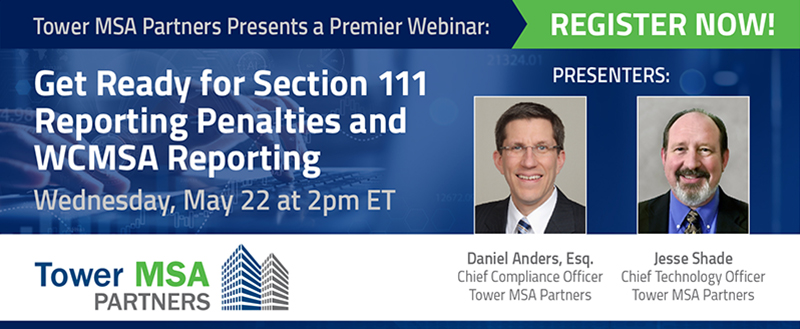
Tower will hold a “Get Ready for Section 111 Reporting Penalties and WCMSA Reporting” webinar on May 22.

Please join Tower’s Chief Compliance Officer Dan Anders and Chief Technology Officer Jesse Shade for this valuable, instructional session. Scheduled for Wednesday, May 22, 2024, at 2 pm ET, the hour-long webinar will address:

  • Criteria and timeline for the implementation of Section 111 Reporting penalties.
  • Practices to mitigate and eliminate the potential for penalties.
  • How a Section 111 reporting audit can identify errors, blind spots and recommend corrective actions to your systems and processes.
  • Criteria and timeline for Workers Compensation MSA reporting.
  • Implication of WCMSA reporting for claims professionals, attorneys, and settling parties.

A Q&A session will follow the presentation, and you can provide questions ahead of time at registration. Please click the link below and register today!

CMS Moves Start Date for WCMSA Reporting to April 2025

April 23, 2024

CMS delays start date for section 111 reporting of WCMSAs

CMS delays start date for Section 111 reporting of WCMSAs to April 2025 and announces new webinar for Q&A

During last week’s webinar, the Centers for Medicare and Medicaid Services (CMS) announced an extension of the start date for Section 111 reporting of WCMSAs from January 2025 to April 4, 2025.

(Due to technical difficulties with the April 16 webcast, CMS has scheduled another webinar for Q&A this Thursday, April 25, 2024, at 2:30 ET. Details on the webinar are here.

Remember, CMS requires Section 111 reporting of WCMSAs of any MSA amount, even if $0. These amounts must be reported whether they are CMS-approved MSAs or not.

CMS details new reporting guidelines and start date for Section 111 WCMSA Implementation

CMS reiterated several points that had been detailed in a prior webinar and through the recent Section 111 User Guide update.  Please review CMS Updates Section 111 NGHP User Guide and WCMSA Reference Guide for this information. New points are below:

  • The start date for WCMSA reporting was changed from January 2025 to April 4, 2025, to give Responsible Reporting Entities (RREs) more time to make the needed changes to their reporting processes.
  • Testing of the new fields will be available beginning on October 7, 2024.
  • All WCMSA fields except Field 43 (Professional Administration EIN) will result in “hard” errors if reported incorrectly. Hard errors cause the TPOC report to be rejected, which can in turn cause the report to be untimely if it is not corrected promptly.
  • As such, hard errors may result in the imposition of civil money penalties (CMPs) although CMS will not impose a CMP for two reporting periods after implementation of WCMSA reporting. In other words, only records on or after October 15, 2025, and with a reportable MSA are subject to a CMP.
  • If an RRE fails to report an MSA, CMS may utilize all available statutory and regulatory options to recover mistakenly made payments, including under the False Claims Act.
  • No changes are made as to what constitutes a reportable TPOC. If a TPOC is reportable, then the WCMSA fields must be completed. If it is not reportable, such as when the WC settlement is $750 or less, then the WCMSA fields are not completed.
  • If multiple defendants are parties to a single settlement, they must report the total TPOC amount (and not their “share”) and the total MSA amount.
  • The Section 111 reporting process is not intended to replace the submission of settlement documents to CMS following the settlement of a claim with a CMS-approved MSA. (Final settlement documents should always be sent to Tower for upload to CMS.)
  • Receipt of the MSA report through the Section 111 reporting process will allow CMS to send information to the beneficiary on the attestation and exhaustion process. (Currently this is not done for most self-administered non-submit MSAs).

CMS outlines impact of “W” records in common working file (CWF) for MSA reporting

CMS also explained that once the MSA is reported, a “W” record will be posted in the Common Working File (CWF), which prevents payments of medical services related to the reported diagnosis codes. The CWF is part of CMS’s system to accurately coordinate benefits, so Medicare does not make payment when another “primary payer” is available.

A copy of the webinar slides can be found here.

Please contact Dan Anders at daniel.anders@towermsa.com with any questions.

CMS Updates Section 111 NGHP User Guide and WCMSA Reference Guide

April 5, 2024

CMS Updates 111 NGHP User Guide and WCMSA Reference Guide.

CMS Releases Updates to MMSEA Section 111 NGHP User Guide and WCMSA Reference Guide

The Centers for Medicare and Medicaid Services (CMS) began April with updates to two of its popular user guides, the MMSEA Section 111 NGHP User Guide and the WCMSA Reference Guide.  Notably, the NGHP User Guide, version 7.5, now includes details on the requirements to report WCMSA amounts with other relevant data. These will need to be reported as of April 4, 2025.

The NGHP User Guide, Section 6.5.1.1 of Chapter III: Policy Guidance, was updated to state:

For workers’ compensation records submitted on a production file with a TPOC date on or after April 4, 2025, Workers’ Compensation Medicare Set-Aside Arrangements (WCMSAs) must be reported.

CMS also updated Chapter IV: Technical Information with similar language.

CMS Revisions to WCMSA Reporting Fields in Chapter V: Appendices

Additionally, CMS updated Chapter V: Appendices to identify the fields that will be added to the Claim Input File Detail for WCMSA reporting:

  • Field 37 – MSA Amount: This will be either $0 or an amount greater than $0. If an annuity is used, then the “total payout” is reported.
  • Field 38 – MSA Period: If the MSA amount is greater than $0, you need to enter the number of years the MSA is expected to cover the beneficiary.
  • Field 39 – Lump Sum or Structured/Annuity Payout Indicator: If the MSA amount is greater than $0, you will enter “L” for a lump-sum MSA or “S” for a structured/annuity MSA.
  • Field 40 – Initial Deposit Amount: If an annuity, then the MSA seed amount is reported.
  • Field 41 – Anniversary Deposit Amount: If an annuity, then the amount of the annual payments.
  • Field 42 – Case Control Number (CCN): If an MSA is submitted to CMS for review or is otherwise submitted to CMS post-settlement, it will be assigned a CCN. The CCN is entered in this field, although this is optional.
  • Field 43 – Professional Administrator EIN: Enter the Employer Identification Number of the professional administrator here if there is one. If this EIN is not provided, the “case administrator” defaults to the beneficiary. If the EIN does not match a registered administrator account in the Workers Compensation Medicare Set-Aside Portal (WCMSAP), then “case administrator” will also default to the beneficiary.

CMS provided a table of error codes for errors identified in the above-reported information.

Responsible Reporting Entities (RREs) can start testing these new fields on October 7, 2024. For further details, see the Tower article, CMS Sets Date for Start of Section 111 WCMSA Reporting.

CMS also incorporated the following notice into the NGHP User Guide:

As of January 1, 2024, the threshold for physical trauma-based liability insurance settlements will remain at $750. CMS will maintain the $750 threshold for no-fault insurance and workers’ compensation settlements, where the no-fault insurer or workers’ compensation entity does not otherwise have ongoing responsibility for medicals (Section 6.4).

The $750 reporting threshold has been in place for several years.

CMS included minor updates to the WCMSA Reference Guide, version 4.0

Specifically, CMS added:

Instruction specific to beneficiaries has been added to encourage them to use their Medicare.gov access to the portal for the most efficient method of submitting attestations (Sections 11.1.1 and 17.5).

For further information on electronic reporting of attestations, see the above-referenced sections in the guide or the Tower article, CMS Adds Electronic Submission Option for MSA Attestations.

CMS also amended the link in Section 10.3 to reflect the most recent CDC Life Table link. The life tables are used to determine life expectancy for calculation of the MSA.

Tower’s Cybersecurity Measures Go the Extra Mile to Protect Your Data

April 3, 2024

Tower MSA Partners Cybersecurity Measures Go the Extra Mile to Protect Your Data

Navigating cybersecurity landscape: Insights from CTOs on cybercrime trends

Cybercrime continues to mount, threatening organizations of all sizes and types. The right cybersecurity measures matter. And which cyber risks worry Chief Technology Officers the most?  That would be the danger of an employee accidentally opening the door to an attack.

A recent survey of CTOs showed that 59% considered human error a significant security threat.  Highlighted in a March 12 Risk & Insurance brief, the survey was conducted by STX Next with results reported in Technology Magazine.

The phenomenal increase in the sales of cyber insurance underscores the growth of cybercrimes and corporations’ concerns about their impact.  Cyber insurance sales, which were $1 billion in 2013, soared to $16 billion in 2023.

Still, only half the companies surveyed had a cybersecurity insurance policy. Tower, of course, has had cybersecurity insurance for years. It’s necessary, but we hope we never have to use it. Our focus is on detecting and preventing attacks in the first place.

Cybercrime spotlight: Cybercriminals zeroing in on users

Cybercriminals are becoming more sophisticated.  Forget the lone hacker in his basement; now there are large “professionalized” cybercrime operations. They know most companies that hold sensitive personal health or financial data have reinforced their networks and systems, and now criminals have their sights on soft targets, the people.

One wrong click can launch a devastating breach. Without the right kind of education and ongoing awareness of new viruses and scams, employees can easily fall prey to phishing, vishing, smishing, and social engineering issues.

Fortifying remote workforce: Tower’s cybersecurity education to combat cybercrime

Cybersecurity education is essential for a remote workforce, where an employee can’t quickly turn to a teammate for a second opinion on an email. Tower’s employees receive extensive cybersecurity training and understand how to do their part to prevent breaches.

Tower equips our remote workforce with virtual desktop infrastructure (VDI), including VPNs, anti-virus software, and software that analyzes and downloads electronic email attachments before they can be accessed by any of our devices. We also conduct monthly training sessions that cover topics such as how to detect phishing attacks and procedures for reporting suspicious email and malware, and how to handle email attachments that may contain them.

Enhancing cybersecurity protocols: Tower’s robust defense system against cybercrime

We don’t stop there, though.  We conduct annual penetration testing, also called pentesting, where a third-party security expert tries to find and exploit vulnerabilities. Ntierty, our cloud provider, keeps us up to date on the latest viruses and scans our network every week. Tower’s IT department also conducts its own weekly scans using different software as an extra precaution.

And the Tower management team engages in annual cybersecurity tabletop exercises to simulate real-world attacks on Tower’s systems.  These simulations probe for known vulnerabilities, which allows us to develop new strategies and procedures to secure our systems.

We also review our controls, processes and procedures to assess their effectiveness every year in a formal SOC 2, Type 2 audit.  All this is done to continually identify potential vulnerabilities so we can proactively fortify our defenses.

Tower invests significant amounts of time and money to ensure business continuity and the protection and privacy of data. This may sound like overkill, but we understand the risks, and we’re not willing to take chances on our security and the protection of our clients’ data.

To learn more about Tower’s security suite, please contact Chief Technology Officer Jesse Shade at jesse.shade@towermsa.com.

Links

Human Error is Biggest Cybersecurity Threat, CTOs Say | Technology Magazine

5 things business leaders must know to combat the cybercrime menace – Liberty Mutual Business Insurance

https://towermsa.com/your-settlement-partner/security-confidentiality/

CMS Sets April 16 for Webinar on Section 111 Reporting of WCMSAs

March 27, 2024

Webinar on Section 111 Reporting of WCMSAs

Prepare for Change: CMS Webinar on Expanding Section 111 NGHP TPOC Reporting to Include WCMSA Information

The Centers for Medicare and Medicaid Services has scheduled a webinar for April 16, 2024, at 2 PM ET to provide updates on the implementation of Section 111 reporting of Workers Compensation Medicare Set-Asides (WCMSAs).  Per the March 25, 2024 announcement:

CMS will be hosting a second webinar regarding the expansion of Section 111 Non-Group Health Plan (NGHP) Total Payment Obligation to Claimant (TPOC) reporting to include Workers’ Compensation Medicare Set-Aside (WCMSA) information. After the first webinar in November, CMS received additional questions and feedback from the industry. The intent of this webinar is to ensure that RREs will be prepared for the change once implemented. With that in mind, this webinar will include a background recap, summary of technical details, updated timelines and CMP impacts. The presentation will be followed by a question and answer session. Because this expansion impacts reporting of WCMSAs, it is strongly recommended that Responsible Reporting Entities (RREs) that report Workers’ Compensation settlements attend.

There is no pre-registration for the webinar.  Full details can be found here.

As of April 4, 2025, TPOC reporting must include Workers’ Compensation Medicare Set-Aside Arrangements (WCMSAs). (See CMS Sets Date for Start of Section 111 WCMSA Reporting).

The WCMSA reporting requirement applies to both CMS-approved and non-approved MSAs.  This information must be reported if the insurance type is workers’ compensation and the TPOC amount is greater than $0. The rule will be prospective only, meaning it applies to TPOC dates of April 4, 2025 and later.

To collect this data, CMS is adding new fields to the Section 111 Claim Input File.

Tower will provide a post-webinar summary.  If you have any questions, please contact Dan Anders at daniel.anders@towermsa.com or 888.331.4941.


Tower Webinar Shared the Best Ways to Manage Conditional Payments

February 29, 2024

Man with magnifying glass and calculator adding up Conditional Payments.

What are conditional payments?  How and when should payers respond to Conditional Payment Letters, Notices and Demands? What happens if you don’t? Our Chief Compliance Officer Dan Anders and Director of MSP Compliance Services Ada Lopez covered these topics and much more in our February 7 webinar.  Here’s a quick recap.

How does Medicare know who the primary payer is … or that a case has settled?

The Medicare Secondary Payer Act was written to protect the Medicare Trust Fund. And the Centers for Medicare and Medicaid Services developed Coordination of Benefits (COB) rules and processes to keep Medicare from paying for treatment that is covered by a primary payer (workers’ compensation, liability, no-fault). If Medicare has made a payment for which a primary payer exists, then such a payment is considered conditional, meaning it is conditioned upon reimbursement to the Medicare Trust Fund.

Most commonly, CMS learns that a primary payer for a Medicare beneficiary’s claim exists through these Section 111 reporting triggers:

  • Acceptance of Ongoing Responsibility for Medical (ORM), usually in a WC or no-fault claim
  • Total Payment Obligation to Claimant (TPOC), typically a settlement

Timeliness and accuracy are keys to protecting the payers who are the Responsible Reporting Entities (RREs)

  • ORM and TPOC should be reported via Section 111 every quarter.
  • As of Oct. 11, 2024, RREs will be subject to penalties if ORM or TPOC are reported more than 365 days late. (Link to Penalty blog)
  • Report valid ICD-10 codes:
    • For ORM, report only diagnosis codes that are accepted on the claim.
    • For TPOC, only report diagnosis codes that are released as part of the settlement.
    • Be careful to report only codes that apply to the claim. (Medical bills and records often contain non-claim-related ICD-10 codes.)

Conditional payment recovery

The webinar took a deep dive into the processes and communications the Benefits Coordination & Recovery Center (BCRC) and Commercial Repayment Center (CRC) deploy to obtain reimbursements. Dan and Ada also discussed ways to dispute conditional payment notices and demands.  It’s worth requesting a recording of the session from Dan (daniel.anders@towermsa.com) just to get this information.

Some best practices for conditional payments

  • Make sure claims are accurately and timely reported for ORM and TPOC.
  • Update ICD-10 codes when additional body parts are accepted or denied or they need correction.
  • Terminate ORM when appropriate, e.g., settlement.
  • Identify your Medicare-eligible claimants.
  • Immediately review and act on conditional payment correspondence and meet the deadlines!
  • Make sure settlement terms specify who is responsible for conditional payments post-settlement.
  • When a Demand is received, either pay or appeal. Pay attention to Conditional Payment Letters (CPLs) and Conditional Payment Notices (CPNs) and take action on them, but do not pay before the Demand.
  • Be sure to respond to the Demand on time. Otherwise, the debt will eventually be transferred to the U.S. Treasury.
  • Follow-up with the CRC or BCRC to ensure payment was received and applied to the debt and that no debt remains.

If you don’t work with conditional payments on a daily basis, consider partnering with Tower for conditional payment identification, resolutions and appeals. And, if you have any questions about conditional payments, even on specific claims, or any other MSP compliance issues, Dan Anders is happy to answer them.  Email daniel.anders@towermsa.com.

Also, let us know what areas of MSP compliance you would like us to cover in future Premier Webinars. We want to help you.

Section 111 Mandatory Insurer Reporting Updates

February 22, 2024

Section 111 Mandatory Insurer Reporting Updates

The Centers for Medicare and Medicaid Services (CMS) issued a series of updates over the past month, which include an updated NGHP Section 111 User Guide, the latest Top 10 Section 111 Reporting errors, and its 2024 conditional payment recovery threshold.  We have summarized these for you below.

Updated NGHP Section 111 User Guide

CMS released NGHP User Guide Version 7.4, which incorporates the Section 111 civil monetary penalties rule into Section 5.1 of Chapter III: Policy Guidance of the guide. See our most recent update on Section 111 penalties in Recap of CMS Section Penalties Webinar.  CMS includes the following in the guide:

The occurrences to be audited will include both Section 111 submissions and records from sources outside of the Section 111 reporting process, to ensure that CMS does not miss those situations where an RRE has entirely failed to report the occurrence. RREs will only be informed when there is a potential instance of non-compliance.

In short, CMS will be auditing untimely reporting through Section 111 and reviewing reports outside of Section 111 to determine if there was a failure to report at all.

Top 10 List of Section 111 Reporting Errors

CMS released a chart of the Top 10 Section 111 Non-Group Health Plan Reporting Error Codes from 7/1/2023 to 12/15/2023.  The top three reporting errors were:

  • TN – 99: No matching, valid TIN Reference File Detail Record was found for the TIN/Office Code combination on the Claim Input File Detail Record.
  • CI05 – Invalid Diagnosis Code 1.
  • SP49 – No previously accepted record can be matched to the submitted delete. Delete failed.

These issues are what CMS calls “hard errors,” meaning the record will be rejected.  Remember that if a record is rejected and not timely corrected, it could be subject to Section 111 civil monetary penalties for untimely reporting.

$750 Threshold Kept for Reporting and Conditional Payment Recovery

In a February 14, 2024 alert, CMS announced that the 2024 conditional payment recovery threshold for liability, no-fault and workers’ compensation settlements will remain at $750. Accordingly, Total Payment Obligations to the Claimant (TPOCs) in the amount of $750 or less do not need to be reported to CMS through the Section 111 Mandatory Reporting process. Nor will CMS attempt to recover conditional payments for TPOCs of $750 or less (The threshold does not apply to liability settlements for alleged ingestion, implantation or exposure cases.)

By way of background, pursuant to the SMART Act of 2012, CMS must determine a threshold amount each year to ensure the collection cost stays within the amount recovered through such efforts.

Please get in touch with Tower’s Chief Compliance Officer, Dan Anders, with any questions at (888) 331-4941 or daniel.anders@towermsa.com

Medicare Conditional Payment Tune-up, a Tower MSA Partners Webinar

January 25, 2024

Medicare Conditional Payment Tune-up, a Tower MSA Partners Webinar

Tune-up your conditional payment resolution processes with Tower’s Feb. 7 webinar!

Medicare conditional payment resolution should be a standard practice when settling workers’ compensation or liability claims that involve an injured worker or claimant who is a Medicare beneficiary.  While most settling parties recognize this obligation, many have questions about Medicare Secondary Payer (MSP) Medicare conditional payment requirements, conditional payment policies, the practices of CMS recovery contractors, and the role of the Treasury Department in debt recovery.

For the answers, join Tower for a complimentary webinar on Wednesday, February 7, at 2:00 PM ET. Dan Anders, Tower’s Chief Compliance Officer, and Ada Lopez, Director of Medicare Secondary Payer Compliance Services will tell you when and how to:

  • Communicate with the Commercial Repayment Center (CRC) instead of the Benefits Coordination and Recovery Center (BCRC).
  • Investigate conditional payments.
  • Respond to Medicare conditional payment recovery correspondence.
  • Dispute and appeal conditional payment demands- What works, what doesn’t work, and what sometimes works.
  • Resolve Treasury Department debt recovery actions.
  • Work with Tower to investigate, dispute and resolve conditional payments.

A Q&A session will follow the presentation and you can submit questions now.

Please click the link below and register today!

Note there is no CEU credit offered for this webinar.

Register Here

Top 5 MSP Stories of 2023 & What to Expect in 2024

January 4, 2024

Top 5 MSP Stories of 2023 & What to Expect in 2024

As we start the new year, here’s a look at the top five Medicare Secondary Payer (MSP) compliance stories of 2023 and what to watch for in 2024.

 A Look Back

Centers for Medicare and Medicaid Section 111 Penalties Rule Released

The long-awaited Section 111 penalties rule was published in October. Surprisingly, the final rule was more narrowly focused than the proposed version. Now, only untimely reporting (defined as one year later than it should have been reported) of Ongoing Responsibility for Medicals (ORM) and Total Payment of Claim (TPOC) is at risk for potential penalties. Not only that, not all claims that run afoul of the rule will be penalized. CMS will incorporate a randomized selection process to identify records for audit. Finally, CMS’s rule only applies prospectively, that is, with reportable data on October 11, 2024, and later.

See CMS Section 111 Penalties Rule Focuses on Untimely Reporting and CMS Releases FAQs on Section 111 Penalties for more details.

CMS to Require Section 111 Reporting of WCMSA Amounts

In a November 16, 2023 webinar, CMS announced plans to require the report of a Workers’ Compensation Medicare Set-Aside (WCMSA) amount concurrently with the report of TPOC in Section 111 Mandatory Insurer Reporting.  While CMS can presently coordinate post-settlement Medicare benefits when they receive settlement documents with an MSA amount, except for CMS-approved MSAs, this is not required.

CMS wants to close this information gap with a requirement to disclose an MSA amount included in a workers’ compensation settlement whether CMS approved the MSA or not. In the webinar, CMS indicated it would like to have the new reporting fields in place by January 2025.  This represents a technical and training challenge for Responsible Reporting Entities (RREs), who will now have to capture and report this data along with the currently required information.

More information can be found in our article, CMS to Require Section 111 Reporting of WCMSA Amounts.

Amended Reviews Open to All MSAs

Tower had urged CMS for some time to drop the past 60-month time requirement for an Amended Review and open it up to any prior WCMSA determination. We were pleased when CMS ended the 60-month requirement in May. It now allows a one-time Amended Review when a case meets this criteria:

  • CMS has issued a conditional approval/approved amount at least 12 months prior.
  • The case has not yet been settled as of the date of the request for re-review.
  • Projected care has changed so much that the submitter’s new proposed amount would result in a 10% or $10,000 change (whichever is greater) in CMS’ previously approved amount.

Further information can be found in CMS Significantly Expands Amended Review MSA Availability and MSA Amended Reviews – Key to Settlements of Old Dog Legacy Claims

Option for Unsolicited Response File on ORM Record Changes

Starting in July 2023, RREs had the option to receive a monthly NGHP Unsolicited Response File through the Section 111 secure website. The Unsolicited Response File provides the RRE with changes made to ORM records by the Benefits Coordination and Recovery Center (BCRC), which were not requested by the RRE, but rather are typically in response to communication with the claimant. The file allows the RRE to update or correct its reporting dataor report to the BCRC that the action taken is inconsistent with the RRE’s legal obligations in relation to ORM.

See Section 7.5 of the NGHP Section 111 User Guide, Chapter IV, Technical Information, for further information on the NGHP Unsolicited Response File.

Medicare Conditional Payment Appeals Guide

While it did not break any new ground on bases to appeal Medicare conditional payments, the April release of the NGHP Applicable Plan Appeals Reference Guide represents an important move toward CMS transparency around demand letter appeals. The guide clarifies both the policy and process for RREs or their representatives in submitting such appeals. Notably, Tower referenced the guide in successfully appealing a Medicare conditional payment demand before a CMS Administrative Law Judge.

A copy of the guide can be found here.

What to Watch for in 2024

Section 111 Penalties Implementation:  As the data to be considered for Section 111 penalties is October 11, 2024 and later, there is no possibility of a penalty being issued in 2024 (as the data must be reported one year late). When it released the rules, CMS stated that it would have further policy announcements and webinars. This includes a January 18, 1:00 pm ET, informational webinar. Details on the webinar can be found here.

Section 111 Reporting of WCMSA Amounts: CMS has tentatively set the start date for reporting WCMSAs as January 2025. The planned timeframe is for an updated file layout and error codes to be released in early 2024, with testing in the fall of 2024. CMS is expected to issue written guidance along with webinars on the topic.

New MSPRP Portal Features:  CMS has indicated it will continue introducing new Medicare Secondary Recovery Portal features. We will be on the lookout for these throughout 2024.

Medicare Beneficiary Appeals Guide:  In 2023, CMS released an appeals guide for NGHP plans to appeal Medicare demands from the Commercial Repayment Center. We expect CMS will also release a similar document for Medicare beneficiaries to appeal demands from the BCRC.

Finally, there will surely be other CMS announcements during the year. As always, we will provide you with summaries and key takeaways.

Best wishes from your friends at Tower for a healthy, happy, and prosperous new year! Remember to contact our Chief Compliance Officer Dan Anders with questions about any MSP compliance and MSA issues. Reach him at daniel.anders@towermsa.com.

Happy Holidays From Your Friends at Tower MSA Partners

December 20, 2023

Happy Holidays from your friends at Tower MSA Partners.

Tower MSA Partners wishes you a happy holiday season filled with peace, joy and laughter! We hope you can connect with loved ones and have time to relax and recharge.

This is a time to reflect on the past and prepare for new opportunities in the upcoming year. As we do this, we are filled with gratitude for our clients and other partners. We cherish these strong relationships and deeply appreciate the opportunity to work closely with you.

May your holidays be merry, your New Year prosperous … and your settlements smooth!