CMS Announces Upcoming Section 111 Webinar / WCMSA Reference Guide Update Released

November 15, 2022

Tower MSA Partners covers CMS new guide on Medicare conditional payment appeals and the upcoming Section 111 reporting webinar.

The Centers for Medicare and Medicaid Services (CMS) recently published a Section 111 reporting webinar notice and an update to its CMS WCMSA Reference Guide.

CMS Section 111 Reporting Webinar

CMS will hold a Section 111 NGHP Webinar on December 6, 2022, at 1:00 PM ET.  The notice says:

CMS will be hosting a Section 111 NGHP webinar. The format will be opening remarks by CMS, a presentation that will include NGHP reporting best practices and reminders followed by a question and answer session. For questions regarding Section 111 reporting, prior to the webinar, please utilize the Section 111 Resource Mailbox PL110- 173SEC111-comments@cms.hhs.gov.

The webinar notice can be found here.  We encourage anyone involved in the management of Section 111 reporting to tune into it.  Please note that there is no pre-registration; instead, the link and call-in phone numbers are on the notice.  You just log in shortly before the webinar’s start time.

WCMSA Reference Guide Update

The update to CMS’s WCMSA Reference Guide, Version 3.8 provides for changes to the re-review criteria. (Because CMS does not have a formal appeals process after an MSA determination, it allows what are called re-review submissions).  Currently, CMS allows for re-reviews for mathematical errors and missing documentation.  It has now added a section for submission errors which provides:

Submission Error: Where an error exists in the documentation provided for a submission that leads to a change in pricing of no less than $2500.00, a re-review request may be made by submitting updated documents free of errors that caused the original review outcome. Amended documents must come from the originators with appropriate notation to identify that the error was corrected, along with the date of correction and no less than hand-written “wet” signature of the correcting individual. Note: This submission option is only available for approvals from September 1, 2022 forward.

  •  Examples include, but may not be limited to: medical records with incorrect patient identifying information or rated ages where the rated-age assessor provided incorrect information in the rated-age document.

Rather than applying to submitter errors, this addition to the re-review policy appears to account for errors in the documentation that was provided to the submitter, such as a rated age or medical records.

Tower conducts a thorough review of all relevant documentation when the MSA is prepared and submitted.  Consequently, documentation errors are identified and corrected before MSA submission.  As such, we expect to make minimal use of the Submission Error Re-Review.

CMS also added a new section entitled Re-Review Limitations:

16.2 Re-Review Limitations

 Note: The following re-review limitations are only available for approvals from September 1, 2022 forward.

 Re-review shall be limited to no more than one request by type.

 Disagreement surrounding the inclusion or exclusion of specific treatments or medications does not meet the definition of a mathematical error.

 Re-review requests based upon failure to properly review already submitted records must include only the specific documentation referenced as a basis for the request.

It appears that the long-time policy of unlimited re-reviews has come to an end.  We understand CMS’s statement that a re-review “shall be limited to no more than one request by type” to mean one re-review is allowed for a mathematical error, one for missing documentation, and one for a submission error.

CMS’s intention for stating that a “disagreement surrounding the inclusion or exclusion of specific treatment or medications does not meet the definition of a mathematical error” is not clear.  While perhaps not a math error, when medical records from a treating physician clearly say surgery is no longer recommended or medication has been discontinued but CMS includes such treatment or medication in the MSA, we submit it as an error.

Tower has submitted numerous re-review requests to remove or modify treatment or medication from the MSA based on treating physician statements in the medical records.  Tower has a 68% success rate with re-reviews when CMS previously issued an MSA counter-higher, proof that these are reasonable requests. We hope the addition of Section 16.1 does not signal CMS’s intention to reject these reasonable re-review requests.

If you have any questions, please do not hesitate to contact Dan Anders, Tower’s Chief Compliance Officer, at Daniel.anders@towermsa.com or 888.331.4941.


 

For the First Time, CMS Releases Key Metrics on WCMSA Review Program

November 9, 2022

Person pointing out metrics on a posterboard to measure Medicare Set Aside.

The Centers for Medicare and Medicaid Services (CMS) recently released data that provides insight into its Workers’ Compensation Medicare Set-Aside (WCMSA) reviews.  This is the first time CMS has released such detailed metrics.

CMS shared statistics for a 3-year period of 2020 through 2022 (CMS’s fiscal year ends on Sept. 30). The data compared proposed MSA amounts with the CMS-recommended amounts (what we typically call the “approved” MSA amounts).  The data can be found here.

 MSA reviews are down

In 2020 CMS completed 16,517 reviews and by the FY end of 2022, this had dropped to 13,752 reviews, a 17% decline.

The reason for the decline is up for speculation.  There may have been fewer settlements and thus fewer MSAs during the pandemic. However, NCCI’s data* show that claim frequency only declined by about 1% when 2020 and 2021 are considered together.

Another theory is that the reduction reflects a trend of settling parties choosing not to submit the MSA to CMS for approval.  Whatever the reason, there has been less engagement with the CMS WCMSA review program.

 Review Methodologies Remain Consistent

When CMS disagrees with a proposed MSA amount it issues a counter-higher with an amount it recommends for the MSA allocation.  The data provided by CMS show that the variance between total MSAs proposed versus recommended change was 13% (2020), 15% (2021) and 14% (2022). This consistency of result is because CMS’s WCMSA review methodologies have remained largely the same over the last several years.

Average Recommended MSA Is Steady

The year-over-year data show very little change in the average recommended MSA amount from $84,563.33 in 2020 to $81,571.75 in 2022.

 A Billion Dollars a Year

The CMS data show that the amount the agency consistently recommends for all the MSAs comes to over $1 billion annually.  However, this does not necessarily represent $1 billion in savings to Medicare.  Savings result when the MSA is funded in a settlement and the MSA funds are expended for injury-related medical care that Medicare would otherwise cover.

How Tower’s MSAs Stack Up

The release of these statistics gives us a unique opportunity to compare Tower CMS-approved MSAs against all CMS-approved MSAs.

Average CMS-Approved MSA (2021 numbers):

CMS:  $80,741                                                 Tower:  $54,956

Tower’s CMS-approved MSAs are 32% lower than the CMS average approved MSA

And if we isolate just the prescription drug component of the MSA.

Average CMS-approved Rx Amount in MSA (2021 numbers):

CMS: $20,916                                                  Tower:  $14,079

Tower is 33% lower than the CMS average for the prescription drug component.

These comparisons prove that Tower’s MSA allocation methodology along with our focus on cost mitigation through interventions, such as our Physician Follow-up service, reduce MSA allocations. Simply put, what this means to our partner clients is millions of dollars in savings.  These metrics also show that cost reductions can be obtained, even when payers choose the CMS MSA approval process.

The release of data on CMS programs has been a policy initiative of the National Medicare Secondary Payer Network (MSPN), to which Tower belongs. We are pleased that MSPN’s efforts have resulted in this release.

We also thank CMS for publishing these statistics.  Hopefully, it will become an annual report that includes more metrics on WCMSA reviews, such as the percentage of MSA proposals that are developed for information post-submission. It would also be interesting to learn how many MSAs are funded in a lump sum versus those funded via an annuity. In addition, MSPN is interested in metrics surrounding Section 111 reporting and Medicare conditional payments.

If you have any questions about this report or anything else on MSP compliance or MSAs, please feel free to contact Dan Anders, Chief Compliance Officer, at Daniel.anders@towermsa.com or 888.331.4941.

*See Rabb, W., (2022, May 11). “Claims Frequency Up for 2021, but Workers’ Comp Profitability ‘Unprecedented,’” Insurance Journal.

CMS Withdraws Proposed Rule on Future Medicals in Liability Settlements

October 18, 2022

CMS withdraws rule on future medicals in liability settlements affecting LMSA guidance

On October 13, 2022, the Centers for Medicare and Medicaid Services (CMS) withdrew its proposed rule on future medicals in liability settlements from review by the White House Office of Information and Regulatory Affairs (OIRA review and approval is required before a proposed rule is published).

While never published to the public, the proposed rule was expected to provide guidance regarding obligations associated with future medical items in liability cases. It was commonly believed these obligations would include the use of a Liability Medicare Set-Aside (LMSA), similar to MSAs used in workers’ compensation, in certain situations.

What is uncertain now is whether a proposed rule around LMSAs will be reworked and resubmitted to OIRA for consideration soon or whether CMS is closing out regulations around liability settlements and future medicals for the foreseeable future. This is the second time CMS has withdrawn a rule on LMSAs, with the first withdrawn in 2014.

Practical Implications

While the lack of guidance around future medical obligations to CMS may have frustrated parties to liability settlements, these parties could have been even more frustrated if CMS had issued rules. As it is, parties in liability cases continue to have much more discretion in determining how to best consider Medicare’s interests in future medicals at the time of settlement than do parties in workers’ compensation cases.

What should settling parties do, given that no CMS LMSA review policy or process currently exists? Please reference Tower’s “Navigating Through the Fog: Medicare, Future Medicals & Liability Settlements” as a starting point. Of course, always feel free to contact me, Dan Anders, for consultation at Daniel.anders@towermsa.com or 888.331.4941.

Related Posts

Proposed Rules on LMSAs and Section 111 Penalites Again Delayed

CMS Rulemaking Notices Provide Possible Timeline for Criteria on LMSAs and Reporting Penalties


Is a CMS-approved $0 MSA Still Possible?

July 26, 2022

WCI TV interviews on workers compensation claims data analytics and insights

A common question we receive is whether a CMS-approved $0 MSA is still possible.  The answer is, yes– if it meets the criteria.

There are three different ways a $0 MSA can be obtained, each with its own criteria and documentation requirements.

Denied Claim $0 MSA

This is a $0 MSA based on a completely denied workers’ comp claim when no payments have been made for medical treatment or indemnity.  In certain jurisdictions, such as California, some medical payments can have been made during a statutory investigating period. Payments for non-treatment purposes such as IMEs, case management and medical records copies do not impact the ability to obtain a $0 MSA approval.

This type of $0 MSA has significant documentation requirements:

1. Claim Payment History

  • A claim payment history printout, even if blank, representing payments since the inception of the claim. All payments must be itemized.
  • Printout must be divided into categories for medical, indemnity and expenses with subtotals for each category and a grand total listed. This printout needs to include the print or run date.
  • If the claim payment history does not meet the above requirements, then Tower will work with you to identify alternative documentation that meets CMS requirements.

2. Draft or final settlement documents and court orders or rulings or a statement that no such documents exist (see below Financial Detail and Denial Letter). CMS recently added a requirement that there must be a proposed or agreed-to settlement.  Importantly, while CMS requires a proposed settlement, it will reject the $0 MSA if the settlement is finalized, for example with court or commission approval, before CMS’s review and approval of the $0 MSA.

3. First Report of Injury or a statement that no such document exists (See below Financial Detail and Denial Letter).

4. Financial Detail and Denial Letter – At the time of submission Tower will draft a letter for the client to sign that confirms the denial of the claim and any other necessary explanations, such as why no First Report of Injury is available.

5.  Medical Records:  As with a regular MSA, medical records for the past two years must be provided with the submission.

6. CMS Consent to Release form executed by the claimant.

Accepted Claim $0 MSA 

This is a $0 MSA based on medical documentation supporting no further need for injury-related treatment.  In the WCMSA Reference Guide, CMS provides as follows:

The individual’s treating physicians conclude (in writing) that to a reasonable degree of medical certainty the individual will no longer require any Medicare-covered treatments related to the WC injury.

In practice, CMS accepts treating physician statements that say the injury-related treatment has resolved or returned to baseline (when there was a pre-existing condition) and that no further injury-related treatment will be necessary as sufficient to support the $0 MSA.

Keep in mind that CMS will not accept the physician’s statement unless it is consistent with the treatment records/notes.  For example, if the physician states the injury-related has resolved, but treatment notes document ongoing pain to the relevant body part, CMS is unlikely to approve a $0 MSA.  Also, if the injured worker will require a revision or replacement to a body part, e.g., a knee replacement, a $0 MSA will not be approved.

In addition to the physician statement, a claim payment history, medical treatment records and an executed Consent to Release are required.

Judicial Decision $0 MSA

CMS will accept a judicial decision after a hearing on the merits of the case as a basis for a $0 MSA.  This can be on a completely denied claim where the judge upholds the denial of the claim or an accepted claim where the judge finds future medical treatment, if any, is unrelated to the work injury.  The key here is the decision is “on the merits.”  If it in any way looks like an agreement between the parties and the judge just stamped their approval, CMS will not accept it.

In addition to the judicial decision, a claim payment history, medical treatment records and an executed Consent to Release are required.

While there are strict documentation requirements, these $0 MSA approvals remain available for workers’ compensation cases meeting the applicable criteria. Please contact Tower MSA Partners at referrals@towermsa.com or (888) 331-4941 to refer a claim meeting these requirements or for further consultation.

Catch Tower’s Dan Anders on the popular ADJUSTED podcast

July 13, 2022

Dan Anders who was quoted in the Claims Journal

The latest episode of the popular ADJUSTED podcast features our Chief Compliance Officer Dan Anders on one of his favorite topics, Medicare Set-Asides. When are they needed? How do you mitigate their costs? What’s the deal with rated ages? Host Greg Hamlin and Guest-host Matt Yehling, Director of Claims at Midwest Employers Casualty wanted to know.

The hosts posed the all-important question of when should workers’ comp claim with a Medicare beneficiary claimant be settled: now, later or not at all? Dan guides listeners through the various elements to consider when coming to this decision. Is the Medicare beneficiary’s condition stable? Is surgery imminent? Are they still tapering off certain medications? Are there ways to lower costs without compromising care? What are the barriers to Centers for Medicare and Medicaid (CMS) approval?

While talking about ways to mitigate costs, Dan stresses the need to obtain physician statements to clarify treatment, including which medications are discontinued. CMS requires the costs for these to be included in the MSA unless changes are documented in certain ways. Tower’s Physician Follow-up service does this and has been used on nearly half of our CMS-submitted MSAs.

If you’re new to MSAs or need to know more about reducing their costs, this podcast is for you. Find it on Apple, Google, Spotify, other platforms and here: Medicare Set Asides with Dan Anders (buzzsprout.com).

Even better, you’ll learn a little more about Dan. Did you know he considered a career in politics?

Produced by Berkley Industrial Comp, ADJUSTED presents interviews with experts on a variety of topics touching workers’ comp. Other recent episodes on settlement issues were Ametros’ Andrea Wells and Brad Cantwell with Arcadia Structured Settlements. Visit the Berkley Industrial Comp blog for these and more.

MSAs are complicated and confusing—they even stump the specialists at times. Sometimes you just need to talk to an expert in a certain area. If you ever have a question about an MSA, Dan is happy to talk to you. Get in touch with him at Daniel.anders@towermsa.com.

Related posts

Premier Webinar: Tricks of the Trade for Successful MSA Outcomes

Medicare Set-Asides

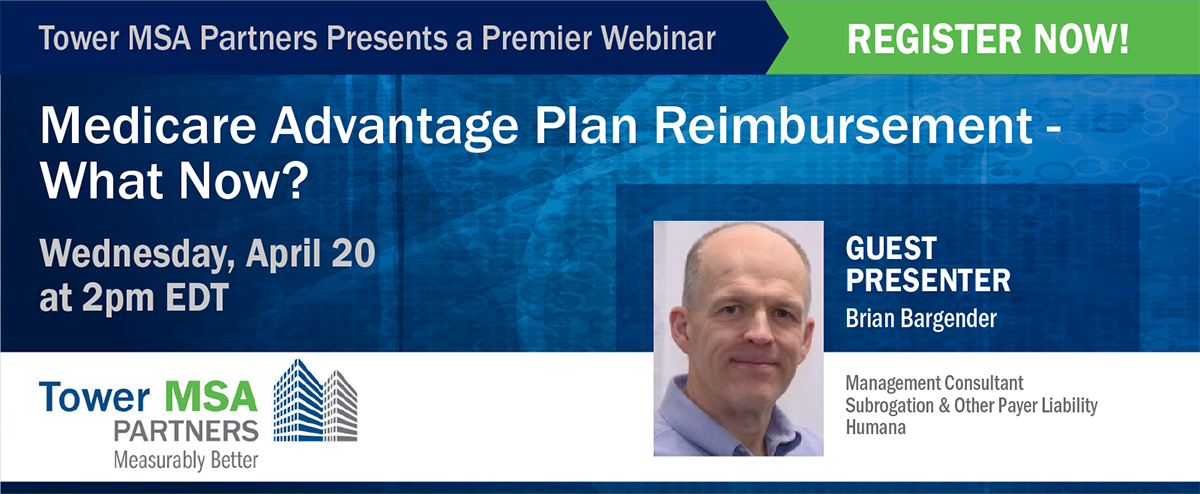
Premier Webinar: Medicare Advantage Plan Reimbursement – What Now?

April 7, 2022

In December 2021, the Centers for Medicare and Medicaid Services (CMS) started providing access to data showing a claimant’s enrollment in Medicare Part C and D plans. Now payers are wondering how to best interact with Medicare Advantage (MA) plans and prescription drug plans. What are their reimbursement rights? How does this work with Section 111 reporting?

Tower is pleased to feature a guest presentation by Brian Bargender, Management Consultant, Subrogation and Other Payer Liability for Humana on Wednesday, April 20 at 2:00 PM ET.  Brian is arguably the industry’s foremost expert on Part C and D plan subrogation. Humana is the second-largest Medicare Advantage Plan and Part D plan in the country and has been the leading advocate for reimbursement under the MSP Act.

Here’s just some of what you will learn:

  • Role of Part C and D plans in providing services to Medicare beneficiaries.
  • Reimbursement rights of Part C and D plans under the Medicare Secondary Payer (MSP) Act.
  • Interplay between CMS and Part C and D plans in use of Section 111 Mandatory Insurer Reporting data.
  • Part C and D plans role in Workers’ Compensation MSAs.
  • Best practices for working with Part C and D plans to resolve reimbursement claims.

A Q&A session will follow the presentation, and you can provide questions at the time you register. Please click the link below and register today!

REGISTER HERE

CMS Clarifies Policy on Non-Submit MSAs in Updated Reference Guide

March 22, 2022

book marked by sticky notes illustrating changes Section 111 reporting on ORM

The January 2022 addition of Section 4.3 to the CMS WCMSA Reference Guide that discussed the agency’s treatment of non-submit Medicare Set-Asides caused quite a stir throughout the MSA industry and raised many questions for those who use non-submit MSAs in workers’ comp settlements.  A February CMS webinar addressed some of those questions and we now have an update (Version 3.6) to the CMS WCMSA Reference Guide that modifies and clarifies this section.

Revisions to Section 4.3

Below is a breakdown of the revisions to Section 4.3 along with comments.

More general language around non-submit MSAs

The original language called out certain MSA products as indemnifying:

“A number of industry products exist with the intent of indemnifying insurance carriers and CMS beneficiaries against future recovery for conditional payments made by CMS for settled injuries.”

The new language is more general:

“A number of industry products exist for the purpose of complying with the Medicare Secondary Payer regulations without participation in the voluntary WCMSA review process set forth in this reference guide.”

Comment:  The original language took aim at MSA indemnification agreements where the new language is broader and includes any product that addresses future medicals. It also reiterates that the CMS MSA review process is voluntary. This was likely in response to people who said that CMS’s original policy changed the MSA review process from voluntary to mandatory.

 ‘May’ instead of ‘Will’ Deny

 CMS’s original policy said that it “will” deny payment of medical services up to the total settlement amount whereas the revised policy indicates CMS “may at its sole discretion” deny payment.

Comment:  It appears that CMS is giving itself wiggle room depending on the circumstances of an individual case.  Also, as is further explained below, CMS has given itself the option to accept less than the entire settlement amount as sufficient to protect its interests.

Total Settlement Definition

The original Section 4.3 defined total settlement as “total settlement less procurement costs.”  This was now revised to define total settlement “as defined in Section 10.5.3 of this reference guide, less procurement costs and paid conditional payments.”

Comment:  Section 10.5.3 is CMS’s longtime definition of “total settlement.” It makes sense that the definition of total settlement in the non-submit context should align. CMS also acknowledges that besides procurement costs, payment of conditional payments from the settlement amount should also be deducted from the amount of the settlement available to pay for future medical.

Post-MSA exhaustion review

When released in January, Section 4.3 provided no option for CMS to acknowledge the non-submit MSA as sufficient. The updated policy now says, “CMS will ignore the non-submit MSA and use the total settlement amount (minus procurement costs and paid conditional payments) as the amount available to pay future medicals “unless it is shown, at the time of exhaustion of the MSA funds, that both the initial funding of the MSA was sufficient, and utilization of MSA funds was appropriate.”

Comment:  It will be the Medicare beneficiary’s responsibility, or someone working on their behalf, to demonstrate that the MSA was sufficient at the time of settlement and that the MSA funds were spent appropriately.  We can assume that CMS will use the standards found in the WCMSA Reference Guide and its MSA Self-Administration Guide to make its determination. If CMS finds either that the MSA was insufficiently funded or inappropriately utilized, does the Medicare beneficiary have a right to an appeal? Medicare beneficiaries have a right to appeal a denial of payment for medical care. Presumably, that right extends to the context of a non-submit MSA, but it remains unclear how this would play out in practice, and CMS did not address it here.

Policy start date:  Per CMS, Section 4.3, “shall apply to all notifications of settlement that include the use of a non-CMS-approved product received on, or after, January 11, 2022; however, flags in the Common Working File for notifications received prior to that date will be set to ensure Medicare
does not make payment during the spend-down period.”

Comment:  Before the January date, there was no obligation to notify CMS of a settlement that includes the use of a non-CMS-approved MSA product (Yes, there is a Section 111 reporting responsibility, but that does not include notification of a non-submit MSA). Is there an obligation now? Nothing in Section 4.3 affirmatively states such an obligation exists and there is no statutory basis that provides for such notification.

Under threshold MSAs:  CMS says “CMS does not intend for this policy to affect any settlement that would not otherwise meet review thresholds. This comment does not relieve the settling parties of an obligation to consider Medicare’s interests as part of the settlement; however, CMS does not expect notification or submission where thresholds are not met.”

Comment:  Again, by saying it does not expect notification where thresholds are not met, CMS implies that they do expect notification when a non-submit MSA is used and thresholds are met. Why would CMS expect no notification on an under-threshold MSA? I suspect there are two reasons:

  • If a claimant is a Medicare beneficiary with a settlement of $25,000 or less, CMS expects that the MSA is a low-dollar amount and not worth the time it takes to coordinate its benefits.
  • If a claimant is not a Medicare beneficiary but has a reasonable expectation of Medicare eligibility within 30 months and the settlement is $250,000 or less, CMS cannot track the claimant as they are not yet a Medicare beneficiary.

Summary comments on Section 4.3 revisions

CMS should be credited for quickly addressing several of the questions and concerns that arose from the original Section 4.3 language. The revised section backs off the seeming implication that the mere use of a non-submit MSA represents a potential cost shift to Medicare. With that said, CMS reiterated that if the non-submit MSA exhausts, then it must be demonstrated that the MSA was sufficiently allocated at the time of settlement and the funds properly expended. As we do not know how this policy will play out in practice, the non-submit MSA route continues to present a notable risk to the claimant Medicare beneficiary.

Other CMS Updates to WCMSA Reference Guide

Beyond Section 4.3, CMS also made updates to other sections of the guide:

Section 9.4.1.1 Most Frequent Reasons for Development Requests

CMS added language to this section around documentation required for disputed cases, in other words, $0 MSAs for denied claims. CMS stated that medical records are required even when the parties are in dispute. Further, draft or final settlement agreements and court rulings are required documentation if they exist.

Comment:  CMS has required the above for quite some time.  This is just putting the requirements into the reference guide.

Section 16.1 Re-Review

CMS added the following to its re-review criteria:

 “Should no change be made upon response to a re-review request (i.e., no error was identified), additional requests to re-review the same error will not be entertained. “

Comment:  Tower has on occasion gone back and forth with CMS on arguments to remove a certain treatment or medication from the MSA. This new statement implies that once CMS makes its decision regarding a particular item it will not entertain other arguments.

If you have any questions, please contact Dan Anders, Chief Compliance Officer, at 888.331.4941 or daniel.anders@towermsa.com.


CMS Webinar Delves Further into Non-Submit MSA Matters

February 26, 2022

Man confused on a Non Submit MSA

The Centers for Medicare and Medicaid Services recently hosted a webinar on Workers’ Compensation Medicare Set-Asides (WCMSAs). While the webinar covered several topics around MSA submissions, CMS policy toward non-submit and evidence-based MSAs was an attendance-driver, according to its presenter, John Jenkins, Health Insurance Specialist for the CMS Division of Medicare Secondary Payer Operations.

As Tower’s recent articles CMS: Non-Submit MSAs Potentially Shift Costs to Medicare and CMS Letter Confirms Non-Submit MSA Denial is Real noted, the addition of Section 4.3 to the WCMSA Reference Guide has raised many questions and led some payers to reconsider whether non-submit MSAs are the best option for them.

Here is a webinar summary with Tower’s comments on Mr. Jenkins’ statements pertaining to non-submit MSAs along with a breakdown of some of the other matters discussed.

Non-Submit MSAs

Mr. Jenkins explained that the addition of Section 4.3 on non-submit and evidence-based MSAs was in response to industry requests for CMS’s position on such products.

He said that Section 4.3 is consistent with prior policy announcements which advise that Medicare has a right of recovery up to the settlement amount when the MSA is not CMS-approved and is prematurely exhausted.

  • Tower comment:  As we indicated in our prior article on Section 4.3, we believed this would be CMS’s position.

Mr. Jenkins could not clear up the question about MSAs that do not meet the CMS WCMSA review thresholds, i.e., Medicare beneficiary and total settlement higher than $25,000.  First, he said CMS treats these as if they never existed, thus the total settlement would be considered available to pay for future medical. However, later he said that if CMS obtains the non-submit MSA amount, that amount may be used to determine the “marker” in their system (This marker determines whether Medicare will pay for a certain treatment). Ultimately, he indicated further policy guidance will be issued around under-threshold MSAs.

  • Tower comment:  The common working file is CMS’s system to coordinate benefits to Medicare beneficiaries so that Medicare does not pay when a primary payer is available to pay. CMS places the marker for certain diagnoses to enable it to deny payment for treatment related to those diagnoses codes.  CMS needs to clarify how under-threshold MSAs will be treated. If parties have included a clinically and/or legally reasonable and defensible MSA in the settlement or have acceptable reasons for not including one, CMS should limit the liability for future medicals to the MSA amount. Perhaps CMS will have a post-settlement review process but its details are not clear at this time.

Mr. Jenkins went on to indicate that if CMS receives the non-submit documentation, settlement, and MSA amount, then it will use this information to place a marker in the common working file to deny medical care until such time as the settlement is exhausted.

According to Mr. Jenkins, CMS expects that Medicare should never see an injury-related bill if the non-submit MSA is priced correctly. If the MSA prematurely exhausts, the Medicare beneficiary will have to provide reasons for its exhaustion. Then it would be up to CMS to determine if the allocation and spending of the MSA were appropriate, using the same process used to approve MSAs.

  • Tower Comment:  Mr. Jenkins said that they see many instances of CMS-approved MSA funds exhausting and expects the same from non-submit MSAs. Even the best cost projections for future medical care are, in the end, still predictions. Future medical inflation alone will increase costs in addition to changes in treatment and medications. Thus, while a majority of non-submit MSAs will appropriately cover future medical care, some non-submit MSAs–just like some CMS-approved MSAs–will exhaust.

Mr. Jenkins referenced conducting some type of review if non-submit MSA exhausts, similar to the current pre-settlement WCMSA review process. Naturally, this raises more questions.  First, who is completing the review? The current CMS WCMSA review contractor, CMS itself, or some other contractor? What criteria will be used as part of the review? What documentation must be submitted to support the MSA allocation as sufficient and the fund spending as appropriate? To verify adequate funding, the same documentation used at settlement (medical treatment records, prescription histories, and rated ages) would likely be required. We assume appropriate spending of the funds would be determined using healthcare bills and payment receipts.

Mr. Jenkins advised that if a structured MSA’s funds exhaust in any given year, CMS will not temporarily step in to pay for injury-related care as it does with a CMS-approved MSA.

  • Tower Comment:  This leaves anyone with a non-submit MSA annuity in a difficult position. They would need to use their personal funds to pay for medical until next annuity payment is received when they could theoretically reimburse themselves. Even if they can reimburse their medical bills from the annuity payment, CMS is not likely to agree that reimbursing interest payments that occurred from putting medical bills on a credit card is an appropriate use of these funds.

Mr. Jenkins was clear in stating that the MSA, whether CMS-approved or not, is an agreement solely between CMS and the Medicare beneficiary.

  • Tower Comment:  This indicates that CMS will not take any action against the employer or insurance carrier as they are not seen as a party to the agreement. That said, there remain repercussions to the payer. A Medicare beneficiary claimant may be reluctant to agree to a settlement with a non-submit MSA. Additionally, the workers’ compensation board, commission or other governing authority may be less likely to approve such a settlement.

Mr. Jenkins stated that a large number of CMS-approved MSAs exhaust early and that non-submit MSAs are even more likely to exhaust early.

  • Tower Comment:  The allegation that a large number of CMS-approved MSAs exhaust early is, thus far, unsupported by data from CMS.

As to whether Section 4.3 of the reference guide applies retrospectively or just prospectively, Mr. Jenkins said that while what was stated in this section has always been CMS policy, anything after 1/11/22 must meet this requirement.

  • Tower Comment:  We believe this statement is still unclear. Does this mean that CMS will only apply this policy to settlements that occur after 1/11/22 or does it apply to settlements that took place before 1/11/22 when MSA funds continued to be used after that date?

Finally, Mr. Jenkins advised that Section 111 reporting and WCMSAs are not connected. Therefore, the agency does not use the Section 111 Total Payment Obligation to the Claimant (TPOC) data to place a marker in the common working file.

  • Tower Comment:  While this has been our understanding, CMS’s statement that it does not use Section 111 reporting data to stop Medicare payment for post-settlement medical is significant. It means that unless the settling parties proactively advise CMS of a non-approved MSA, CMS will continue to pay for injury-related care because it is unaware that an MSA was funded.

While the webinar answered some questions around CMS’s approach to non-submit MSAs, many remain. We believe CMS needs to significantly increase its guidance to Medicare beneficiaries surrounding their rights, responsibilities, and the risks they face when settling a claim with a non-submit MSA. At a minimum, CMS may not automatically acknowledge the non-submit MSA amount as the extent of liability for future medical. Consequently, the Medicare beneficiary may be placed in a position to defend the MSA amount and their spend from that amount at some point years in the future.

Other MSA Matters

  • Submission of settlement documents:  CMS continues to identify cases where settlement occurred, and the settlement documents were not forwarded to CMS. These documents must be submitted to make the MSA effective in CMS’s system.
  • Electronic attestation:   Mr. Jenkins indicated that MSA administrators are not submitting yearly and final attestations electronically even though this option is available. He encouraged its use.
  • State statutes:  Advised that parties who wish to limit the MSA per the Georgia 400-week cap need to provide an order from the Georgia Workers’ Compensation Board confirming the claim as non-catastrophic. Also, if a California Independent Medical Review (IMR) confirms the denial of certain care, CMS will not exclude the denied care from the MSA without an “Alternative Treatment Plan” from the treating physician.
  • Pricing of Prescription Drugs:  Addressed a question about whether CMS would consider another pricing mechanism for prescription drugs other than Red Book by saying that CMS is always open to a discussion on alternatives.
  • Lack of updated medical treatment:  In situations where the claimant has not been treated in several years CMS will not assume that this is sufficient evidence to demonstrate that no further care is necessary. Instead, CMS will consider the worst-case scenario and assume that the claimant will return for care.
  • Comorbidities that prevent surgery:  If a comorbidity, such as cardiac or respiratory problems, prevents a surgery from proceeding, CMS will assume that the person will improve and thus allocate the surgery in the MSA.
  • Release from care statements:  If a treating physician releases a claimant from care this does not automatically create a presumption of no future care. CMS assumes that if a specialist releases the claimant from care that there may be follow-up with a primary care physician for ongoing maintenance unless otherwise indicated.
  • MSA Amended Reviews:  Advised that parties who have a previously approved MSA that falls outside of the 72-month window for submitting an Amended Review can still fund that older approved MSA as it will be the only one on record with CMS.

If you have any questions, please contact Dan Anders, Chief Compliance Officer, at 888.331.4941 or daniel.anders@towermsa.com.


CMS Letter Confirms that Denial for Non-Submit MSAs is Real

February 11, 2022

Man confused about Medicare Set Aside (MSA) and cms denial

CMS to Hold WCMSA Webinar on February 17

The Centers for Medicare and Medicaid Services updated its Workers’ Compensation Medicare Set Aside (WCMSA) Reference Guide on 1/10/22 adding a section that addresses non-submit MSAs or evidence-based MSAs. The new section makes it clear that CMS will treat the use of such MSAs as a potential attempt to shift the financial burden of future medical care to Medicare.

Since the update, questions have swirled around whether CMS will follow through and deny payment for Medicare beneficiaries with non-submit MSAs.

Now we know CMS does and will.

Tower obtained a recent letter sent to a Medicare beneficiary claimant in which CMS advised that while a certain amount for future medical was agreed to in settlement between the claimant and the employer/insurer, as the claimant chose to forgo the CMS WCMSA review process, Medicare will not pay until the entire settlement minus procurement costs is exhausted.  In other words, the non-submit MSA is not recognized as the limit of settlement funds available to pay for future medical.

The letter states:

Section 1862(b)(2)(A) of the Social Security Act prohibits the Medicare program from making payment where payment was made or may reasonably be expected to be made by another party. 42 C.F.R. 411.46 specifically allows Medicare to deny payment for treatment of work-related conditions if a settlement does not “adequately protect Medicare’s interest”-that is, does not include enough money to pay for treatment of those conditions. Because you did not seek prior review and approval by CMS of the amount set aside in your settlement for your future medical care, Medicare will not pay for the treatment of your work-related condition until you have demonstrated the appropriate exhaustion of your “net” settlement proceeds. Please review the enclosed package for information about the submission of annual attestations. Once you have shown that the settlement proceeds (total settlement amount minus procurement costs such as attorney fees, and minus funds repaid to Medicare for care prior to the date of settlement) have been exhausted, Medicare will make payment again. If you have questions about this letter, please call RO-09 CUSTOMER SERVICE at (415) 744-3658.

Also notable is that CMS issued the letter on 1/13/2022, a few days after the WCMSA Reference Guide update on 1/10/2022.  In addition, the letter references a settlement date of 11/17/2021, one that occurred before the update. This confirms CMS is reviewing non-submit MSAs retrospectively.

The letter shows that CMS does not recognize the amount set aside for future medicals when it has not reviewed and approved the MSA. Instead, the Medicare beneficiary claimant must exhaust the amount in their entire settlement minus procurement costs before Medicare will cover future medicals. The following scenario illustrates this:

Parties settle a workers’ compensation case for $50,000 inclusive of $10,000 for a non-submit or evidence-based MSA.  Procurement costs (attorney’s fees and expenses) are $12,000 of the settlement.  Post-settlement the claimant Medicare beneficiary (whether self or professionally administering the MSA) uses the $10,000 to pay for injury-related treatment and medications. However, treatment is still needed.

At this point, Medicare’s position is that the entire settlement amount minus procurement costs, $50,000 – $12,000 = $38,000 is available to pay for such care.  It would need to be documented to CMS that not just $10,000, but $38,000 was paid for injury-related care before Medicare steps in to pay.

There is no problem with Medicare unless the $10,000 runs out and injury-related care is still needed.

As Tower discussed in our prior article, CMS; Non-Submit MSAs Potentially Shift Costs to Medicare, and in our recent webinar, many questions remain.  Some may be answered in CMS’s upcoming webinar on Thursday, February 17, at 1 p.m. ET.

Here is the announcement:

CMS will be hosting a webinar to discuss a variety of WCMSA topics, including a summary of what’s new in Medicare set-asides, and addressing questions related to the inclusion of treatments, application of state rules, re-reviews/amended reviews and more. The webinar format will be opening remarks and a presentation by CMS followed by a live question and answer session with representatives from CMS.

Note, there is no pre-registration, instead just follow the provided link shortly before the webinar start time.

Additionally, Tower is working with our industry colleagues at the National MSP Network (MSPN) to directly address questions around the policy and seek needed clarifications, especially around retrospective applicability, Medicare beneficiary claimant appeal rights, and settlements that do not meet CMS WCMSA review thresholds.

The bottom line is CMS has begun 2022 with a significant effort to assert what it believes is its right to claim the entire settlement amount, minus procurement costs, as available to pay for future injury-related medical when the settlement does not include a CMS-approved MSA. Parties to settlements where the CMS WCMSA review thresholds are met and the MSA is not submitted should be wary of the risks and the potential extent of liability for payment of future medical before Medicare will pay for injury-related care.

Since its founding a decade ago, Tower has recommended MSA submission when CMS review thresholds are met. Consequently, we have extensive experience in the CMS submission process and can identify and address MSA cost drivers and facilitate quick CMS MSA approval.  We would be pleased to discuss a seamless transition from a non-submit to submit MSA program which properly addresses future medical costs while also confirming CMS compliance.

If you have any questions, please contact Dan Anders, Chief Compliance Officer, at 888.331.4941 or daniel.anders@towermsa.com.

Study Shows Post-Settlement Medicare Treatment Denials Do Occur

February 1, 2022

Medicare card and info on handling Medicare Treatment Denials

A recent study finds Medicare treatment denials systematically occur in medical claims for Medicare beneficiaries with Medicare Set-Asides (MSAs).

“Don’t worry so much about the Medicare Set-Aside; Medicare will never deny post-settlement treatment claims.”  That is the refrain from some when the matter of an MSA inclusion in settlement arises.

Tower has consistently warned that Medicare has steadily increased efforts to protect the agency’s interests. One need only look at CMS’s Section 111 Mandatory Insurer Reporting platform or its two conditional payment recovery contractors, the CRC and BCRC, to see CMS is serious about enforcing the Medicare Secondary Payer (MSP) Act. Still, some believe that Medicare will not deny claims post-settlement.

Thanks to our Professional Administrator Partner Ametros, we now know CMS will deny post-settlement claims for injury-related treatment.

Ametros wanted to know what happened when a Medicare beneficiary with a fully funded, CMS-approved MSA failed to report proper exhaustion of funds to Medicare and then billed Medicare for injury-related claims.  To find out, Ametros’ General Counsel Shawn Deane and Senior Strategic Account Executive Jayson Gallant worked with the Research Data Assistance Center (ResDac) to analyze Part B claim data.

The result?

Researchers examined a random sample of five percent of the Medicare beneficiary population over a three-year period. They estimated the following number of claims were denied because WCMSA funds were responsible for their payment.

  • 35,980 in 2018
  • 36,060 in 2019
  • 30,720 in 2020

The key conclusion of the report is “Medicare is systematically denying MSA recipients’ claims, and with steady frequency.”

You can download the free report “A Study of CMS Policy on Treatment Denials for Injured Workers with a Medicare Set Aside from Ametros’ website (ametros.com/medicaredenials).  Plus, Ametros will present the study’s findings in a February 15 webinar starting at 1 p.m. EST. Register here.

Practical Implications

As Tower always suspected–and as CMS always warned–the agency will deny claims that should be covered by an MSA.  Consequently, the most important implication is the need for the proper administration of those funds whether that is with professional administration or self-administration assistance.  Both services are available through our partner Ametros and are recommended for most MSAs.

The study specifically indicated it did not consider non-submit MSAs or non-CMS-approved MSAs.  One might argue then that a non-submit MSA is the better option because if CMS is not aware of the MSA, it will not deny payment for injury-related medical care.  Such a position is problematic for the following reasons:

  • While CMS may not be aware of a non-submit MSA, it is aware of any settlement involving a Medicare beneficiary claimant because these are reported through the Section 111 reporting process.
  • CMS recently updated its WCMSA Reference Guide to add Section 4.3 which views non-submit/evidence-based MSAs “as a potential attempt to shift financial burden” to Medicare.  The guidance goes on to state that “CMS will deny payment for medical services related to the WC injuries or illness requiring attestation of appropriate exhaustion equal to the total settlement less procurement costs before CMS will resume primary payment obligation for settled injuries or illnesses.”
  • Given CMS has a process in place to deny injury-related treatment in CMS-approved MSAs, where a CMS-approved MSA is not on records, CMS can presumably use the Section 111 reporting information to deny payment for medical treatment up to the settlement amount.

Accordingly, a non-submit MSA when the MSA qualifies for CMS review/approval presents its own risks and with CMS’s increased focus on non-submit MSAs, these risks are heightened.

Whether a CMS-approved MSA or non-submit MSA is used, payers should commit to producing MSAs that balance care, cost and compliance and strongly encourage those MSAs are professionally administered by a company like Ametros.

Tower will host a webinar on February 5 at 2 p.m. ET, WC Settlements in Light of CMS Policy on Non-Submit MSAs which will touch on the Ametros study and further discuss the implications of CMS policy toward non-submit MSAs.  Register here.

Please contact Dan Anders at daniel.anders@towermsa.com or 888.331.4941 with any questions.