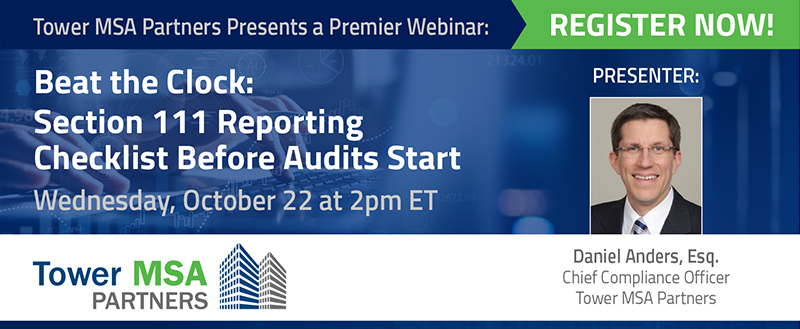
Beat the Clock: Section 111 Reporting Checklist Before Audits Start

September 30, 2025

Tower MSA Partners October Webinar prepare you for CMS Section 111 audits in 2026.

Starting in Q1 2026, the Centers for Medicare and Medicaid Services (CMS) will begin quarterly Section 111 reporting audits and is expected to issue financial penalties for non-compliant payers. What has been “coming soon” for years is now a reality, and the clock is ticking.

Join Dan Anders, Tower MSA Partners’ Chief Compliance Officer on Wednesday, October 22, at 2 pm ET, for a practical, actionable session designed to make sure your reporting is audit-proof. Dan will also provide an update on Workers’ Compensation Medicare Set-Aside (WCMSA) Section 111 reporting.

Here’s what you’ll learn:

  • Key criteria & timelines for Section 111 penalty implementation.
  • Final reporting checklist to eliminate errors and avoid penalties.
  • How CMS Section 111 reporting audits identify errors and blind spots and how to correct them.
  • Critical updates on Workers’ Compensation MSA reporting, and common pitfalls that lead to penalties

Date: Wednesday, October 22

Time: 2:00 PM ET

Register Here

Bring your toughest questions – a live Q&A session will follow the presentation. You may also submit questions ahead of time during registration.

Please click the link above and register today!

Please note that no CEU credit is offered for this webinar.

Tower MSA Partners’ Chief Compliance Officer Dan Anders Featured on Ametros Podcast “It’s Settled”

September 25, 2024

Tower MSA Partners’ Chief Compliance Officer Dan Anders Featured On Ametros Podcast

Dan Anders, Chief Compliance Officer at Tower MSA Partners, was recently featured on Ametros’ podcast, “It’s Settled.

We are excited to share that Dan Anders, Chief Compliance Officer at Tower MSA Partners, was recently featured on Ametros’ podcast, “It’s Settled.” In this engaging episode, Dan sat down with Andrea Mills, Ametros’ Chief Client Officer, and John Kane, Senior Vice President of Strategy, to dive deep into the latest news and developments surrounding Medicare Set-Asides (MSAs). This discussion covered essential topics that impact the workers’ compensation and liability settlement space, including upcoming changes to Section 111 reporting, best practices for preparing MSAs, and the value of professional administration.

Upcoming Section 111 Reporting Changes

One of the key topics covered was the upcoming changes to Section 111 reporting and their implications for insurers and self-insured entities. Dan provided insightful commentary on what these changes mean and how they will affect the reporting process. With new compliance requirements on the horizon, now is the time for stakeholders to review their reporting strategies and ensure they are prepared for these regulatory shifts.

When to Prepare an MSA

Another critical topic discussed was when to prepare an MSA. Dan highlighted the importance of evaluating the need for an MSA early in the settlement process to avoid costly delays. He also provided insights into how Tower MSA Partners helps clients navigate complex cases by offering expert guidance on when and how to prepare MSAs effectively.

The Value of Professional Administration

The conversation also touched on the value of professional administration for MSAs, emphasizing how Ametros helps individuals manage their settlement funds to ensure compliance with Medicare’s requirements. Dan, Andrea, and John discussed how professional administration not only ensures the longevity of settlement funds but also helps alleviate the administrative burden on injured individuals.

Tips for Preparing an MSA

During the episode, Dan shared several tips and tricks for preparing an MSA, helping listeners understand the importance of accuracy and thoroughness when it comes to documentation. He also explained how Tower MSA Partners’ streamlined approach helps clients minimize risks and expedite settlements.

Upcoming Webinars and Conferences

As the discussion wrapped up, the group previewed upcoming educational opportunities, including a webinar, A Claims Professional’s Guide to Successful Settlements with MSAs, hosted by Tower MSA Partners on October 2nd. Dan encouraged attendees to sign up for this and other webinars to stay informed on compliance topics and best practices in the MSA industry.

Listen Now

You can catch this insightful episode of “It’s Settled” featuring Dan Anders by clicking here.

Stay tuned for more updates from Tower MSA Partners as we continue to provide our clients with the latest compliance and settlement strategies. Be sure to sign up for our upcoming October 2nd webinar to stay informed on these important issues.

CMS Sets September 12 for Webinar on Section 111 Reporting

August 28, 2024

Webinar on Section 111 Reporting of WCMSAs

Don’t Miss the CMS Webinar on Section 111 Reporting

The Centers for Medicare and Medicaid Services has scheduled a September 12, 2024 webinar on Section 111 reporting.  Per the announcement:

The format will be opening remarks by CMS, a presentation that will include NGHP reporting best practices and reminders, followed by a question and answer session. For questions regarding Section 111 reporting, prior to the webinar, please utilize the Section 111 Resource Mailbox PL110-173SEC111-comments@cms.hhs.gov.

There is no pre-registration for the webinar.  Full details can be found here.

While CMS does not indicate the webinar is specific to Section 111 Civil Money Penalties, given that CMPs become applicable as of October 11, 2024, this presents an opportunity to have any questions addressed before that date.  Questions around the April 4, 2025 implementation of Section 111 Reporting of WCMSAs would also be encouraged.

CMS Section 111 Reference Guide Update Clarifies Date of Incident Reporting

July 15, 2024

CMS Section 111 Reference Guide Update Clarifies Date of Incident Reporting

New DOI Reporting Rules for Cumulative Injuries in Section 111 NGHP Guide

The new update of the Section 111 NGHP User Guide, Version 7.6, clarifies how to report the Date of Incident (DOI) in a Cumulative Injury.  The Centers for Medicare and Medicaid Services added the following to Chapter III Policy Guidance, Chapter 2: Introduction and Important Terms:

Note: Cumulative injury refers to those categories of injuries that may persist or grow in severity, intensity, or pain but for which a formal diagnosis may not occur until a later date. Examples of cumulative injuries include, but are not limited to, carpal tunnel syndrome, or back pain that is not the result of an acute trauma. Exposure, ingestion, and inhalation injuries are not considered cumulative injuries for purposes of calculating DOI or any other reporting requirements.

Differentiating DOI Reporting for Cumulative Trauma vs. Exposure, Ingestion, or Inhalation Claims

We assume CMS added this note to ensure that RREs do not use the definition for DOI in cumulative trauma claims when they report an exposure, ingestion or inhalation claim, as there is indeed a difference.

Cumulative Trauma Claim DOI is defined as: The earlier of the date that treatment for any manifestation of the cumulative injury began, when such treatment preceded formal diagnosis, or the first date that formal diagnosis was made by a medical practitioner (for claims involving cumulative injury).

The guide defines the exposure, ingestion or implant DOI as:

  • The date of first exposure (for claims involving exposure, including; occupational disease)
  • The date of first ingestion (for claims involving ingestion)
  • The date of the implant or date of first implant, if there are multiple implants (for claims involving implant(s)

The NHGP update to Chapter IV Technical Information, Section 6.3.3 also included this addition regarding TIN/TN errors:

If your address fails validation with USPS, you must visit your local USPS office to correct this issue. Please make the correction immediately, as TN errors delay MSP records posting.

Per Section 6.6.5 of the guide:

RRE Address Validation

• RREs are encouraged to pre-validate insurer and recovery agent addresses using postal verification software or online tools available on the USPS website pages such as https://tools.usps.com/go/ZipLookupAction_input. RREs should try to use standard abbreviations and attempt to limit data submitted in these fields and adhere to USPS standards. The address validation enhancements in place will “scrub” addresses submitted on the TIN Reference File using USPS standards, and we recommend that RREs also attempt to meet these standards, to improve results. Although NGHP DDE reporters do not submit TIN Reference Files, they do submit the same TIN information online. It is recommended that DDE reporters also pre-validate RRE addresses.

CMS stressed:

Please address errors immediately, as TIN errors delay MSP record posting.

In short, make sure your TIN Reference File has a USPS-accepted address. If you are a Tower Section 111 reporting client, we will advise you if the file contains an error and recommend a correction and resubmission.

If you have any questions, please contact Dan Anders at daniel.anders@towermsa.com.

Section 111 Reporting for WCMSAs & Avoiding Civil Penalties

June 28, 2024

Section 111 Reporting for WCMSAs: Avoiding Civil Penalties

It’s time to get everything set up to accommodate new Section 111 reporting fields for WCMSAs. While compliance has long been required, Civil Money Penalties (CMPs) are real now.

Tower’s Chief Technology Officer Jesse Shade joined our Chief Compliance Officer Dan Anders for the “Premier Webinar: Get Ready for Section 111 Reporting Penalties and WCMSA Reporting” to help attendees do just that. Here are the highlights:

Important Section 111 penalty and WCMSA reporting dates

October 11, 2024
The date that CMS starts to make Responsible Reporting Entities (RREs) accountable for the timely reporting of ongoing responsibility for medicals (ORM) and of the Total Payment Obligation to the Claimant (TPOC). Any claims with ORM or TPOC on or after October 11, 2024, can be audited and subject to penalties.

April 1, 2025
CMS requires the reporting of WCMSA information when a TPOC is reported

October 11, 2025
Date that CMS starts its compliance review process.

April 1, 2026
CMS begins Section 111 reporting audits.

About those penalties

No penalties will be issued for claims that are reported within one year of the date of acceptance of ORM or the TPOC date. And no claims with ORM or TPOC dates prior to October 11, 2024, will be reviewed.

If a claim is not reported within one year, the RRE can incur penalties of $357 per calendar day. This per-day penalty increases to $1,428 if it’s not reported for three years. (These are 2024 inflation-adjusted rates.)

The good news is that CMS caps the amount of a penalty for a single instance of noncompliance by a non-group health RRE. The bad news is that cap is $365,000!

In the somewhat good news department, CMS will randomly select only 1,000 claims to audit each year and audit 250 claims every quarter. Additionally, the agency will randomly select claims from group health as well as non-group health plan (NGHP) claims from workers’ compensation, liability and no-fault programs. This greatly mitigates your risk of an audit even if you have instances of late ORM or TPOC reporting.

How does CMS notify RREs of penalties?

CMS first emails an informal notice, so it is important to keep contact information updated in the Section 111 Profile. This initial notice allows the RRE to present mitigating evidence and this must be presented within 30 days.

Examples of the type of evidence to submit include: ORM was not reported because the claim was under investigation OR a good-faith effort was made to obtain claimant information, such as a social security number, but the claimant refused to provide it or did not respond. (See CMS Section 111 Penalties Rule Focuses on Untimely Reporting – Tower MSA for details on “good-faith efforts” to establish Medicare eligibility.)

If the RRE does not respond to the informal notice or CMS rejects the explanation, the agency mails a formal written notice. At this point, an RRE either needs to pay a fine or appeal to an administrative law judge within 60 days.

WCMSA Reporting Fields

Jesse Shade reviewed the upcoming changes CMS will implement to collect additional information on WCMSAs through Section 111 reporting. New fields and the information for them were covered in this post.

Tower smooths the transition for its Section 111 clients.

Jesse also described Tower’s IT efforts to make things as easy as possible for our Section 111 reporting clients. Our goal is to improve your ability to monitor the pivotal events in a claim.

The first step for Tower reporting clients is adding the new WCMSA fields to the end of your current claim input file.  Once the fields are added to the feed file, testing will be scheduled to confirm that the data is properly transmitted to Tower. Tower will, in turn, participate in a testing period with CMS that begins in October.

The additional fields will require those who enter the Section 111 reporting information to be trained on when to enter the WCMSA date, what date to enter, and how to enter the data.

Additionally, Tower will highlight in our MSA delivery correspondence the importance of completing this information at the time of settlement.

Tower will continue to provide comprehensive reports to our Section 111 reporting clients, ensuring the accuracy of the data reported.

Our commitment is to make this transition easy and seamless for everyone involved and we will customize systems where needed so the process works for all our clients.

Practices that protect RREs from penalties

Dan advised clients to do the following to maintain compliance with the reporting rules:

  • Query claims to identify Medicare beneficiaries monthly and document when a social security number cannot be obtained.
  • Report ORM acceptance and TPOCs on the next quarterly submission.
  • Correct errors in reporting data to avoid report rejection (if they reject a submission, it will be considered untimely if not corrected within the reporting deadline).
  • When WCMSA reporting begins, make sure these fields are completed anytime a TPOC is reported.

The webinar also provided several examples of how ORM and TPOC penalties could work and how they could be mitigated. Slides and access to the recorded webinar can be requested from Dan Anders, daniel.anders@towermsa.com.

Tower’s proactive audit

To ensure your organization’s readiness for the coming audits and penalties, have Tower audit your processes, policies and systems to see if there are any holes in your compliance. Not only will we identify errors and other issues that could lead to penalties, but we also help you fix issues that lead to them. For more information on our Section 111 audit offer, please contact hany.abdelsayed@towermsa.com.

Section 111 Mandatory Insurer Reporting Updates

February 22, 2024

Section 111 Mandatory Insurer Reporting Updates

The Centers for Medicare and Medicaid Services (CMS) issued a series of updates over the past month, which include an updated NGHP Section 111 User Guide, the latest Top 10 Section 111 Reporting errors, and its 2024 conditional payment recovery threshold.  We have summarized these for you below.

Updated NGHP Section 111 User Guide

CMS released NGHP User Guide Version 7.4, which incorporates the Section 111 civil monetary penalties rule into Section 5.1 of Chapter III: Policy Guidance of the guide. See our most recent update on Section 111 penalties in Recap of CMS Section Penalties Webinar.  CMS includes the following in the guide:

The occurrences to be audited will include both Section 111 submissions and records from sources outside of the Section 111 reporting process, to ensure that CMS does not miss those situations where an RRE has entirely failed to report the occurrence. RREs will only be informed when there is a potential instance of non-compliance.

In short, CMS will be auditing untimely reporting through Section 111 and reviewing reports outside of Section 111 to determine if there was a failure to report at all.

Top 10 List of Section 111 Reporting Errors

CMS released a chart of the Top 10 Section 111 Non-Group Health Plan Reporting Error Codes from 7/1/2023 to 12/15/2023.  The top three reporting errors were:

  • TN – 99: No matching, valid TIN Reference File Detail Record was found for the TIN/Office Code combination on the Claim Input File Detail Record.
  • CI05 – Invalid Diagnosis Code 1.
  • SP49 – No previously accepted record can be matched to the submitted delete. Delete failed.

These issues are what CMS calls “hard errors,” meaning the record will be rejected.  Remember that if a record is rejected and not timely corrected, it could be subject to Section 111 civil monetary penalties for untimely reporting.

$750 Threshold Kept for Reporting and Conditional Payment Recovery

In a February 14, 2024 alert, CMS announced that the 2024 conditional payment recovery threshold for liability, no-fault and workers’ compensation settlements will remain at $750. Accordingly, Total Payment Obligations to the Claimant (TPOCs) in the amount of $750 or less do not need to be reported to CMS through the Section 111 Mandatory Reporting process. Nor will CMS attempt to recover conditional payments for TPOCs of $750 or less (The threshold does not apply to liability settlements for alleged ingestion, implantation or exposure cases.)

By way of background, pursuant to the SMART Act of 2012, CMS must determine a threshold amount each year to ensure the collection cost stays within the amount recovered through such efforts.

Please get in touch with Tower’s Chief Compliance Officer, Dan Anders, with any questions at (888) 331-4941 or daniel.anders@towermsa.com

Recap–Special Webinar: Your Need-to-Know Guide on Section 111 Reporting Penalties

October 31, 2023

Blocks spelling RECAP regarding the recap of Section 111 Penalties webinar

On October 18 Tower’s Chief Compliance Officer Dan Anders and Chief Technology Officer Jesse Shade presented an informative webinar on Section 111 reporting and the final rule on Civil Monetary Penalties for untimely reporting. As shared in our post, these range from $250 per calendar day to $1,000 for each calendar day of non-compliance. Dan defined Section 111 reporting and covered the history of the penalty regulation before digging into the details and effects on payers. Here are some highlights:

Key dates

Penalties only apply to claims on and after December 11, 2023. Additionally, only 1,000 claims a year – from Group Health as well as Non-Group Health Plans – will be audited. The Centers for Medicare and Medicaid (CMS) will not issue penalties before October 11, 2024.

Dan advised that RREs should ensure that Ongoing Responsibility for Medicals (ORM) and Total Payment Obligation to the Claimant (TPOC) are reported in a timely fashion (within 135 days) in the quarterly file submission closest to the dates.

 Triggers for reporting

  • Acceptance of ORM
  • Termination of ORM
  • Total Payment Obligation to the Claimant (TPOC)

Although all three milestones require reporting, there is no penalty for untimely reporting of termination of ORM. (However, if termination is not reported, an RRE could receive repayment demands after it is no longer liable to pay for medical treatment.)

Penalty process

The first penalty notification is informal and gives the Responsible Reporting Entity (RRE) 30 days to respond with any mitigating evidence.  If CMS doesn’t receive a response or accept the explanation, a formal notice will be issued.  RREs can pay the penalty or appeal it to an Administrative Law Judge.

Dan suggested examples of mitigating information and outlined the appeal process.  He also provided hypothetical cases that illustrate what could and would not risk one of these penalties.

Prevention

While the chance of receiving a penalty is relatively small, why risk it at all?  Compliance steps:

  • Query for Medicare-eligible claimants every month
  • Document attempts to obtain missing data (CMS prescribes the number and type of attempts.)
  • Report ORM and TPOC within the next quarterly file submission

How Tower Helps

Jesse Shade demonstrated several powerful tools in Tower’s Section 111 portal that make it easier for RREs to comply with all aspects of Section 111 reporting.  Through the portal, RREs gain insight into individual claims or groups of claims and can:

  • See errors that must be fixed before CMS can accept a file
  • Drill down into specific error codes in order to correct them in the claims software
  • Identify claims that could require ORM or TPOC reporting
  • Find Medicare-eligible claims with open ORM that could be closed.
  • Run and download reports to share with colleagues.

Your organization does not use Tower’s Section 111 reporting platform? Consider having Tower audit your Section 111 reporting program. This will identify the potential for penalties and reveal other issues that could lead to unwarranted conditional payment demands.

Finally, some Q&As

Who receives the notice of penalty?

 The RRE, of course.  We will also advocate that the reporting agent, Tower, receive a copy of the penalty notice, both informal and formal.

Are defense attorneys or other attorneys required to report Medicare beneficiaries?

There are no duties under the regulation for the attorney. This is specific to the RRE and claims handler. An attorney could be involved in tracking social security numbers or other claimant data for the RRE.

We have been advised that those enrolled in Medicaid are exempt from Section 111 reporting requirements. Is that correct?

That is correct; this only applies to Medicare.  However, if a claimant is a dual beneficiary enrolled in Medicare and Medicaid, then there would be a reporting obligation based on the Medicare enrollment.

What happens if the claimant doesn’t report the incident in a timely manner?

Interesting question.  In this case, the RRE could be reporting ORM for an injury that happened over a year earlier.  Or if a claim was initially denied but later accepted, perhaps due to a judicial decision, there could be an ORM reported more than a year after the date of injury. This seems like an explanation that CMS would accept and why the informal notice and response process is so important.

Do you still have questions about Section 111 reporting or a specific claim?  We are happy to help and like a challenge.  Please contact Daniel.Anders@TowerMSA.com.

Nov. 13 CMS Webinar to Discuss Adding WCMSA Info to Section 111 Reporting of TPOC

October 23, 2023

Picture of Keyboard with a red Medicare button.

Based on a recent webinar invitation, the Centers for Medicare and Medicaid Services (CMS) plans to expand Section 111 reporting to include data from Workers’ Compensation Medicare Set-Asides (WCMSAs). Per CMS:

CMS will be hosting a webinar regarding the expansion of Section 111 Non-Group Health Plan (NGHP) Total Payment Obligation to Claimant (TPOC) reporting to include Workers’ Compensation Medicare Set-Aside (WCMSA) information. The format will be opening remarks and a presentation by CMS that will include background and timelines, followed by a question and answer session. Because this expansion impacts reporting of WCMSAs, it is strongly recommended that Responsible Reporting Entities (RREs) who report Workers’ Compensation settlements attend.

The webinar will be held on November 13, 2023, at 1:00 p.m. ET.  The notice can be found here.

We encourage anyone managing Section 111 reporting for a WC RRE to tune in.  Please note that there is no pre-registration. The link and call-in phone numbers are on the notice, and you log in shortly before the webinar’s start time.

Tower MSA Partners will provide a post-webinar summary with key takeaways and recommendations.

Special Webinar: Your Need-to-Know Guide on Section 111 Reporting Penalties

October 16, 2023

Details regarding the October 18th Webinar on Section 111 Penalties featuring Tower MSA Partners speakers.

CMS recently published its final rule on the imposition of Section 111 Mandatory Insurer Reporting penalties.  While we addressed the specifics of the rule in our article, CMS Section 111 Penalties Rule Focuses on Untimely Reporting, we know that many questions remain.

In a special webinar on October 18 at 2 p.m. ET, Tower’s Chief Compliance Officer, Dan Anders, and Chief Technology Officer, Jesse Shade, will provide your need-to-know guide to these penalties.  Topics will include:

  • Complete analysis of the rule, including criteria, penalty amounts and appeals
  • Examples of reporting situations which will and will not run afoul of the rule
  • Safe harbors from penalties
  • Best practices to mitigate and eliminate the potential for penalties
  • Resources available to Tower Section 111 reporting clients to ensure proper reporting

A Q&A session will follow the presentation, and we encourage you to submit questions when you register. Please click the link below and register today!

Please note there is no CEU credit offered for this webinar.

Register Here


CMS Section 111 Penalties Rule Focuses on Untimely Reporting

October 12, 2023

Stamp icons representing regulatory enforcement of Section 111 reporting by CMS.

On October 11, 2023, CMS published a final rule on the imposition of Civil Monetary Penalties for failure to comply with the Section 111 Mandatory Insurer Reporting requirements.  The rule’s focus and the sole reason for penalties will be untimely reporting.  Even if a Responsible Reporting Entity (RRE) reports untimely, it may only be subject to penalties if that claim is identified through a randomized quarterly audit process.

Please see a full Q&A below.  We will be sending an invitation for a special webinar on Section 111 penalties shortly!

Note, while the final rule encompasses both Group Health Plans (GHPs) and Non-Group Health Plans (NGHPs), this article is specific to NGHPs.

Under what circumstances can CMS impose penalties?

Per CMS:

. . . we have determined that we will only impose penalties where the initial report was not received in a timely manner. Penalties will not be imposed on any other basis, such as in relation to the quality of reporting. Timeliness is determined by comparing the date a record is submitted and accepted against the date CMS should have received the record. The date CMS should receive a record is determined by the effective date of coverage or the date of settlement (or settlement funding date if the funding of the settlement is delayed) plus 1 year (365 days).

CMS considers the “initial report” to be the reporting on Ongoing Responsibility for Medicals (ORM) or, if ORM was not previously reported, the reporting of Total Payment Obligation to the Claimant (TPOC), namely the settlement, judgment, award, or other payment.  Importantly, CMS expressly indicated in these comments that a failure to report ORM termination will not subject the RRE to penalties:

In the final rule, based on stakeholder concerns and submitted comments, CMS has chosen to focus its definition of noncompliance solely on those situations where an entity has failed to provide its initial report of primary payment responsibility in a timely manner. That means that untimely termination of ORM coverage records would not be considered eligible for a civil money penalty under this rule.

On the surface, even this more narrowly tailored rule could subject many claims to penalties. However, CMS is implementing a randomized audit process that will only review a small portion of the thousands of reported claims it receives. Per CMS:

CMS has determined that, given the time and resources necessary to accurately and thoroughly evaluate the accuracy of any submitted record, it would be possible to audit a total of 1,000 records per calendar year across all RRE submissions, divided evenly among each calendar quarter (250 individual beneficiary records per quarter).

    •  CMS will evaluate a proportionate number of GHP and NGHP records based on the pro-rata count of recently added records for both types of coverage over the calendar quarter under evaluation. For example, if over the calendar quarter being evaluated, CMS received 600,000 GHP records and 400,000 NGHP records for a total of 1,000,000 recently added beneficiary records, then 60 percent of the 250 records audited for that quarter would be GHP records, and 40 percent would be NGHP records.
    •  At the end of each calendar quarter, CMS will randomly select the indicated number of records and analyze each selected record to determine if it is in compliance with the reporting requirements as required by statute and defined herein.

Accordingly, to be chosen for a penalty a claim would need to both be reported untimely and identified through this randomized audit.  As CMS indicated in its comments, it expects this type of audit to pick up larger reporting entities.

How will the RRE be notified of the penalty?

Once a claim has been identified for a penalty there is an informal notice process, per CMS:

We intend to communicate with the entity informally before issuing formal notice regarding a CMP. The informal (that is, prior to formal enforcement actions) written “pre-notice” process will allow the RRE the opportunity to present mitigating evidence for CMS review prior to the imposition of a CMP. The RRE will have 30 calendar days to respond with mitigating information before the issuance of a formal written notice in accordance with 42 CFR 402.7.

Common to all such instances where informal notice will be given is the intention to give the RRE an opportunity to clarify, mitigate, or explain any errors that were the result of a technical issue or due to an error or system issue caused by CMS or its contractors. It would be impractical and counter to the spirit of the informal notice process to regulate or enumerate all circumstances in which mitigating information could be provided or what that information should convey. As such, any mitigating factors or circumstances are welcomed, and a dialogue is encouraged in an attempt to find solutions that are short of imposing a CMP. We believe it is in the best interests of all RREs to leave the informal notice process open to any reasonable submission of mitigating factors so that we are free to entertain all such documentation without strict limits on what is, or is not, acceptable.

In many circumstances, the RRE may have a reasonable explanation for the untimely reporting. Because of the 30-day timeline, RREs must be prepared to react quickly to these informal notices by investigating and responding within the required timeframe.

If the RRE fails to respond to the informal notice or CMS does not accept the explanation for why the report was untimely, then CMS will issue a formal notice.

Is there an appeals process?

Yes, per CMS:

The recipient will have the right to request a hearing with an Administrative Law Judge (ALJ) within 60 calendar days of receipt. Any party may appeal the initial decision of the ALJ to the Departmental Appeals Board (DAB) within 30 calendar days. The DAB’s decision becomes binding 60 calendar days following service of the DAB’s decision, absent petition for judicial review.

If a penalty is imposed, how will the dollar amount be calculated?  Is there a maximum penalty?

CMS has developed a tiered approach to penalties, which provides:

Because we have the statutory authority to adjust the amounts of penalties imposed on NGHP RREs, a tiered approach and cap on the total amount of penalties applicable to such RREs are being finalized in this rule. As explained previously, the statute does not permit us to extend this approach to GHP RREs. For any record selected via the random audit process described above where the NGHP RRE submitted the information more than 1 year after the date of settlement, judgment, award, or other payment (including the effective date of the assumption of ongoing payment responsibility for medical care); the daily penalty will be—

    • $250, as adjusted annually under 45 CFR part 102, for each calendar day of noncompliance, where the record was reported 1 year or more, but less than 2 years after, the required reporting date;  
    • $500, as adjusted annually under 45 CFR part 102, for each calendar day of noncompliance, where the record was reported 2 years or more, but less than 3 years after, the required reporting date; or  
    • $1,000, as adjusted annually under 45 CFR part 102, for each calendar day of noncompliance, where the record was reported 3 years or more after the required reporting date.

Additionally, the total penalty for any one instance of noncompliance by an NGHP RRE for a given record identified by CMS will be no greater than $365,000 (as adjusted annually under 45 CFR part 102).

Are there any safe harbors from penalties?

 Per CMS:

First, any untimely reporting that is the result of a technical or system issue outside of the control of the RRE, or that is the result of an error caused by CMS or one of its contractors would not be considered noncompliance for purposes of this rule.

Second, any untimely reporting by an NGHP that is the result of a failure to acquire all necessary reporting information due to a lack of cooperation by the beneficiary will not lead to a CMP provided that certain standards are met.

CMS defines a safe harbor based on good faith efforts to obtain claimant information for reporting as follows:

 If an NGHP entity fails to report timely because the NGHP entity was unable to obtain information necessary for reporting from the reportable individual, including an individual’s last name, first name, date of birth, gender, MBI, or SSN (or the last 5 digits of the SSN), and the responsible applicable plan has made and maintained records of its good faith effort to obtain this information by taking all of the following steps:

    •  The NGHP has communicated the need for this information to the individual and his or her attorney or other representative (if applicable) and requested the information from the individual and his or her attorney or other representative at least twice by mail and at least once by phone or other means of contact such as electronic mail in the absence of a response to the mailings.
    •  The NGHP certifies that it has not received a response, or has received a response in writing that the individual will not provide his or her MBI or SSN (or last 5 digits of his or her SSN).
    •  The NGHP has documented its efforts to obtain the missing information, such as the MBI or SSN (or the last 5 digits of the SSN) and the reason for the failure to collect this information.

The NGHP entity should maintain records of these good faith efforts (such as dates and types of communications with the individual) in order to be produced as mitigating evidence should CMS contemplate the imposition of a CMP. Such records must be maintained for a period of 5 years. The current OMB control number assigned to this information collection effort, as required under the Paperwork Reduction Act, is 0938-1074.

Is there a statute of limitations on penalties?

Yes, per CMS:

We agree and will apply the 5-year statute of limitations as required by 28 U.S.C. 2462. Under 28 U.S.C. 2462, we may only impose a CMP within 5 years from the date when the noncompliance occurred.

The five-year limitation begins to run as of the date the untimely report is made to CMS.

When does the rule become effective?

The rule becomes effective as of December 11, 2023.

Will the rule be retroactive?

No, per CMS:

CMPs will only be imposed on instances of noncompliance based on those settlement dates, coverage effective dates, or other operative dates that occur after the effective date of this regulation and as such, there will be no instances of inadvertent or de facto retroactivity of CMPs.

Since the rule effective date is December 11, 2023, CMS can consider penalties on untimely reported claims on or after this date.  This means that if the untimely ORM and TPOC date was December 11, 2023, or later, it may be subject to penalties.  Untimely, pre-December 11, 2023, ORM and TPOC dates will not be subject to penalties.

Additionally, CMS has indicated that penalties will not be issued until one year after the final rule’s publication, namely October 11, 2024.

How does the final rule differ from the proposed rule?

The proposed rule contained two other issues that could result in penalties.  These were RREs reporting ORM and later reporting contradictory diagnosis codes and exceeding error tolerance thresholds.  The final rule consists solely of penalties for untimely reporting.

This means that reporting errors, such as incorrect diagnosis code reporting, will not result in Section 111 reporting penalties (although it can still result in inappropriate Medicare conditional payment demands).  Further, when the RRE corrects this data, it will not be penalized for doing so.

What steps must an RRE take to avoid penalties?

Simply put, reporting of ORM and/or TPOC must be timely.  When the criteria are met for a claim to be reported, it should be reported during the next quarterly reporting period.

Suppose the RRE has difficulty obtaining identifying information to determine whether a claimant is a Medicare beneficiary. In that case, those efforts should be in accordance with the good faith effort rules described in the safe harbor section.

Tower’s Section 111 reporting platform and management dashboard provides our reporting partners the tools necessary to identify Medicare-eligible claimants.  Once eligibility is confirmed it is critical to use this information to report acceptance of ORM and/or TPOC. Tower MSA Partners stands ready to assist you with your questions and to provide necessary reports and overall guidance to ensure compliance.

Contact us if you are concerned that your current reporting platform may not protect you from penalties.  An audit of your current Section 111 reporting data often reveals gaps in reporting which may lead to penalties.

Tower’s Chief Compliance Officer, Dan Anders, can be reached at daniel.anders@towermsa.com.