Section 111 Reporting Penalties Rule Released

October 10, 2023

Tower MSA Partners analyzes CMS final Section 111 penalties rule and compliance requirements for RREs.

The long-awaited Section 111 Mandatory Insurer Reporting Civil Monetary Penalties (CMPs) rule has been released.  Recall that the purpose of the rule is to set out specific criteria for when CMS may impose penalties for what it considers a failure to report or improper reporting.  The rule is unpublished but will be considered published tomorrow, October 11.

In conjunction with its release, the Centers for Medicare and Medicaid Services issued the following Alert:
 
Effective Dates

Please note that this rule is effective as of 60 days following the date of publication (December 11, 2023), but is only applicable one year after publication (October 10, 2024). RREs are expected to be compliant with their Section 111 Mandatory Insurer Reporting requirements no later than October 10, 2024, or they may be eligible for a CMP.

Additional Information

RREs should review the published rule and take time to evaluate their reporting processes to ensure the RRE is compliant with all reporting requirements before the rule goes into effect. If RREs have any questions or concerns about their reporting, they should contact their EDI representative.

We know that CMPs are of great interest to RREs, and CMS is in the process of developing and publishing additional written guidance related to CMPs. Questions should be directed to the new CMS Section 111 Civil Money Penalties mailbox at Sec111CMP@cms.hhs.gov. Please be aware that responses should not be anticipated at this time; CMS will use these questions and comments to help inform outreach and educational materials (including webinar presentations). RREs should continue to monitor the Mandatory Insurer Reporting pages on CMS.gov where additional guidance and updates, including information about CMP-related webinars, will be posted.

Key Takeaway
 
The initial key takeaway from this announcement is the rule will be enforced against RREs starting on October 10, 2024, one year from today. Further, as noted by CMS, there will be additional guidance before that date.

We are in the process of reviewing the regulation and will provide a complete analysis shortly.  This will be followed by an invitation to a special Tower webinar to explain the rule and its implications for RREs and answer your questions.

If you have any immediate questions, please reach out to Tower’s Chief Compliance Officer, Dan Anders at daniel.anders@towermsa.com.

Fixed Percentage Option Now Available for Liability Settlements up to $10,000

September 29, 2023

Tower MSA Partners explains CMS Fixed Percentage Option for liability settlements up to $10,000.

The Centers for Medicare and Medicaid Services recently announced that the maximum settlement amount for use of the Fixed Percentage Option will increase from $5,000 to $10,000, effective 10/2/2023. The Fixed Percentage Option is available to the claimant in a liability settlement and allows them to agree to pay 25% of the total settlement amount to resolve Medicare’s recovery claim for conditional payments.  The criteria for selecting this option are:

  • Your liability insurance (including self-insurance) settlement, judgment, award or other payment is related to an alleged physical trauma-based incident and;
  • The total settlement is for $5,000 (Note this amount will be raised to $10,000, effective October 2, 2023) or less.
  • You elect the option within the required timeframe and Medicare has not issued a demand letter or other request for reimbursement related to the incident.
  • You have not received and do not expect to receive any other settlements, judgments, awards, or other payments related to the incident.

This option benefits the injured person when Medicare conditional payments exceed 25% of the total settlement amount.  For example, if Medicare has made conditional payments of $8,000 on a $10,000 total settlement, the claimant would pay only $2,500 to resolve them with the Fixed Percentage Option. On the other hand, if conditional payments are $800 on a $10,000 settlement, it is better to use the traditional repayment method with a proportional reduction for attorney’s fees and costs, if any.

Accordingly, it is essential for claimants and their attorneys to investigate Medicare conditional payments prior to settlement so that they can choose the best method for resolving Medicare’s interests.

More information on the Fixed Percentage Option can be found on the CMS website here.

Please contact Tower’s Chief Compliance Officer, Dan Anders, at daniel.anders@towermsa.com with any questions.

Tower MSA Partners Launches New Website and Celebrates 12th Anniversary

September 26, 2023

Tower MSA Partners celebrates its 12th anniversary and launches its new website.

Tower MSA Partners recently marked our 12 years in business with the rollout of a new, streamlined website that emphasizes our focus on your settlements.  We facilitate claim closure by aggressively seeking savings and making Medicare Secondary Payer (MSP) compliance and Medicare Set-Aside (MSA) prep better, faster and easier.

Working on the new site allowed us to reflect on our differentiators. We don’t try to be all things to all people.  We are singularly focused on MSP compliance, MSA preparation, and going above and beyond to serve our clients.  It’s you, our client partners, and your need to close claims and continually improve your workers’ comp programs that drives us.

This includes our built-for-this-industry MSP Automation Suite, which integrates Section 111 reporting with conditional payment resolution and MSA preparation processes.  Automation saves significant time, reduces errors and allows our client partners to focus on matters other than MSP compliance. And our annual SOC 2 Type II audit confirms the efficiency and effectiveness of our systems and processes.

As great as our tech is, however, at some point, it must give way to human expertise. It’s our legal and clinical specialists who apply their knowledge and experiences to remove barriers to settlement. Our clients appreciate our intuitive technology, but they love the personal service we provide.

As our name says, Tower is your partner. We actively listen to our clients’ goals and desires and make them our own.  Our specialists respond quickly to your questions with clear answers. We consult, advise and stay involved through claim closure and (when appropriate) approval from the Centers for Medicare and Medicaid Services (CMS).

We know that an MSA allocation can determine if a claim can close and we fight for every dollar of savings while we maintain 100% compliance with CMS and state regulations. Tower will also assemble and lead a settlement team to work with injured workers and their attorneys to bring claims to closure.

As we celebrate our 12th anniversary and the launch of a new website, we thank our clients – our partners – for your trust and support.  Many of you have been with us for all 12 years.  We look forward to many more years of innovation and successful settlements.

Please visit our new website, still www.TowerMSA.com, and tell us what you think.


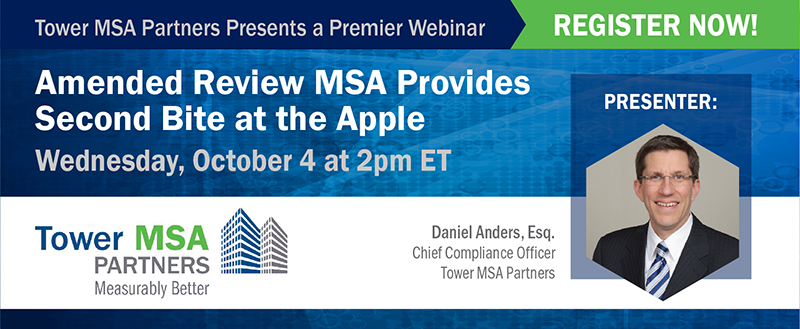
Premier Webinar: Amended Review MSA Provides Second Bite at the Apple

CMS now allows any previously approved MSA to have a one-time Amended Review.  This means that CMS will consider a new MSA submission that may be lower or higher than the previously approved MSA. Essentially, it is a second bite at the apple for old MSAs that, for whatever reason–they were too high, or the injured worker was not ready to settle–weren’t utilized for settlement.

Tower is pleased to feature our Chief Compliance Officer, Dan Anders, who on Wednesday, October 4, at 2:00 PM ET, will address the following topics:

  • Criteria for an Amended Review MSA
  • Is an Amended Review MSA required?
  • Documentation to support an Amended Review MSA
  • Examples of Amended Review MSA submissions

Besides Amended Review MSAs, the webinar will also consider how MSA Re-Reviews can reduce MSA amount resulting from CMS counter-highers.

A Q&A session will follow the presentation, and you can provide questions when you register. Please click the link below and register today!

Please note there is no CEU credit offered for this webinar.

Register Here

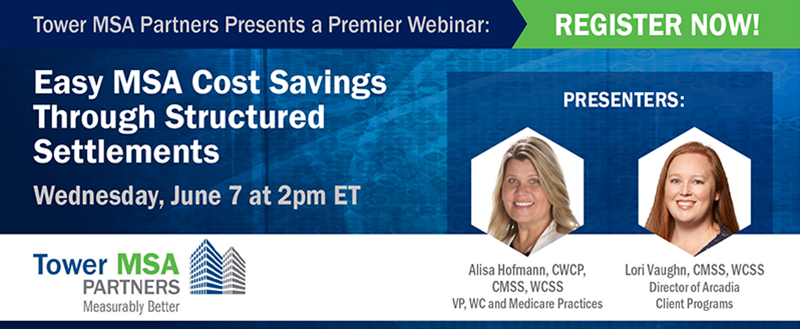
Easy MSA Cost Savings Through Structured Settlements

June 21, 2023

Easy MSA Cost Savings Through Structured Settlements.

Tower’s structured settlement partner, Arcadia Settlements Group, gave an in-depth overview of how Medicare Set-Asides, structured settlements, and professional administration facilitate workers’ comp settlements during our recent Premiere Webinar. Tower MSA Partners Chief Compliance Officer, Dan Anders, moderated the informative session that featured Alisa Hofmann, Arcadia’s VP of Workers’ Comp and Medicare Practices, and Lori Vaughn, who oversees its structured settlement programs.

As you may know, workers’ comp settlements can be paid out in a lump sum or through structured settlements.  Here are some not-so-fun facts about lump sums:

  • 25-30% of injured people exhaust lump sum settlement funds within 2-3 months.
  • 85-90% of injured people dissipate lump sum settlement funds within 2-5 years.

When injured workers exhaust these funds, if they are Medicare beneficiaries, they turn to Medicare to cover injury-related medical bills. And the whole point of the Medicare Secondary Payer Act is to prevent this.

Structured settlements protect the MSA funds by paying them over time as an annuity. The injured worker receives two years of the MSA allocation at settlement plus the cost of a first procedure or replacement if there are any. The rest of the MSA comes in annual payments, so the injured worker receives a consistent stream of funds for injury-related care over their lifetime.

For payers, this arrangement offers significant savings and a path to faster claim resolution, especially when paired with professional administration. And, like an MSA, the structured settlement shows Medicare that its interests are protected.

A Couple of Takeaways:

  • Structured settlements aren’t only for MSAs. They can be used for indemnity and funds for healthcare services and equipment not covered by Medicare. Even attorneys can be paid through these.
  • CMS-approved lump sum MSAs can be converted to a structured MSA but require submission to CMS of an attestation from the injured worker agreeing to the change.
  • It is easier to submit the MSA to CMS in the structured settlement format as if it is later decided to go with a lump sum there is no need to submit an injured worker letter to CMS agreeing to the change. In short, submitting in this format saves time, money and frustration.

Hofmann and Vaughn also discussed self-administration versus professional administration of the MSA. They urged payers to educate injured workers on the risks, rules, and responsibilities of MSA administration.

CMS prefers professional administration. Plus, some companies like our partner Ametros provide medical and pharmaceutical savings in addition to managing the fund and reporting.

With examples that show how structured settlements are calculated, the webinar is great for new claims representatives and those who want a refresh on settlement tools.  If you’d like to receive more information on structuring an MSA or a link to the recording, please email your request to Dan Anders at daniel.anders@towermsa.com.

 

CMS Changes Rules for ORM and NOINJ Reporting in the Latest Update of its Section 111 Reporting User Guide

June 9, 2023

Tower MSA Partners explains CMS updates to ORM and NOINJ rules in the Section 111 reporting user guide.

The Centers for Medicare and Medicaid Services (CMS) recently released Version 7.2 of its MMSEA Section 111 User Guide. The guide contains some notable updates for Ongoing Responsibility for Medicals (ORM) reporting, determination of the ORM termination date with a physician letter, and use of the NOINJ code in certain liability settlements.

Revised Trigger for ORM Reporting

CMS revised Section 6.3 (Policy Guidance) on the trigger for reporting Ongoing Responsibility for Medicals (ORM):

The trigger for reporting ORM is the assumption of ORM by the RRE, which is when the RRE has made a determination to assume responsibility for ORM and when the beneficiary receives medical treatment related to the injury or illness. Medical payments do not actually have to be paid, nor does a claim need to be submitted, for ORM reporting to be required. The effective date for ORM is the DOI, regardless of when the beneficiary receives the first medical treatment or when ORM is reported.

We surmise that CMS added the additional requirement (bolded) for reporting ORM so that allow no-fault plans do not have to report ORM on minor claims that have no evidence of medical treatment.  Workers’ compensation plans already have an exclusion for reporting ORM on minor medical-only WC claims where medical payments do not exceed $750, along with other requirements (See Section 6.3.1 of the guide).

The change raises an interesting question: What obligation does the no-fault plan have to determine if treatment has occurred?  In other words, does the no-fault plan have to actively inquire about treatment? Or can it be passive and wait to report ORM after treatment is occurring? There isn’t an answer from CMS’s ORM definition.

Determining ORM Termination Date Based on Physician Statement

CMS previously added a provision to Section 6.3.2 (Policy Guidance) which allows ORM termination based on a physician statement finding that no additional medical items and/or services associated with the claimed injuries will be required.  Apparently, a question arose about what ORM termination date to enter if such a physician letter is obtained.  Per CMS:

Where an RRE is relying upon a physician’s statement to terminate ORM, the ORM termination

date to be submitted should be determined as follows:

  • Where the physician’s statement specifies a date as to when no further treatment was

required, that date should be the reported ORM termination date;

  •  Where the physician’s statement does not specify a date when no further treatment was

required, the date of the statement should be the reported ORM termination date;

  •  Where the physician’s statement does not specify a date when no further treatment was

required, nor is the statement dated, the last date of the related treatment should be used as the ORM termination date.

The above should clarify the appropriate ORM termination date to use when a physician statement is obtained.

Reporting of NOINJ is Now Optional

Since the early days of Section 111 reporting CMS has required liability claims where medicals are released in settlement but where the type of claim typically has no associated or alleged medical care to be reported.  Because there were no diagnosis codes to report, these claims were reported with a “NOINJ” code.  Examples of such claims were loss of consortium, an errors or omissions liability insurance claim, a directors and officers liability insurance claim, or a claim resulting from a wrongful action related to employment status action.

CMS has now revised its policy in Section 6.2.5.2 of the User Guide (Technical Information) on the reporting of such claims to state:

Note: In cases where the reporting of a liability record only meets the criteria for reporting a ‘NOINJ’ diagnosis code in Field 18, the reporting of the record is no longer required. However, it is optional for the RRE to report the record with the ‘NOINJ’ diagnosis code following the previously existing rules in the User Guide as follows:

This update is great news for carriers who have had to report these types of claims for more than a decade now.

If you have any questions on these updates, please contact Tower’s Chief Compliance Officer, Dan Anders, at (888) 331.4941 or daniel.anders@towermsa.com

CMS News Roundup: New Conditional Payment Appeals Guide & Webinar on Section 111 Reporting

May 25, 2023

Tower MSA Partners covers CMS new guide on Medicare conditional payment appeals and the upcoming Section 111 reporting webinar.

The Centers for Medicare and Medicaid Services (CMS) recently released a how-to guide for appealing Medicare conditional payment demands. The Non-Group Health Plan (NGHP) Applicable Plan Appeals Reference Guide consolidates conditional payment rules and best practices that the agency has issued through webinars, slides and its website.

Section 2.0 gives a breakdown of the appeals levels and explains how to submit an appeal and authorization/letter of authority requirements.  Section 3.0 details what can be appealed and supporting documentation.  Section 4.0 lists additional resources.  Finally, an appendix provides sample letters and model language for applicable plans to appoint recovery agents.

It is important to note that this guide does not cover Conditional Payment Notices (CPNs), which are issued before demand letters to allow the recipient 30 days to dispute the charges.  However, the bases for CPN disputes are the same as those found in Section 3.0.  When the dispute fails or is not timely, a demand letter is issued and the demand letter can be appealed, even with the same arguments used to dispute the CPN.

We appreciate CMS taking the time to draft and release this guide.  It joins the WCMSA Reference Guide and the Section 111 User Guide as critical reference tools for anyone impacted by Medicare Secondary Payer compliance.

CMS Section 111 Non-Group Health Plan (NGHP) Unsolicited Response File Webinar

The Centers for Medicare and Medicaid Services (CMS) recently published a Section 111 reporting webinar notice for a webinar on June 6, 2023 at 1:00 PM ET and states:

CMS will be hosting a webinar regarding the upcoming implementation of the Section 111 NGHP
Unsolicited Response File option. The format will be opening remarks by CMS, a presentation that will include background as well as how to opt in and what to expect, followed by a question and answer session. For questions regarding this topic, prior to the webinar, please utilize the Section 111 Resource Mailbox PL110-
173SEC111-comments@cms.hhs.gov

As of July 2023, Responsible Reporting Entities (RREs) can opt-in to receive a monthly “NGHP Unsolicited Response File” via the Section 111 secure website. Per CMS, the file “will provide critical information about updates to ORM records originally submitted in the last 12 months and allow RREs to either update their internal data or contact the Benefits Coordination & Recovery Center (BCRC) for a correction.”

It is important for an RRE to review and confirm that the changes made by the BCRC and listed in this report are correct.  If not, then the BCRC must be contacted to advise them that the RRE disagrees with the change made by the BCRC.  We encourage anyone involved in managing Section 111 reporting to tune in.  Please note that there is no pre-registration; the link and call-in numbers are on the notice.  You log in shortly before the webinar’s start time.

Related Articles

CMS to Provide RREs with Response File on ORM Record Changes

Premier Webinar: Easy MSA Cost Savings Through Structured Settlements

May 18, 2023

Tower MSA Partners webinar on structured settlements for Medicare Set-Asides cost savings and compliance.

One of the easiest ways to lower the settlement cost is through a structured Medicare Set-Aside. Not only does this reduce the payer’s cost of funding the MSA, but it also provides the injured worker a consistent stream of funds for injury-related medical care over their lifetime.

 On June 7 at 2 pm (EDT) Tower will present an informative session on structured settlements for MSAs. Tower’s Chief Compliance Officer will moderate a special guest panel from Arcadia: Alisa Hofmann, Vice President – Workers’ Compensation and Medicare Practices and Lori Vaughn, Director of Arcadia Client Programs. This hour-long webinar will show how structured MSAs can benefit all stakeholders in a settlement – the injured party, Medicare and the insurance carrier or employer.

Attendees will learn:

  • How to work with a structured settlement provider to incorporate an MSA structure into settlement.
  • The methodology CMS uses to calculate a structured MSA.
  • Rules around converting a CMS-approved lump sum MSA into a structured MSA.
  • The role of a structured settlement broker pre-settlement, during settlement negotiations and post-settlement.

A Q&A session will follow the presentation, and you can provide questions you’d like to have answered when you register. Please click the link below and register today!

Please note that there is no CEU credit offered for this webinar.

Register here.

About Alisa Hofmann:

Alisa is the Vice President of Workers’ Compensation and Medicare Practices at Arcadia Settlements Group and currently works on the Business Development team. She has been handling and overseeing Workers’ Compensation claims for almost three decades with various national carriers.  Alisa obtained her BA in Organizational Communication at Otterbein University. She maintains her adjuster licensing in many states, also holds Life, Health, and Accident Licensing, and many Insurance Accreditations. Alisa has been an active member of the National Structured Settlement Trade Association since 2019, and a member of The MSP Network where she serves on the Professional Administration and Structure-Education Committee.

About Lori Vaughn:

Lori Vaughn has 15+ years of experience in the structured settlement industry and currently oversees structured settlement programs for multiple workers’ compensation and private insurance carrier clients. She leads teams of consultants, case managers, and corporate employees, and is the primary point of contact for the corporate management team for each client. Lori obtained her BS in Kinesiology from California State University, Fresno, and her MS in Kinesiology from California Baptist University. She holds her Life, Health, and Accident licenses in many states and is a member of the National Structured Settlements Trade Association.

CMS Significantly Expands Amended Review MSA Availability

May 17, 2023

Tower MSA Partners covering CMS expanded Amended Review availability for Medicare Set-Aside arrangements.

The Centers for Medicare and Medicaid Services (CMS) announced the expansion of its Amended Review policy to significantly more MSAs in the latest update to its WCMSA Reference Guide, Version 3.9. The Amended Review process was previously limited to MSAs approved within the last 12 to 60 months.

The 60-month limitation is now gone, opening the door to a second bite at the apple for any MSA approved over 12 months prior.

Does Your MSA Qualify?

CMS provides the following criteria for an Amended Review:

Where the following criteria are met, CMS will permit a one-time request for re-review in the form of a submission of a new cover letter, all medical documentation related to the settling injury(s)/body part(s) since the previous submission date, the most recent six months of pharmacy records, a consent to release information, and a summary of expected future care.

  • CMS has issued a conditional approval/approved amount at least 12 months prior.
  • The case has not yet been settled as of the date of the request for re-review.
  • Projected care has changed so much that the submitter’s new proposed amount would result in a 10% or $10,000 change (whichever is greater) in CMS’ previously approved amount.

A claim that meets these criteria qualifies for an Amended Review.

Other Notable Updates

The CMS Regional Offices no longer approve the MSA before its release to the submitter.  For a brief history, when CMS introduced the MSA review process in 2001 the regional offices reviewed the MSA submissions.  CMS replaced their review responsibility in 2005 by introducing a centralized review contractor, the Workers Compensation Review Contractor (WCRC).  Since then, the regional offices approved the MSA recommendation made by the WCRC.

While no longer putting their stamp of approval on the MSA, the regional offices are still responsible for the receipt and review of final settlement documents to confirm the proper funding of the MSA.

Also, as part of the update, CMS clarified pricing methodology around intrathecal pumps, spinal cord stimulators, and peripheral nerve stimulator replacement frequency.

Practical Implications

The big news is the availability of Amended Review MSAs for any prior approval which otherwise meets the above-defined criteria.  We recommend that payers review their files to identify open medical claims which may now be eligible for an Amended Review. Tower stands ready to assist you with such a review and identify claims that can now be settled.  Please contact us for further consultation.

The Critical Care Nurses Give MSAs

May 11, 2023

Graphic of The Critical Care Nurses Give MSAs and photo of Brittney O'Neal, a nurse and Tower’s Director of Clinical Operations.

In the second installment of our quarterly series, “Tower Partners: People Behind the Settlements,” and in celebration of Nurses Week, we spotlight Brittney O’Neal, our Director of Clinical Operations. A nurse, Brittney oversees the team of nurses that produces our Medicare Set-asides (MSAs).

There are so many elements and areas of expertise needed to develop an MSA that is fair, reasonable and compliant.  Or, as we say: optimized. If Tower’s MSA operation was in the shape of a wheel, Brittney would be the hub.  Read on to learn more about her and how our MSAs are written to be effective settlement tools.

  1. What does your position as Director of Clinical Operations entail? And how does your role impact Tower’s clients?

I lead clinical operations which includes MSA writing, quality assurance and our Physician Follow-up service. We have a team of RNs who review the records and write MSA reports.  In so doing, they identify potential treatment and pharmacy problems and make intervention and mitigation strategies. As part of our quality assurance, I review MSA allocations for accuracy and make necessary corrections before they are delivered to our clients.  I also oversee our Physician Follow-up team, which is contacting treating physicians to resolve many of the problems we identified in writing the MSA.

Client communication is vitally important. I’m available to answer questions from clients and prospects and help them put together a plan of action to settle a claim.

  1. What led you to become a nurse? What experiences shaped your professional journey?

I actually started in the pharmacy field, wanting to become a pharmacist. However, one of my mentors told me that the industry was moving away from patient care and that I should look into more of the medical side.

  1. How did you get into MSP compliance and MSAs?

Honestly, by chance. I was a pharmacy technician looking for something different and was fortunate to land an interview with Tower MSA Partners. Kristine Dudley, Tower’s Chief Operating Officer, gave me an opportunity to turn a job into a career.

  1. How does being a nurse help you in your job at Tower?

Being a nurse enables you to better understand the medical material you are reading to in turn prepare an accurate allocation. It guides your approach to researching services and Medicare coverage and the ability to provide intervention strategies.

  1. What part of the job do you find the most rewarding?

I enjoy being able to help our teams and clients navigate the different aspects of this industry.  It’s great to be able to teach and share my knowledge while also learning from others. It is also rewarding to hear from clients who are grateful for the cost-saving measures our team accomplishes and the turn-around time of the reports.

  1. What are some of the things clients ask about most often?

Many questions include whether an MSA or Medical Cost Projection (MCP) is needed, CMS review thresholds, and the Amended Review process. Other questions deal with mitigation tactics to help with cost-saving measures.

  1. How do you facilitate the settlement of claims for Tower clients?

Everything Tower does is designed to facilitate claims settlement.  Carefully reviewing claims for cost drivers, like the wrong body part or duplicative or discontinued drugs. (That pharmacy background really came in handy!)  Turning around reports quickly and recommending and implementing clinical interventions to eliminate unnecessary costs.  Physician Follow-up ensures that treatment changes are properly recorded in medical records and that we have a signed physician statement so CMS can approve our MSA.

  1. Where did you attend school/degrees?

I earned an Associate of Arts degree from Palm Beach State College, then an Associate Degree in Nursing (ADN) from HCI College, also in Palm Beach, Florida.

  1. What do you like best about working for Tower?

The close-knit family atmosphere. No matter what “title” one holds, we all understand the different levels of the workflow and are willing to assist in various areas when needed. Everyone is willing to share their knowledge so that other members can better understand the MSA/CMS process, along with other MSP matters, such as conditional payments and mandatory reporting.

  1. How do you think Tower sets itself apart from companies that sell the same/similar services?

I feel Tower MSA Partners sets itself apart from other companies by promptly being available for our clients to speak with and by having attorneys on staff for consultation. Another way is our free Physician Follow-up service and fast turn-around time on reports.

  1. Where did you grow up, and where do you live now?

I was Born in Long Island, NY, and moved to Palm Beach County, FL as a child.  Now we’re living in Saint Lucie County, FL.

  1. Tell us about your background and family.

Prior to joining this industry, I worked in retail and hospital pharmacy which assisted me with transitioning into the MSA world and going on to pursue my RN. My husband is a Firefighter/Paramedic, and we have three children (12, 9, and 5).

  1. What do you like to do on your time off?

On my off-time, I am a busy wife/mom running around to football practices/games and will soon start softball for my baby girl. I also enjoy weightlifting with my husband and family outings.

Thank you to Brittney and all our Tower nurses for your commitment to providing our clients with the highest level of service.  Happy Nurses Week!