CMS Rolls Out ACH Payment Option for Recovery Debts

February 23, 2022

Tower MSA Partners covers CMS new guide on Medicare conditional payment appeals and the upcoming Section 111 reporting webinar.

The Centers for Medicare and Medicaid Services now provides ACH payment option for Medicare conditional payment debts.

The Centers for Medicare and Medicaid Services (CMS) is now accepting recovery debt (Medicare conditional payment recovery) payments via ACH (Automated Clearing House) transactions. CMS’s February 18, 2022 announcement says this applies to Non-Group Health Plans (NGHP) as well as Group Health Plans (GHP).

Employers, insurers, third-party administrators, attorneys, and plan sponsors can send payments electronically to the Commercial Repayment Center (CRC) or Benefit Coordination & Recovery Center (BCRC) for processing. ACH setup must be coordinated with the CRC and/or BCRC.

The CMS announcement states:

“ To begin sending payments using ACH, please send an email to the appropriate email address below with “ACH Set Up” in the subject line. Be sure to include a specific point of contact with your organization for the CRC or BCRC. The BCRC/CRC will reach out directly to get the process started.

For the CRC: Please submit an e-mail to CRCACHpayments@performantcorp.com

For the BCRC: Please submit an e-mail to BCRC_Finance@GDIT.com

Practical Implications

The ACH payment option means that CMS is now allowing payers to provide their bank account routing and account numbers to facilitate payment of Medicare conditional payment debts.  This is a benefit to the payer in not only avoiding the cost of a postage stamp but to having a quick electronic confirmation of receipt of payment.   This can avoid a “lost in the mail” or a late payment situation which can result in the imposition of interest charges from Medicare.

If you have any questions, please contact Dan Anders, Chief Compliance Officer, at 888-331-4941 or daniel.anders@towermsa.com.

Marking Insurance Careers Month During “The Great Resignation”

February 22, 2022

Two employees walking into office building during The great resignation

How is the insurance industry faring in the choppy waters of “The Great Resignation”? February is Insurance Careers Month, the perfect time to assess where we are after two years of the pandemic.

As a specialty provider of Medicare Secondary Payer (MSP) compliance and Medicare Set-Aside (MSA) services, Tower MSA Partners is a member of the workers’ compensation industry. We’re happy then to commemorate and promote the Sixth Annual Insurance Careers Month. Insurance and related services have been a great career path for many of us at Tower and we’re glad to do our part to raise awareness for the next generations.

At the close of 2021, the Department of Labor/Bureau of Labor Statistics (BLS) put the insurance sector’s employee census at more than 2.8 million employees, with a 1.9% unemployment rate. It’s generally been a stable and resilient business, weathering the pandemic and various other catastrophes fairly well. This is borne out by a new report by Capital Relocation Services (CapRelo), which says that the insurance industry has managed to retain employees relatively better than many industries both in volume and tenure.

But as we look hopefully towards a post-pandemic future, what’s in the cards on the employment front? Will “The Great Resignation” take a terrible toll on the insurance sector as it has with so many other industries?

First, let’s look at what people are talking about when they refer to The Great Resignation.  Start with this:  In December 2021, the “quit” rate was 2.9% as 4.3 million workers voluntarily left their jobs. This was down from November’s highwater mark of a 3.0% quit rate  (4.5 million jobs).  (Source: BLS – Job Openings and Labor Turnover Summary, or “JOLTS” report). This massive flight from jobs is not just happening in the U.S., it’s a global phenomenon, and there are various theories and explanations for why this is happening, with the only commonality agreed upon is that it is related to the pandemic. And there were 4.6 million more job openings than unemployed workers in December. Whatever the reason, it’s an employee’s market, leaving employers struggling to retain and recruit workers.

Industries with low paying jobs and public-facing jobs are among the hardest hit, but there are other reasons beyond low pay and poor conditions that lead to job quits. Gallup surveys put burnout as #1 on the list of reasons why employees are quitting jobs. Feeling unsafe is another frequently cited reason. People don’t want to return to the physical workplace if they don’t feel safe from contracting an illness that they may bring home to children or elderly parents.

But what’s happening to all the workers who quit? Are they just staying home and abandoning the job market entirely?  Well, yes, some are  – in the form of retirement or launching a new business.  Others are seizing the opportunity to trade up on a job, exit a low-paying company/industry, or rethink and re-engineer their career in some other way. While the phenomena of the post-pandemic labor market has been popularly dubbed “The Great Resignation,” other observers think it is more precise to define it as a “Great Realignment” or a “Great Reshuffle.”

In its Q3 2021 U.S. Insurance Labor Market Study and the related whitepaper,  Coming Out Ahead in the Great Reshuffle, The Jacobsen Group, a leading insurance recruitment organization, talked about this:

“While the overall economy is experiencing what many are calling “the Great Resignation,” the insurance industry is encountering more of a “Great Reshuffle.” Professionals who were waiting to make moves earlier on in the pandemic are exploring their options. Individuals are reevaluating their place within their current companies, considering future opportunities and looking forward as offices reopen and the economy continues its recovery.”

In fact, the insurance industry was grappling with certain employment challenges well before the pandemic.  As an industry with an aging workforce, we’ve been faced with the daunting challenge of a retirement talent drain of about half the workforce over the next decade.  And to attract young Gen Z workers and retain millennials, there is the critical need to re-examine and redefine our industry’s value and meaning to generations for whom a sense of  “mission” is table stakes. Plus, as with many long-term industry sectors, there’s been a need to bolster the workforce with deep technology expertise.

Regardless of whether it’s called a great resignation, realignment or reshuffle, employees are sitting in the proverbial catbird seat right now. Insurance organizations need to be proactive in both retaining the talent and expertise they currently have and in retooling to compete aggressively for the talent of the future.

The Transitions

In 2021 a group of leaders in the workers’ compensation industry founded The Transitions with the mission to think strategically about how to handle the influx and outflux of talent over the coming decade.  The Transitions offers an extensive webinar series on such topics as reimagining management style, communication models and technology models in WC.  Additionally, a mentorship program to help recruit and retain talented individuals through professional and personal growth.  We encourage you to check out their website and follow the organization on LinkedIn.

Related posts


CMS Letter Confirms that Denial for Non-Submit MSAs is Real

February 11, 2022

Man confused about Medicare Set Aside (MSA) and cms denial

CMS to Hold WCMSA Webinar on February 17

The Centers for Medicare and Medicaid Services updated its Workers’ Compensation Medicare Set Aside (WCMSA) Reference Guide on 1/10/22 adding a section that addresses non-submit MSAs or evidence-based MSAs. The new section makes it clear that CMS will treat the use of such MSAs as a potential attempt to shift the financial burden of future medical care to Medicare.

Since the update, questions have swirled around whether CMS will follow through and deny payment for Medicare beneficiaries with non-submit MSAs.

Now we know CMS does and will.

Tower obtained a recent letter sent to a Medicare beneficiary claimant in which CMS advised that while a certain amount for future medical was agreed to in settlement between the claimant and the employer/insurer, as the claimant chose to forgo the CMS WCMSA review process, Medicare will not pay until the entire settlement minus procurement costs is exhausted.  In other words, the non-submit MSA is not recognized as the limit of settlement funds available to pay for future medical.

The letter states:

Section 1862(b)(2)(A) of the Social Security Act prohibits the Medicare program from making payment where payment was made or may reasonably be expected to be made by another party. 42 C.F.R. 411.46 specifically allows Medicare to deny payment for treatment of work-related conditions if a settlement does not “adequately protect Medicare’s interest”-that is, does not include enough money to pay for treatment of those conditions. Because you did not seek prior review and approval by CMS of the amount set aside in your settlement for your future medical care, Medicare will not pay for the treatment of your work-related condition until you have demonstrated the appropriate exhaustion of your “net” settlement proceeds. Please review the enclosed package for information about the submission of annual attestations. Once you have shown that the settlement proceeds (total settlement amount minus procurement costs such as attorney fees, and minus funds repaid to Medicare for care prior to the date of settlement) have been exhausted, Medicare will make payment again. If you have questions about this letter, please call RO-09 CUSTOMER SERVICE at (415) 744-3658.

Also notable is that CMS issued the letter on 1/13/2022, a few days after the WCMSA Reference Guide update on 1/10/2022.  In addition, the letter references a settlement date of 11/17/2021, one that occurred before the update. This confirms CMS is reviewing non-submit MSAs retrospectively.

The letter shows that CMS does not recognize the amount set aside for future medicals when it has not reviewed and approved the MSA. Instead, the Medicare beneficiary claimant must exhaust the amount in their entire settlement minus procurement costs before Medicare will cover future medicals. The following scenario illustrates this:

Parties settle a workers’ compensation case for $50,000 inclusive of $10,000 for a non-submit or evidence-based MSA.  Procurement costs (attorney’s fees and expenses) are $12,000 of the settlement.  Post-settlement the claimant Medicare beneficiary (whether self or professionally administering the MSA) uses the $10,000 to pay for injury-related treatment and medications. However, treatment is still needed.

At this point, Medicare’s position is that the entire settlement amount minus procurement costs, $50,000 – $12,000 = $38,000 is available to pay for such care.  It would need to be documented to CMS that not just $10,000, but $38,000 was paid for injury-related care before Medicare steps in to pay.

There is no problem with Medicare unless the $10,000 runs out and injury-related care is still needed.

As Tower discussed in our prior article, CMS; Non-Submit MSAs Potentially Shift Costs to Medicare, and in our recent webinar, many questions remain.  Some may be answered in CMS’s upcoming webinar on Thursday, February 17, at 1 p.m. ET.

Here is the announcement:

CMS will be hosting a webinar to discuss a variety of WCMSA topics, including a summary of what’s new in Medicare set-asides, and addressing questions related to the inclusion of treatments, application of state rules, re-reviews/amended reviews and more. The webinar format will be opening remarks and a presentation by CMS followed by a live question and answer session with representatives from CMS.

Note, there is no pre-registration, instead just follow the provided link shortly before the webinar start time.

Additionally, Tower is working with our industry colleagues at the National MSP Network (MSPN) to directly address questions around the policy and seek needed clarifications, especially around retrospective applicability, Medicare beneficiary claimant appeal rights, and settlements that do not meet CMS WCMSA review thresholds.

The bottom line is CMS has begun 2022 with a significant effort to assert what it believes is its right to claim the entire settlement amount, minus procurement costs, as available to pay for future injury-related medical when the settlement does not include a CMS-approved MSA. Parties to settlements where the CMS WCMSA review thresholds are met and the MSA is not submitted should be wary of the risks and the potential extent of liability for payment of future medical before Medicare will pay for injury-related care.

Since its founding a decade ago, Tower has recommended MSA submission when CMS review thresholds are met. Consequently, we have extensive experience in the CMS submission process and can identify and address MSA cost drivers and facilitate quick CMS MSA approval.  We would be pleased to discuss a seamless transition from a non-submit to submit MSA program which properly addresses future medical costs while also confirming CMS compliance.

If you have any questions, please contact Dan Anders, Chief Compliance Officer, at 888.331.4941 or daniel.anders@towermsa.com.

Study Shows Post-Settlement Medicare Treatment Denials Do Occur

February 1, 2022

Medicare card and info on handling Medicare Treatment Denials

A recent study finds Medicare treatment denials systematically occur in medical claims for Medicare beneficiaries with Medicare Set-Asides (MSAs).

“Don’t worry so much about the Medicare Set-Aside; Medicare will never deny post-settlement treatment claims.”  That is the refrain from some when the matter of an MSA inclusion in settlement arises.

Tower has consistently warned that Medicare has steadily increased efforts to protect the agency’s interests. One need only look at CMS’s Section 111 Mandatory Insurer Reporting platform or its two conditional payment recovery contractors, the CRC and BCRC, to see CMS is serious about enforcing the Medicare Secondary Payer (MSP) Act. Still, some believe that Medicare will not deny claims post-settlement.

Thanks to our Professional Administrator Partner Ametros, we now know CMS will deny post-settlement claims for injury-related treatment.

Ametros wanted to know what happened when a Medicare beneficiary with a fully funded, CMS-approved MSA failed to report proper exhaustion of funds to Medicare and then billed Medicare for injury-related claims.  To find out, Ametros’ General Counsel Shawn Deane and Senior Strategic Account Executive Jayson Gallant worked with the Research Data Assistance Center (ResDac) to analyze Part B claim data.

The result?

Researchers examined a random sample of five percent of the Medicare beneficiary population over a three-year period. They estimated the following number of claims were denied because WCMSA funds were responsible for their payment.

  • 35,980 in 2018
  • 36,060 in 2019
  • 30,720 in 2020

The key conclusion of the report is “Medicare is systematically denying MSA recipients’ claims, and with steady frequency.”

You can download the free report “A Study of CMS Policy on Treatment Denials for Injured Workers with a Medicare Set Aside from Ametros’ website (ametros.com/medicaredenials).  Plus, Ametros will present the study’s findings in a February 15 webinar starting at 1 p.m. EST. Register here.

Practical Implications

As Tower always suspected–and as CMS always warned–the agency will deny claims that should be covered by an MSA.  Consequently, the most important implication is the need for the proper administration of those funds whether that is with professional administration or self-administration assistance.  Both services are available through our partner Ametros and are recommended for most MSAs.

The study specifically indicated it did not consider non-submit MSAs or non-CMS-approved MSAs.  One might argue then that a non-submit MSA is the better option because if CMS is not aware of the MSA, it will not deny payment for injury-related medical care.  Such a position is problematic for the following reasons:

  • While CMS may not be aware of a non-submit MSA, it is aware of any settlement involving a Medicare beneficiary claimant because these are reported through the Section 111 reporting process.
  • CMS recently updated its WCMSA Reference Guide to add Section 4.3 which views non-submit/evidence-based MSAs “as a potential attempt to shift financial burden” to Medicare.  The guidance goes on to state that “CMS will deny payment for medical services related to the WC injuries or illness requiring attestation of appropriate exhaustion equal to the total settlement less procurement costs before CMS will resume primary payment obligation for settled injuries or illnesses.”
  • Given CMS has a process in place to deny injury-related treatment in CMS-approved MSAs, where a CMS-approved MSA is not on records, CMS can presumably use the Section 111 reporting information to deny payment for medical treatment up to the settlement amount.

Accordingly, a non-submit MSA when the MSA qualifies for CMS review/approval presents its own risks and with CMS’s increased focus on non-submit MSAs, these risks are heightened.

Whether a CMS-approved MSA or non-submit MSA is used, payers should commit to producing MSAs that balance care, cost and compliance and strongly encourage those MSAs are professionally administered by a company like Ametros.

Tower will host a webinar on February 5 at 2 p.m. ET, WC Settlements in Light of CMS Policy on Non-Submit MSAs which will touch on the Ametros study and further discuss the implications of CMS policy toward non-submit MSAs.  Register here.

Please contact Dan Anders at daniel.anders@towermsa.com or 888.331.4941 with any questions.


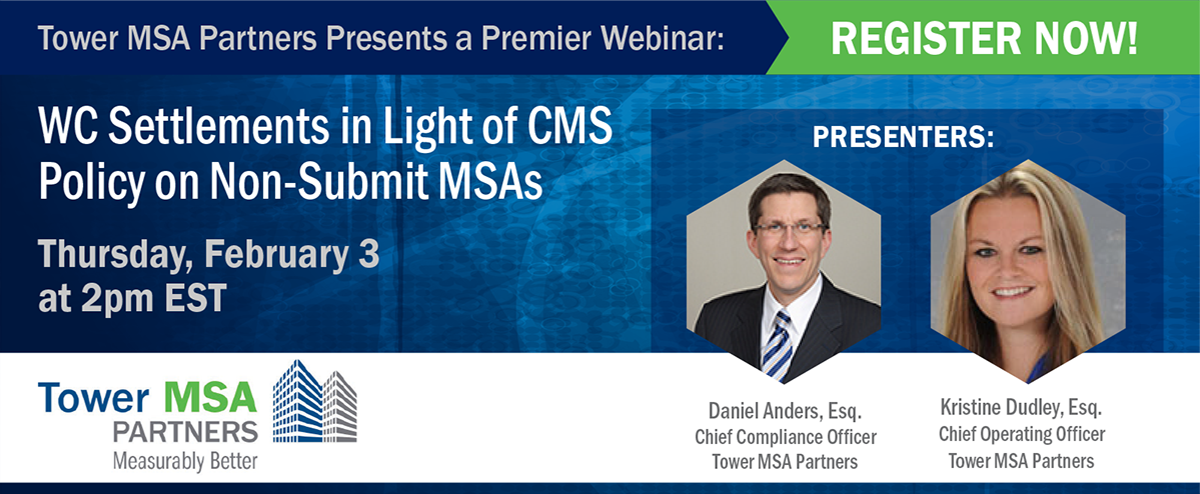
Premier Webinar: WC Settlements in Light of CMS Policy on Non-Submit MSAs

January 25, 2022

pictures of Dan Anders & Kristine Dudley and details for webinar on Non-Submit MSAs

The Centers for Medicare and Medicaid Services (CMS) recent policy statement which considers non-submit/evidence-based MSAs “as a potential attempt to shift financial burden” to Medicare left many questions in its wake (See CMS: Non-Submit MSAs Potentially Shift Costs to Medicare).  It has triggered many payers, along with injured workers and their attorneys, to reconsider the choice to avoid the CMS MSA review and approval process.

On Thursday, February 3 at 2:00 PM ET, Tower’s Chief Operations Officer Kristine Dudley and Chief Compliance Officer Dan Anders will address the many questions which arise out of this announcement and walk attendees through how a move from a non-submit to submit MSA program can still yield cost-effective settlements with the added protection of CMS approval.

Here’s just some of what you will learn:

  • Background on CMS policy on submit vs. non-submit MSAs and what it means for the future of MSAs
  • Potential defenses to CMS claim that a non-submit MSA was deficient
  • A how-to guide to transition from non-submit to submit MSA program which still settles WC cases
  • Tools available to contain MSA costs whether the MSA is submitted or not

While the webinar focus is on those that have primarily pursued a non-submit MSA course, portions on MSA cost containment and ensuring the availability of MSA funds over a lifetime are important to submitters and non-submitters alike.

A Q&A session will follow the presentation, and you can send your questions to Daniel.Anders@TowerMSA.com now. Please click the link below and register today!

Register here

Tower’s Dan Anders Reviews MSP Policies and Predicts 2022 Actions

January 20, 2022

Dan Anders reviews MSP policy updates and Medicare Set-Aside trends in this article

WorkersCompensation.com’s Nancy Grover captured the thoughts of Tower MSA Partners Chief Compliance Officer Dan Anders on a variety of Medicare Secondary Payer and Medicare Set-Aside issues from 2021 and 2022 in a recent article.

WorkersCompensation.com Features Dan Anders on MSP Policy Updates

The article reviews several important MSP and MSA developments. MSAs cost less than many stakeholders think, opioid allocations are down, and the PAID Act makes obtaining Medicare Advantage Plan data easier.

Key Medicare Secondary Payer and MSA Issues Reviewed

The article also notes that the Centers for Medicare & Medicaid Services said MSAs that are not approved by CMS could be viewed as “a potential attempt to shift financial burden” to Medicare.

Read the Full WorkersCompensation.com Article

The article, “MSA Policy Updates, Changes Likely in Store for 2022, Expert Predicts,” can be read here. Remember it’s just a one-time process of subscribing to this free section of Workerscompensation.com.

CMS: Non-Submit MSAs Potentially Shift Costs to Medicare

January 13, 2022

Scale heavy with money showing the costs of Non -Submit Medicare Set-asides

The Centers for Medicare & Medicaid Services updated its Workers’ Compensation Medicare Set-Aside Reference Guide (Version 3.5) with new language on non-CMS-approved products used to address future medical care.

The update specifically addresses products commonly called evidence-based MSAs or non-submit MSAs. CMS says these products may be viewed as a potential attempt to shift financial burden to Medicare when they are not submitted, reviewed, and approved before settlement.

CMS Addresses Non-Submit MSAs in Updated WCMSA Guidance

CMS states that it cannot be certain Medicare’s interests are adequately protected unless a proposed amount is submitted, reviewed, and approved through the process described in the reference guide before settlement.

As a matter of policy and practice, CMS says it will deny payment for medical services related to the workers’ compensation injury or illness until the claimant demonstrates appropriate exhaustion. This could require exhaustion equal to the total settlement less procurement costs, rather than only a CMS-approved WCMSA amount.

Key Takeaways From the CMS Policy Update

CMS directly addresses evidence-based and non-submit MSAs in the reference guide.

The agency says non-CMS-approved products may be treated as a potential attempt to shift financial burden to Medicare.

CMS also states that it may deny payment for medical services related to workers’ compensation injuries until the total settlement has been exhausted.

This policy does not appear to be limited only to future MSAs. It could also affect existing non-submit MSAs unless CMS provides further clarification.

Questions About Non-Submit MSAs and CMS Approval

This does not appear to be a completely new CMS position. CMS has long stated that when an MSA is not approved, Medicare may deny related medical claims or pursue recovery for claims it paid, up to the full amount of the settlement.

What is different is that CMS now directly addresses evidence-based MSAs, non-submit MSAs, and vendor indemnifications that may accompany those arrangements. CMS also indicates that a claimant may need to demonstrate complete exhaustion of the net settlement amount before Medicare resumes primary payment for injury-related care.

What This Means for Payers and Beneficiaries

If a non-submit MSA was used to settle a case, CMS involvement is typically triggered when Medicare is asked to pay for injury-related medical care.

If the MSA amount is enough to cover that care, the beneficiary may not have an immediate issue. However, if the MSA is exhausted, CMS has made clear that it may deny payment.

For payers, this may create concern if indemnification, guarantees, or other liability provisions were used in connection with a non-submit MSA. Those provisions may be tested if Medicare denies payment for future injury-related care.

Cost-Effective CMS-Approved MSAs Are Possible

The non-submit MSA route is often based on the belief that CMS-approved MSAs include unrealistic allocations. However, Tower MSA Partners has found that MSA costs can often be contained while still pursuing CMS approval.

Tower does this through a clear understanding of CMS’s MSA pricing methodology, proactive record review, and targeted physician statements. This process helps move cases toward settlement while reducing the risk that CMS may later deny payment for future injury-related medical care.

Please contact Chief Compliance Officer, Dan Anders, with any questions about this or any other MSP compliance issue at Daniel.anders@towermsa.com or 888.331.4941.

Related Articles

Tower’s Dan Anders Says “It’s Still OK to Submit and MSA”


CMS Releases Updated Section 111 NGHP User Guide

December 28, 2021

book marked by sticky notes illustrating changes Section 111 reporting on ORM

The Centers for Medicare and Medicaid Services (CMS) has released Version 6.6 of its Section 111 NGHP User Guide.  Below is a summary of the notable updates and practical implications.

Funding Delayed Beyond TPOC Start Date Field

Last month we discussed an 11/03/2021 Alert from CMS on the use of Field 82 Funding Delayed Beyond TPOC Start Date.  Field 82, per the Section 111 User Guide, is to be used in specific circumstances where the amount the claimant Medicare beneficiary is to be paid is not known at the time the settlement occurs.  Per CMS, this happens most often in mass tort settlements.

As we previously related, the CMS Alert is confusing when it refers to the date settlement funds are “dispersed.”  CMS seems to assume that the date inserted into Field 82 is not only the date that the settlement amount is determined but is the same date the funds are dispersed. However, these dates may be weeks or months apart.  Our recommendation was to place the date settlement funds are dispersed in Field 82.

In its update to the User Guide, CMS now acknowledges this as the correct use of Field 82.  Specifically, CMS states (Chapter III: Policy Guidance):

6.5.1.2 Timeliness of Reporting

NGHP TPOC settlements, judgments, awards, or other payments are reportable once the following criteria are met:

  • The alleged injured/harmed individual to or on whose behalf payment will be made has been
    identified.
  • The TPOC amount (the amount of the settlement, judgement, award, or other payment) for
    that individual has been determined.
  • The RRE knows when the TPOC will be funded or disbursed to the individual or their
    representative(s)

RREs should retain documentation establishing when these criteria were or will be met. RREs

should not report the TPOC until the RRE establishes when the TPOC will be funded or

disbursed. In some situations, funding or disbursement of the TPOC may not occur until well

after the TPOC Date. RREs may submit the date the TPOC will be funded or disbursed in the

corresponding Funding Delayed Beyond TPOC Start Date field when they report the TPOC Date

and TPOC Amount, but must do so if the TPOC Date and date of the funding of the TPOC are

30 days or more apart.

Timeliness of MMSEA Section 111 reporting for a particular Medicare beneficiary will be based

upon the latter of the TPOC Date and the Funding Delayed Beyond TPOC Start Date.

Example:

There is a settlement involving an allegedly defective drug where a large settlement is to be

disbursed among many claimants.

The settlement provides a process for subsequently determining who will be paid and how much.

Consequently, there will be payment to or on behalf of a particular individual, but the specific amount of the settlement, judgment, award, or other payment to or on behalf of that individual is not known as of the TPOC Date. RREs are to submit the date of the settlement in the TPOC Date field and the amount of the settlement in the TPOC Amount field.

In this example, the determination of the TPOC Amount, as well as the funding or disbursement of the TPOC, will be delayed after the TPOC Date. Once the TPOC Amount and the date when the TPOC will be funded or disbursed are determined, the RRE should submit the record with the appropriate date in the corresponding Funding Delayed Beyond TPOC Start Date field.

Practical Implications

What CMS is getting at here is they want to know when the claimant receives the settlement funds so they can correctly time their recovery efforts.  For Responsible Reporting Entities (RREs) this means if payment will be delayed more than 30 days post the TPOC date, then they must hold off on Section 111 reporting until the date the settlement funds will be disbursed has been identified.

We note that while CMS expects the above rule to apply to mass tort settlements, there are certainly cases, both liability and workers’ compensation, where funding may be delayed more than 30 days beyond the TPOC date.   Thus, we believe the effect of this update on the “Timeliness of Reporting” rule will likely be much wider.

In terms of making this simpler for those entering the TPOC information, if the disbursement of settlement funds commonly occurs more than 30 days post-TPOC date, it may be easiest to always enter a date in the corresponding Funding Delayed Beyond TPOC Start Date field along with the TPOC Date and TPOC Amount, whether less than or more than 30 days from the TPOC date.

Updates to No-Fault Policy Limit

Also last month we discussed another CMS Alert reminding RREs where, depending upon state law or the terms of a given policy, the no-fault policy limit may vary.  The Alert reminded RREs to update to the new policy limit as quickly as possible, including the use of an “off-cycle” report (A report made in addition to the required quarterly reporting).  In our analysis of this Alert, we expressed concern as to whether such “off-cycle” reporting is mandatory or recommended.  In other words, if mandatory and not done, that it would be considered non-compliance and potentially subject the RRE to penalties.

The updated User Guide CMS states as follows (Chapter III: Policy Guidance, Section 6.5.1.3):

Note: In some states, depending on various factors associated with the incident being reported, no-fault policy limits may vary. The reported Policy Limit should reflect the amount the RRE has accepted responsibility for at the time the record is submitted or updated. Just as importantly, if the Section 111 record needs to be corrected to reflect a new Policy Limit, the RRE should update the record as soon as possible.

Practical Implications

While CMS states the RRE should update the record as soon as possible, there is no reference to “off-cycle” reporting.  We assume that while “off-cycle” reporting is preferred, that proper compliance will be determined based upon the quarterly report which includes the updated no-fault policy limit.

$750 Threshold Maintained for Section 111 Reporting and Medicare Conditional Payment Recovery

In a December 15, 2021, Alert CMS announced the 2022 recovery threshold for liability, no-fault and workers’ compensation settlements will remain at $750. Accordingly, Total Payment Obligations to the Claimant, TPOCs, in the amount of $750 or less are not required to be reported to CMS through the Section 111 Mandatory Reporting process, nor will CMS attempt to recover conditional payments for TPOCs of this amount (The threshold does not apply to liability settlements for alleged ingestion, implantation or exposure cases).

Practical Implications

As CMS is keeping the $750 threshold for mandatory reporting and conditional payment recovery there are no changes to the reporting processes or determinations as to when conditional payments should be investigated or resolved.

If you have any questions regarding these updates, please contact Dan Anders at daniel.anders@towermsa.com or 888.331.4941.


A Holiday Wish from Tower MSA Partners

December 22, 2021

Holiday themed Holiday Wishes from Tower

Earlier this year Tower MSA Partners celebrated its 10th anniversary. As 2021 comes to a close we again thank you, our client partners, for your support and loyalty, some for all of those 10 years and some for only the past few months.  Your trust in us to provide MSP compliance services and settlement solutions is never taken for granted . . . nor do we rest on our laurels.

The Tower team looks forward to launching into a new year with new initiatives and enhancements to provide you the best in customer service, systems and controls which keep client data secure from cyber threats and a commitment as your partner to help settle claims that provide the best in care, cost and compliance.

Our wish to you is a safe, happy and healthy holiday season filled with warmth and laughter.  Merry Christmas and best wishes in the new year.


How Did Workers’ Comp Execs Fare During COVID-19?

December 10, 2021

WCI-TV Rower sponsorship banner. indicating that Covid-19 will be a primary programming focus.

How has the Covid-19 affected workers’ comp organizations? What changed professionally for risk managers and claims professionals during the pandemic? Did temporary policies become permanent? Tune to WCI-TV to find out.

Tower MSA Partners has been the exclusive sponsor of WCI-TV since its inception.

“Instead of commercials for our Medicare Secondary Payer compliance services, we’ve explored topics like opioid management, how success is measured, and ways to overcome barriers to claim closures,” said CEO Rita Wilson.

Naturally, an ongoing, international Covid-19 pandemic rated attention. “We wanted to hear how organizations maintained a sense of unity while working from home and how lockdowns changed sales, marketing, and purchasing practices,” explained Chief Compliance Officer Dan Anders.

Among Tower’s TV guests will be Susan Shemanski, Vice President of Corporate Risk Management of the Adecco Group, Joe Berardo, CEO of Carisk Partners, Porter Leslie, CEO of Ametros, and Mark Meyer, Claim Attorney with the Montana State Fund.

WCI-TV airs throughout the convention center and shuttles, in hotel guest rooms and on WCI’s website YouTube channel. These interviews will also be available on Tower’s LinkedIn homepage.

Tower is pleased to be part of the 75th Annual WCI Conference; see for more https://www.wci360.com/conference/ information.

Related:

Tower MSA Partners Arranges for CMS Officials to Headline WCI’s MSP Sessions