Successful Appeal to CMS ALJ Yields $80K Reduction in Conditional Payments

March 15, 2023

Tower MSA Partners case study showing CMS ALJ appeal resulting in $80K+ reduction in conditional payments.

In response to a Medicare conditional payment demand, payers can access a five-level appeals process, including a hearing before a Centers for Medicaid and Medicaid Services (CMS) administrative law judge (ALJ). Most conditional payment demand appeals are resolved at the first two levels: redetermination and reconsideration.  However, some are escalated to an ALJ as happened in this case.

ALJ Appeal Success Story

On July 24, 2020, the Commercial Repayment Center (CRC) issued a demand for reimbursement of $149,902.98.  The work injury had aggravated a pre-existing left knee skin graft, resulting in an infection of the left knee.  The payer accepted the aggravation but not the long-term condition of the knee.

Charges on the demand were either completely unrelated to the left knee or for treatment deemed related to the longstanding pre-existing condition of the left knee.  An appeal was filed, and the CRC redetermination decision stated that none of the charges would be removed.

At this point, a second-level appeal was filed with the Qualified Independent Contractor (QIC). CMS contracts with the QIC to provide an independent review apart from the CRC. Its March 26, 2021 reconsideration decision was partially favorable because almost all the charges related to body parts other than the left knee were removed from the demand. The revised demand was $79,489.97, which also included interest.

The next step was an ALJ appeal submitted on May 12, 2021.  It can take two to three years to receive a hearing date, but in this case, it took a little over a year to receive a hearing date set for June 28, 2022.

The difficulty in this appeal is that after some initial treatment in the state where the injury occurred, the injured worker moved to another state where he received further treatment.  The payer never received bills from the out-of-state medical providers whose charges were listed in the conditional payment demand.  Fortunately, we could work with the defense attorney who subpoenaed the medical records.  Unfortunately, upon review, the medical records were unclear on causation.

Nonetheless, we put our best argument forward at the hearing and through our brief to the ALJ that the work-related infection was a temporary aggravation of a long-standing condition of ulcers to both knees.  This was supported by an inconsistent history from the injured worker and medical notes, which implied that the post-injury infection had resolved shortly after the accident.

What is helpful at the ALJ appeal level is that you can speak to the judge, explain your position and answer his or her questions.  This differs from the first two levels of appeal, which come down to submitting the appeal and receiving a decision.

In a September 12, 2022 decision, the ALJ agreed with our position.  As a result, the demand, which by then exceeded $80,000, was reduced to $441.19.

Keys to Appeal Success

Here is what made this appeal successful:

Appeals Deadline Met

All five levels of appeal have specific timeframes for an appeal submission. It is essential to file an appeal by the designated deadline which should also prevent the CRC from referring the debt to the Treasury Department for collection (assuming the debt is not paid during the pendency of the appeal).

In this case, our client had designated Tower as its recovery agent, which means we receive copies of letters and notices the CRC sends this client.  As the recovery agent, we can immediately advise the client of a Conditional Payment Notice or Demand Letter, what it means, and the deadline for action. As a result, all appeals deadlines were met.

Cooperation Between Tower and Client

Successful conditional payment appeals are often based on medical records, Independent Medical Exams and utilization reviews, as well as legal documentation.  It is imperative that the claims professional and defense attorney work with Tower to obtain the documentation necessary to support the appeal.  In this case, the defense attorney’s diligent efforts at subpoenaing and then follow-up with the medical provider resulted in the timely receipt of the out-of-state medical records.

Knowledge and Experience with Conditional Payment

In addition to having supporting documentation, the appeal must provide an acceptable basis for why the charges should be removed from the demand.  Tower’s team of professionals has the knowledge and experience to combine the facts and law to make successful arguments to the CRC and QIC. Additionally, any matter appealed to the ALJ will be handled by Tower’s Chief Compliance Officer, Dan Anders, who has two decades of experience in Medicare Secondary Payer compliance, including prior successful ALJ appeals, as exemplified in this case.

Whatever your conditional payment scenario, we stand ready to assist.  Learn more about our conditional payment services here, where you can also refer a matter for handling.


 

CMS Extends Deadline for Publication of Final Section 111 Penalties Rule

February 20, 2023

Stamp icons representing regulatory enforcement of Section 111 reporting by CMS.

There was much expectation that the Centers for Medicare and Medicaid Services (CMS) would meet the February 18, 2023 deadline to release a final rule on Section 111 reporting civil money penalties (CMPs). However, it was not to be.  CMS extended its deadline for publishing the final rule by a year to February 18, 2024.

Recall that the purpose of the rule is to set out specific criteria for when CMS may impose penalties for what it considers a failure to report or improper reporting.  A summary of the proposed rule can be found here.

In the notice, CMS explains the reason for the extension:

. . . We are not able to meet the initial targeted 3-year timeline for publication due to delays related to the need for additional, time-consuming data analysis resulting from public inquiry. It was not possible to conclude this data analysis on the initial, targeted timeline for the proposed rule because public listening sessions raised additional concerns that CMS believed were important to properly and thoroughly research prior to publishing the final rule. We have decided that it is critical to conduct additional analysis about the economic impact of the rule. We are preparing additional data analysis and predictive modeling to better understand the economic impact of the proposed rule across different insurer types. This data analysis is designed to review the actual current reporting and model potential penalties that would be imposed were the final rule in place. Along with delays resulting from the agency’s focus on the COVID- 19 public health emergency, we determined that additional time is needed to address the complex policy and operational issues that were raised. We are extending the publication deadline so as to provide the most accurate, complete, and robust data possible to confirm the intent and economic impact of the final rule.

Practical Implications

Besides not having to worry about penalties for another year, we are pleased CMS is taking the time to complete a data analysis of the impact of its penalty regulation.  While in its initial regulatory announcement, CMS indicated its rule would not have a significant economic impact, we, as well as others, noted in our comments to the proposed regulation that the authority to impose penalties of up to $1,000 per day per claim could lead to millions of dollars of penalties on even one claim.  This is most definitely a significant economic impact.

As required by law, CMS will eventually make its penalties rule final and issue penalties.  Accordingly, while we await that final rule, you have been granted more time to ensure the accuracy and timeliness of your reporting.

Current Tower Section 111 reporting partners have access to our Section 111 Management Dashboard, which gives you complete visibility into your claims from a global level all the way down to specific claims.  This, along with our standard error reports and consultation on error correction, is the best path forward to eliminate the potential for CMS to impose penalties.

If you do not yet partner with Tower for Section 111 reporting, now is an excellent time to consider the benefits of a platform which seamlessly manages Section 111 reporting, conditional payments, Medicare Set-Aside triage, clinical and legal interventions, MSA preparation, and CMS submission activities.  Don’t hesitate to contact Tower’s Chief Compliance Officer, Dan Anders, at 888.331.4941 or daniel.anders@towermsa.com, with any questions.

Related Articles

Tower MSA Partners Ready to Steer Clients Through Pending Section 111 Civil Money Penalties

WorkCompWire: Plan Now to Avoid Pending Medicare Reporting Penalties

Tower Partners: People Behind the Settlements Interview with Kevin Puckett of KP Underwriting

February 16, 2023

Tower MSA Partners graphic with Kevin Puckett of KP Underwriting with the question “Rated ages…what are they and how do they affect MSA’s”.

Tower MSA Partners is pleased to launch “Tower Partners: People Behind the Settlements.”  This quarterly series will dig into the elements that go into smooth, cost-effective settlements and introduce Tower’s team members and corporate partners who make them possible.

First up is Kevin Puckett, owner and president of KP Underwriting, who is responsible for assigning a rated age on most of the MSAs we write.  As Kevin explains, a rated age is the statistical age of a person due to their medical conditions.  A person’s actual age may be 60, but their comorbidities and other conditions could cause their rated age to be 65.

Why is this important to the MSA?  Because an MSA is calculated over the injured worker’s life expectancy. A higher rated age that reflects a shorter life expectancy reduces future medical costs. This reduction can be significant, sometimes tens or even hundreds of thousands of dollars.

Case in point: a 67-year-old woman with a rechargeable spinal cord stimulator (SCS) would have required two revisions (one every nine years) over her 18-year life expectancy, in addition to other medical costs. The MSA’s initial allocation was $142,410.64. However, the rated age came back at 72, reducing life expectancy from 18 to 14 years.  This allowed Tower to remove one SCS revision along with other medical costs. The revised MSA was $98,586.35, a $43,824.29 reduction to the allocation.

Now, let’s turn to our rated age expert and partner, Kevin Puckett.

Q & A with Kevin Puckett

What is a rated age? 

A rated age is an adjusted age and reduced life expectancy, that is the expected number of years of life remaining at a given age based on an individual’s medical impairments and the impact they have on their body and life expectancy.  The US Health & Human Services National Vital Statistics life expectancy tables set the baseline for life expectancy determinations.

What is your background in providing rated ages?  What qualifies you to provide this service?

I have been the President and Owner of KP Underwriting, LLC, an independent underwriting company since 2004.  KP Underwriting provides rated ages and modified life expectancies for companies that provide structured settlements, Medicare Set-Asides, and medical cost projections. Our services are also used for settlement purposes and to help set reserves. During my 30+ year career in medical underwriting, I worked with multiple life insurance companies, developing and managing underwriting departments before launching KP Underwriting.  I’ve also written underwriting manuals, audited underwriting departments, and provided expert witness testimony on life expectancy in multiple states and for the Department of Justice.  I earned my BBA in Business Administration with a minor in Biology from Eastern Kentucky University, an Associates designation from the Academy of Life Underwriting, and an FLMI (Fellow, Life Management Institute).

Is KP Underwriting approved to provide rated ages for CMS?

Yes, we’ve been approved since 2006. KP Underwriting is the single largest provider of rated ages in the country, having provided several hundred thousand rated ages to the Centers for Medicare and Medicaid Services (CMS).

What documentation do you require to calculate the rated age?

Medical records should contain two primary categories of records as listed below.  Medical records within the past two years are considered current and have more weight in rated age calculations.

  • Current status of the claimed injury includes:
    • Length of time since injury, permanency of the condition, functional status, stability of treatment, nature of the ongoing treatment.
  • Overall medical status of the individual including:
    • All co-morbidities, personal medical history, pharmaceutical use and related conditions.

Medical records older than two years can be utilized, however, the rated age will normally be more conservative as health history and medical impairments can change drastically over a two-year timeframe or longer.

Can you provide examples of diagnoses that will increase the rated age?

Two conditions can impact the rated age and life expectancy: the injury itself and medical impairments.  Good examples of both are as follows:

  • Injuries
    • Spinal Cord Injuries, head injuries, amputations, burns, chemical exposure, and falls are the most significant. The best thing to consider with injuries is how and if it impacts daily functioning.
  • Medical impairments
    • Most major health impairments will impact the rated age, such as diabetes, stroke, coronary artery disease, obesity, smoking, peripheral artery disease, kidney, colon, and liver diseases, HIV/AIDS, post-covid syndrome, and major respiratory disorders, to name a few. This is a very broad category.  One of the things I cannot stress enough is that medical impairments usually have the biggest impact on the rated age.

Do you solely consider the injury-related diagnoses or both the injury and non-injury-related diagnoses?

The injury and residuals and any medical impairments are both considered in processing the rated age.  We try to let our clients know that not only healthy people get injured.  Medical impairments usually have the biggest impact on rated ages.  In some instances, medical impairments can prevent or delay healing from the injury. For example, diabetes can delay healing in cuts or burns, leading to amputation or slower response to treatment.

What is your typical turnaround time to provide a rated age?

KP Underwriting’s turnaround time is usually 2-3 hours, with rush requests completed within an hour.  All cases that come in before 4 pm EST are completed the same day.  All cases after 4 pm are completed first thing the next business day.

What does your rated age report contain?

 The rated age report sent back to our clients is on KP Underwriting letterhead and contains the name, date of birth, gender, current age and current life expectancy, rated age and rated life expectancy, a brief medical summary of the impairments and injuries used in consideration of the rated age, and the table used in our calculations.  These are tailored to meet our clients’ needs.

How long has KP Underwriting been in business?

KP Underwriting has been in business since 2004. Initially, we prepared rated ages mainly for life companies and structured settlements.  We branched out in 2006 to include rated age services for MSAs.

Do you do all the rated age calculations, or do you have a staff that assists you?

KP Underwriting grew quickly to the point that I needed help to do them.  I currently have a staff of 10-from underwriters to processors- who assist in the rated age process.

If you want more information on KP Underwriting, you can visit their website or contact Kevin at kevinp@kpunderwriting.com or (502) 345-8048.  And if you have a question about a specific MSA or the impact of rated ages on MSAs in general, I am happy to speak with you.  Email Daniel.Anders@TowerMSA.com.

Risk & Insurance: Am I Allocating Enough for a Medicare Set-Aside? Take These Pointers from a Pro to Find Out

January 26, 2023

Business professional seeking guidance on Medicare Set-Aside allocation in Tower MSA Partners article.

Tower’s MSP Compliance blog analyzes the nuances of Medicare Set-Asides (MSAs) and other aspects of Medicare Secondary Payer Compliance. It covers topics like re-reviews and the termination of ongoing responsibility for medicals (ORM), along with tweaks to WCMSA Reference Guide. Most of our posts drill down into the fine details that our readers need to know.

Every now and then, though, it’s good to pull back and take a high-level view of MSAs as our Chief Compliance Officer Dan Anders does in this Risk and Insurance article. Keep it handy in case you need to explain MSAs to an injured employee … or a colleague.

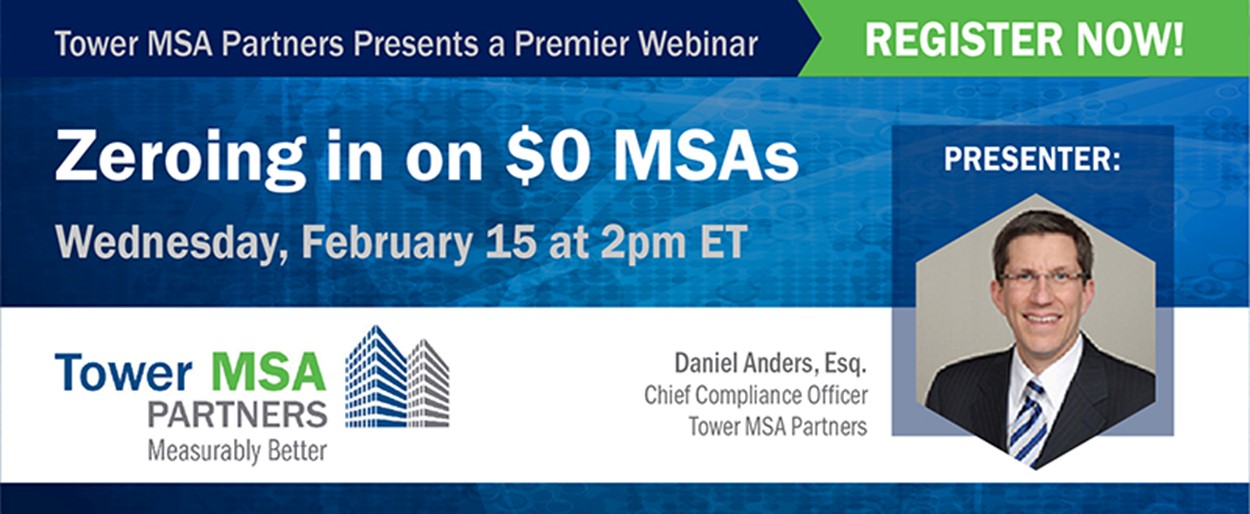
Premier Webinar: Zeroing in on $0 MSAs

January 25, 2023

Webinar details graphic: Tower MSA Partners Premier Webinar on zero Medicare Set-Aside (MSA) allocations.

A $0 MSA remains an option in some workers’ compensation case settlements, although strict criteria must be met if CMS approval is necessary.  It is essential then for claims professionals to understand this criteria as steps taken early in claims handling can sometimes be the difference between a $0 and a fully funded MSA at the time of settlement.

Over his two decades in MSP compliance, Tower’s Chief Compliance Officer, Dan Anders, has successfully obtained CMS approval on hundreds of $0 MSAs.  Please join him for a Tower Premier Webinar on Feb. 15 at 2 PM ET.

In addition to $0 MSAs, Dan will also discuss using state statutes and regulations to limit MSA amounts.

The presentation covers the following:

  • Criteria for a CMS-approved $0 MSA
  • Alternative criteria for a Non-Submit $0 MSA
  • A step-by-step guide as to how to work with Tower to obtain a $0 MSA.
  • Use of state statutes and regulations to limit the MSA amount.

A Q&A session will follow the presentation, and you can provide questions you’d like us to cover when you register. Please click the link below and register today!

Please note that there is no CEU credit offered for this webinar.

Register Here

A Claims Professional’s Guide to Common MSP Acronyms and Abbreviations

January 19, 2023

Picture of scrabble tiles that could be put together to create MSP ACRONYMs

People in the MSP compliance business rattle off acronyms and abbreviations, such as AWP, MMSEA, and TPOC like it’s second nature. People immersed in Section 111 reporting and Medicare Set-Asides understand the abbreviations, but most people listening to us do not. So, here’s a quick cheat-sheet (or handy guide) to frequently used acronyms and their meanings:

Common MSP Acronyms and Abbreviations

AWP – Average wholesale price:  The AWP is a Red Book pricing reference for prescription drugs. The lowest AWP is used to calculate Medicare Part D drugs in a Workers’ Compensation Medicare Set-Aside (WCMSA).

BCRC – Benefits Coordination & Recovery Center: This contractor to the Centers for Medicare and Medicaid Services consolidates the activities that support the collection, management, and reporting of other primary insurance coverage for Medicare beneficiaries.  In short, it manages the MMSEA Section 111 reporting program and pursues conditional payment recovery when the claimant Medicare beneficiary is the debtor.

CMS – Centers for Medicare and Medicaid Services:  The federal government agency oversees the Medicare program.  CMS’s Division of MSP Program Operations directly manages CMS’s Medicare Secondary Payer (MSP) enforcement programs.

COB – Coordination of Benefits:  The coordination of benefits (COB) program aims to identify the health benefits available to a Medicare beneficiary and to coordinate the payment process to prevent mistaken payment of Medicare benefits.

CRC – Commercial Repayment Center: This CMS contractor pursues conditional payment recovery when the self-insured entity or the insurer is the identified debtor.

CWF – Common Working File: CMS uses this tool to maintain national Medicare records for individual beneficiaries enrolled in the Medicare program.  For example, a funded CMS-approved workers’ compensation Medicare Set-Aside (WCMSA) will trigger a marker in the CWF, so Medicare will not pay for care covered by the WCMSA.

LMSA – Liability Medicare Set-Aside: General term for an MSA in a liability case settlement.

MBI – Medicare Beneficiary Identifier:  The Medicare Beneficiary Identifier (MBI) is the identification number replaced SSN-based health insurance claim numbers (HICNs) on all Medicare transactions, such as Medicare cards, billing, claim submissions and appeals.

MIR – Mandatory Insurer Reporting:  Another term for MMSEA Section 111 reporting.

MMSEA – Medicare, Medicaid, SCHIP Extension Act of 2007: Section 111 of this act added mandatory reporting requirements regarding Medicare beneficiaries who have coverage under group health plan (GHP) arrangements as well as for Medicare beneficiaries who receive settlements, judgments, awards, or other payment from liability insurance (including self-insurance), no-fault insurance, or workers’ compensation, collectively referred to as Non-Group Health Plan (NGHP) or NGHP insurance.

MSA – Medicare Set-Aside: An account used to pay for injury-related and Medicare-covered medical services and prescription medications. It is a portion of a settlement that is reserved or “set-aside” for this purpose.

MSP – Medicare Secondary Payer: This is the term generally used when the Medicare program does not have primary payment responsibility, that is when another entity, such as workers’ compensation or liability insurance or a group health plan, is responsible for paying before Medicare.

MSPRP – Medicare Secondary Payer Recovery Portal: A web-based tool designed to assist in the resolution of liability insurance, no-fault insurance, and workers’ compensation Medicare recovery cases.

NGHP – Non-Group Health Plan: Typically used in reference to Section 111 reporting, NGHP includes liability insurance (including self-insurance), no-fault insurance, and workers’ compensation.

ORM – Ongoing Responsibility for Medicals:  This refers to the Responsible Reporting Entity (RRE) paying for the injured party/Medicare beneficiary’s ongoing medical treatment associated with the claim.

RO – Regional Office:  A CMS RO is assigned to each WCMSA case (based on the claimant’s state of residence); that RO makes the final determination of the appropriate funding level for the WCMSA.

RRE: Responsible Reporting Entity: The applicable plan, namely the NGHP, responsible for Section 111 reporting to CMS.

SSDI – Social Security Disability Insurance: Pays monthly benefits to workers who can no longer work due to a significant illness or impairment that is expected to last at least a year or result in death within a year.

SSN – Social Security Number: A numerical identifier assigned to U.S. citizens and other residents to track income and determine benefits.

TPOC – Total Payment Obligation to the Claimant: For Section 111 reporting purposes, CMS uses the term TPOC to refer to the dollar amount of the total payment obligation to, or on behalf of, the injured party in connection with the settlement, judgment, award, or other payment in addition to/apart from ORM.

WCMSA – Workers’ Compensation Medicare Set-Aside: This is a financial agreement that allocates a portion of a workers’ compensation settlement to pay for future medical services related to the workers’ compensation injury, illness, or disease.

WCMSAP – Workers’ Compensation Medicare Set-Aside Portal: The WCMSAP may be used to submit and view WCMSA proposals, to communicate about the review approval process, and to submit re-review requests. Users can also view the status and balance of an established WCMSA and submit annual attestations and detailed transaction records.

WCRC – Workers Compensation Review Contractor: This CMS contractor reviews all submitted WCMSAs and advises the CMS Regional Office whether the proposed WCMSA is sufficient, or a higher or lower amount is recommended.

CMS to Provide RREs with Response File on ORM Record Changes

January 11, 2023

book marked by sticky notes illustrating changes Section 111 reporting on ORM

Starting July 2023, Responsible Reporting Entities (RREs) can access updates/changes that another source has made to their claims for Ongoing Responsibility for Medicals (ORM).  The Centers for Medicare and Medicaid Services (CMS) announced this in an update to its MMSEA Section 111 NGHP User Guide, Version 7.0.

It may surprise insurers and self-insurers that the ORM data they report through Section 111 reporting can be modified by the Benefits Coordination and Recovery Center (BCRC), which coordinates benefits on behalf of CMS. For example, suppose a claimant contacts the BCRC and advises that they are being denied medical care due to an open ORM (ORM indicates the RRE accepts the claim). In that case, the BCRC may update the ORM record to indicate that medical has been terminated (especially if the claimant indicates the case has been settled).

The RRE needs to be notified of this action to correct its reporting or to advise the BCRC that this was an erroneous change to the record.

Presently, and in our experience, the BCRC typically issues a letter to the RRE advising of the change it made to the ORM status.  Starting this summer, RREs can also access these changes through Section 111 reporting. The revised user guide states:

Effective July 2023, RREs will be able to opt in via the Section 111 secure website to receive a monthly NGHP Unsolicited Response File. This will provide critical information about updates to ORM records originally submitted in the last 12 months and allow RREs to either update their internal data or contact the Benefits Coordination & Recovery Center (BCRC) for a correction.

This report will provide the source of the record modification and the reason for it. This should eliminate confusion when the BCRC changes ORM reporting data.

Other Updates to Section 111 User Guide

CMS included these other updates in Version 7.0 of the user guide:

  • Sections 6.4.2, 6.4.3 and 6.4.4. of Chapter III: Policy Guidance indicated CMS would maintain the $750 reporting threshold for physical trauma-based liability insurance settlements and the $750 threshold for no-fault insurance and workers’ compensation settlements, where the no-fault insurer or workers’ compensation entity does not otherwise have ongoing responsibility for medicals.
  • In Chapter IV: Technical Information besides the aforementioned ability to, as of July 2023, obtain an NGHP Unsolicited Response File, CMS put in place the following changes:
  • Information on recovery agents was clarified to emphasize that such agents need written authorizations to pursue any post-demand actions (Section 6.3.1).
  • Recovery agents may now view the Open Debt Report on the Medicare Secondary Payer Recovery Portal (MSPRP), if the agent has an active MSPRP account with a TIN matching one submitted on the RRE’s TIN Reference File (Section 6.3.1.2).
  • ORM Termination Date field number 79 was corrected for the Event Table (Section 6.9.1).

As Tower is a recovery agent for many of our clients, the ability to download a copy of the Open Debt Report will be helpful in monitoring CMS’s ongoing recovery actions.

  • Finally, CMS updated Chapter V: Appendices as follows:
  • The CP13 soft edit policy limit amount has decreased from $1000 to $500 (Appendix F).
  • For the TIN Reference File, the Go Paperless Indicator is no longer required when submitting the Recovery Agent TIN (Field 25) (Appendix G).

If you have any questions on these updates, don’t hesitate to contact Tower’s Chief Compliance Officer, Dan Anders, at Daniel.anders@towermsa.com or 888.331.4941.


Top 5 MSP Stories of 2022 & What to Watch for in 2023

January 4, 2023

pictures of 2022 & 2023 to showing size difference in 22 & 23 MSP

As we launch into 2023, here’s a look back at the top five Medicare Secondary Payer (MSP) compliance stories of 2022 and what to watch for this year.

Addition of Non-Submit MSA Policy to CMS WCMSA Reference Guide

2022 certainly got off with a bang when CMS added Section 4.3 to the CMS Workers’ Compensation MSA Reference Guide.  Entitled “The Use of Non-CMS-Approved Products to Address Future Medical Care,” the policy, which was later amended (See CMS Clarifies Policy on Non-Submit MSAs in Updated Reference Guide), provides as follows:

  • A non-submit MSA represents a potential cost shift to Medicare.
  • At its sole discretion, CMS may deny payment for injury-related medical up to the total settlement amount less procurement costs and paid conditional payments.
  • If the non-submit MSA exhausts, it must be demonstrated that the MSA was sufficiently allocated at the time of settlement and the funds were spent properly.
  • Shall apply to all notifications of settlement that include the use of a non-CMS-approved product received on, or after January 11, 2022
  • It does not apply to under-threshold MSAs (settlements that do not meet the CMS WCMSA review criteria).

Questions remain.  To what extent will CMS issue denials where a non-submit MSA is used? How will this process work when a non-submit MSA exhausts? What steps will CMS take to determine the sufficiency of the MSA when the claim is settled? And what evidence will CMS require to prove the MSA funds were spent correctly?

Ametros Study Confirms Post-Settlement Medicare Denials Do Occur

The question of whether CMS denies payment for injury-related care was answered, at least for CMS-approved MSAs, in an extensive study Ametros published in January 2022.  This first-of-its-kind study examined a random sample of five percent of the Medicare beneficiary population over a three-year period.  They estimated that the following number of claims were denied because WCMSA funds were responsible for their payment.

  • 35,980 in 2018
  • 36,060 in 2019
  • 30,720 in 2020

The report’s key conclusion is “Medicare is systematically denying MSA recipients’ claims, and with steady frequency.”  You can download the free report “A Study of CMS Policy on Treatment Denials for Injured Workers with a Medicare Set Aside from ametros.com/medicaredenials. 

CMS Releases Key Metrics on WCMSA Review Program

It was not only Ametros that published data related to the MSP program in 2022.  For the first time, CMS released data on its WCMSA review program.

CMS shared statistics for the three-year period of 2020 through 2022.  The data compared proposed MSA amounts with the CMS-recommended amounts (what we typically call the “approved” MSA amounts).

Key takeaways from a review of the three years of data:

  • MSA reviews are down, a 17% decline over three years.
  • Review methodologies remain consistent.
  • The average recommended MSA remains consistently between $80K-$85K.
  • A billion dollars in recommended MSAs every year.

Please see For the First Time, CMS Release Key Metrics on WCMSA Review Program for more takeaways and a link to the data.

CMS Withdraws Proposed Rule on Future Medicals in Liability

In a surprise move, CMS withdrew its proposed rule on future medicals in liability settlements from review by the White House Office of Information and Regulatory Affairs (OIRA review and approval are required before a proposed rule is published). It was anticipated that CMS would release the proposed rule in 2022 for comment, but we did not even get to that step in the regulatory process.

The future of formal CMS guidance for liability settlements remains unknown.  While CMS can resubmit a proposed rule for release, we do not know if it will do so or the timeline if it intends to do so.

Notably, in its recently released solicitation for its next five-year Workers’ Compensation Review Contractor (WCRC) contract, CMS included an option for liability MSAs reviews starting in April 2024.  However, while CMS anticipates 19,200 WC MSA submissions per year, the solicitation indicates an expectation of 1,000 per year in LMSAs (with an option to increase to an additional 3,000 per year).  In short, even were CMS to put some LMSA review process in place it seems they contemplate a high dollar or some other type of threshold to reviews given the lower number expected.

In response to CMS’s lack of guidance, Tower released an updated version of its guidance document, Navigating Through the Fog: Medicare Future Medicals & Liability Settlements.

First Anniversary of PAID Act Implementation

On 12/11/2021, payers, gained access to the past three years of Medicare beneficiary enrollment status in Medicare Part C (known as Medicare Advantage) plans and Part D (prescription drug) plans through the Section 111 reporting data. Previously, workers’ compensation payers were required to reimburse these plans for conditional payments but did not know which plans the Medicare beneficiary used.

The PAID Act did not introduce new requirements for resolving debts with Part C and D plans. However, it does allow payers, in some cases, to more easily identify and contact these plans.  Observations one year out:

  • In terms of the technical aspects of the transmission of PAID Act data, there have been minimal problems.
  • Not all RREs have chosen to accept the PAID Act data into their claims systems (Tower created a dashboard allowing our reporting clients to access PAID Act data without having to ingest it into their claims system).
  • While the enrollment information for Part C and D plans is accurate, the same can’t be said for the contact information. (Note, CMS issued a memo in April 2022 to Part C and D plans asking them to provide contact information which can receive inquiries from Non-Group Health Plans in compliance with the PAID Act.)
  • There has been an increase in Tower clients’ pre-settlement requests to contact Part C and D plans to inquire about reimbursement claims.

What to Watch for in 2023

Section 111 Penalties:  2/18/2023 is the due date for CMS to issue final regulations on criteria for imposing Section 111 penalties for improper mandatory reporting.  We expect issuance before this date with final regulations becoming effective this year.

MSA Review Contractor:  Capitol Bridge, the Workers’ Compensation Review Contractor (WCRC), is in the last year of its five-year contract to review MSAs for CMS.  On 1/4/2023 CMS published the solicitation for a new five-year contract set to begin on 4/1/2023.

The new contract contemplates 19,200 WC MSA submissions with no increase over the contract period.  What to watch for here is whether CMS keeps Capitol Bridge or brings in a new contractor.

Release of More MSP Metrics:  As noted above, we were pleased to see CMS release critical metrics around the MSA review program.  We hope this becomes an annual report and expands with more data around MSA administration post-settlement and conditional payment recovery.

Best wishes from your friends at Tower for a healthy, happy and prosperous new year!

Happy Holidays From Your Friends at Tower MSA Partners

December 21, 2022

Alt: Holiday Greetings From Tower MSA Partners

We’ve had an exciting year of growth at Tower MSA Partners in 2022 and would like to extend our appreciation to you, our valued partners, who have supported us.  Whether this is your first year as a Tower client, or one who has been with us for many years, Tower’s success results from your loyalty.

Our team works diligently each and every day to earn your trust by providing a service level unmatched in the MSP industry.  And we can do that only through the expertise, knowledge, professionalism and commitment of our amazing staff, also unmatched in our industry.  Together with our team, we hope we have met and exceeded your service expectations throughout the past year.  

We extend our warmest wishes to you and yours. A Merry Christmas and Happy Holidays from your friends at Tower MSA Partners. 


Tower Releases White Paper on Future Medicals in Liability Settlements

December 13, 2022

woman sitting in a dr waiting room to discuss her liability case

This past October, the Centers for Medicare and Medicaid Services (CMS) withdrew its proposed rule on future medicals in liability settlements from review by the White House Office of Information and Regulatory Affairs (OIRA). (See CMS Withdraws Proposed Rule on Future Medicals in Liability Settlements).

Right now, we don’t know if a proposed rule around Liability Medicare Set-Asides (LMSAs) will be reworked and resubmitted to OIRA for consideration soon or whether CMS is closing out regulations around liability settlements and future medicals for the foreseeable future.

Given the lack of guidance from CMS, we thought this was an opportune time to update our white paper, Navigating through the Fog: Medicare, Future Medicals & Liability Settlements.  Authored by Tower’s Chief Compliance Officer Dan Anders, the paper explores CMS authority to regulate future medicals and provides guidance to the liability practitioner as to how to address future medicals at the time of settlement.