Tower MSA Partners Receives SOC 2 Type I Attestation

August 21, 2020

AICPA SOC logo

Tower MSA Partners has completed its SOC 2 Type I audit. Performed by KirkpatrickPrice, this attestation provides evidence of Tower’s strong commitment to security and delivering high-quality services to its clients by demonstrating that it has the necessary internal controls and processes in place.

A SOC 2 Type I audit provides an independent, third-party validation that a service organization’s information security practices meet industry standards stipulated by the AICPA. During the audit, an organization’s non-financial reporting controls as they relate to security, availability, processing integrity, confidentiality, and privacy of a system are tested. The SOC 2 report delivered by KirkpatrickPrice verifies the suitability of the design of Tower’s controls to meet the standards for these criteria.

“Tower’s processes have been technology driven from its beginning with the privacy and security of client data at the forefront of internal policy and procedure development,” said Tower CEO Rita Wilson.  “We are pleased to receive this affirmation from an independent analysis.”

“The SOC 2 audit is based on the Trust Services Criteria. Tower MSA Partners has selected the security and confidentiality criteria for the basis of their audit,” said Kirkpatrick Price President Joseph Kirkpatrick. “Tower delivers trust-based services to its clients and by communicating the results of this audit, its clients can be assured of their reliance on this company’s controls.”

Related Posts

Tower MSA Partners Completes SOC 2 Type II Audit

Towers’ VP of IT Jesse Shade on The Hot Seat

August 5, 2020

Jesse Shade Portrait

Jesse Shade, Tower’s Vice President of Information Technology, will be a panelist on the “Cybersecurity Threats: What You Can’t See Can Hurt You” webinar. Presented by WorkersCompensation.com as part of its The Hot Seat series, the free webinar starts at noon EDT on August 6.

Shade, who is a member of the Forbes Technology Council, brings more than 35 years of IT experience to the panel. He oversees all aspects of Tower’s technologies, including data security. 

Joining Jesse Shade in the information-packed session is the George State Board of Workers’ Compensation’s Director of Information Technology Bobby Allen and WorkersCompensation.com’s Media Director Nancy Grover.

Among the topics Jesse Shade will cover are:

  • Misconceptions about cybersecurity
  • Should organizations outsource cybersecurity efforts?
  • How can you guard against internet attack?

The webinar will be moderated by WorkersCompensation.com President and CEO Bob Wilson and Judge David Langham. There is no charge for the webinar.

Prepping for Penalties

August 3, 2020

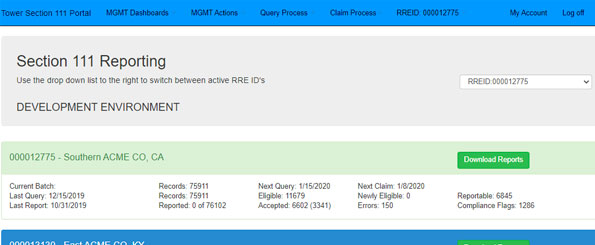
section 111 reporting sample

WorkCompCentral.com covered Tower’s recent webinar “Avoiding the Medicare Mandatory Reporting Penalty” with Chief Compliance Officer Dan Anders and VP of Information Technology Jesse Shade.  CMS has yet to respond to comments or finalize the regulation proposed in February, but its proposal contained alarmingly high penalties for relatively minor infractions, like recording the wrong diagnostic code. 

The webinar highlighted various penalties for inaccurate or late reporting and demonstrated the new dashboard Tower built to help its clients find and fix reporting errors faster and easier.  The dashboard identifies claims with errors and the remedy to correct them. It also enables users to produce instant reports, such as a one showing claims with reported medical closure settlements or Total Payment Obligation to Claimants (TPOCs) where Ongoing Responsibility for Medicals (ORM) has not been terminated, a common reporting error.

For more information, please see Dan Anders’ Feb. 18 and April 27 blog posts on the proposed regulations or email Daniel.Anders@TowerMSA.com.

Avoid Anticipated Medicare Mandatory Reporting Penalties

July 29, 2020

hands on a calculator and keyboard to illustrate Medicare Mandatory Reporting Rules

Nancy Grover of workerscompensation.com wrote an in-depth article on Tower MSA Partner’s “Avoiding Medicare Mandatory Reporting Penalties” webinar.  CMS is considering comments received to its proposed regulation that included penalties as high as $1,000 per day per claim. Final regs could publish any time. 

“There probably won’t be a lot of changes [in the final rule],” said Tower’s Chief Compliance Officer Dan Anders, who presented the webinar with Jesse Shade, VP of Information Technology.

Penalties could be imposed on organizations for not reporting a claim closure at all, exceeding error tolerance, or reporting contradictory information at different times. The article quoted Anders’ “contradictory information” example of a Medicare beneficiary with work-related injury on his right shoulder and a diagnoses code indicating the injury was on the right knee.

“CMS would have conflicting information. Even if the error is subsequently corrected, CMS could still impose a penalty of up to $365,000 [for a year],” he said.

To avoid penalties from even minor mistakes, Anders recommended that attendees note the omission of data, confirm the correct use of diagnosis codes, be sure to promptly report termination of ongoing responsibility for medicals or ORM.

“And ensure you have a reporting platform that is identifying potential errors and is working with you … to resolve errors and avoid penalties,” he said.

Tower is well positioned to serve as your reporting agent partner.  The company proactively developed its own Section 111 Mandatory Reporting dashboard, which Shade demonstrated on the webinar. He showed the many ways the platform helps users identify possible mistakes, address missing data points, confirm ICD9 and ICD10 codes, and run reports to direct their efforts.   Incorporating all the elements CMS examines, the dashboard simplifies and automates the process for users.

The dashboard is ready to roll as soon as CMS publishes the final regs.  As usual, Tower is ahead of the game — meeting clients’ needs before they know they have them.

Related

PREMIER WEBINAR: Avoiding the Medicare Mandatory Reporting Penalty

CMS Releases Updated Section 111 and MSPRP User Guides – Schedules Reporting Webinar

July 17, 2020

Tower MSA Partners explains CMS updates to ORM and NOINJ rules in the Section 111 reporting user guide.

New CMS User Guides released.

The Centers for Medicare and Medicaid Services (CMS) recently released updated user guides for Non-Group Health Plan MMSEA Section 111 Mandatory Insurer Reporting and the Medicare Secondary Payer Recovery Portal (MSPRP).  CMS also just announced an August webinar on Section 111 reporting matters.

CMS User Guides: Updated MMSEA Section 111

On June 29, CMS released Version 5.9 of the NGHP MMSEA Section 111 User Guide.  Highlights of the updated user guide:

  • A reminder has been added that while the threshold for physical trauma-based liability insurance settlements remains at $750, this threshold does not apply to non-trauma liability reporting for alleged ingestion, implantation, or exposure cases. Any settlement, regardless of amount, should be reported for these types of cases. (Sections 6.4.2, 6.4.3, and 6.4.4).
  • The limit dollar amount that triggers a threshold error has been adjusted from $99,999,999 to $99,999,999.99. This error occurs any time the No-Fault Insurance Limit amount or the cumulative value of all reported TPOCs (detailed and auxiliary records) exceed this limit. Additionally, the No-Fault Insurance Limit field number has been corrected under “Exceptions.” (Section 7.3.2).
  • When considering the requirements for the Ongoing Responsibility for Medicals (ORM), remember, per current policy, that the dollar limit for No-Fault Insurance Limits (Field 61) represents a combined total of Med-Pay and Personal Injury Protection (PIP) (Section 6.7.1).
  • When considering the requirements for the Ongoing Responsibility for Medicals (ORM), remember, per current policy, that the dollar limit for No-Fault Insurance Limits (Field 61) represents a combined total of Med-Pay and Personal Injury Protection (PIP) (Appendix A).
  • The CR02 claim response file error code field number has been corrected (Appendix F) (Table F-4).

CMS User Guides: Updated MSPRP

On July 13, CMS released Version 4.9 of its MSPRP User Guide.  The MSPRP is a web-based application which allows authorized users to, among other tasks, investigate, dispute and resolve Medicare conditional payments.  Updates can be found on page 1-1 of the user guide.  Significantly, users can now view and print outgoing correspondence from the MSPRP.  This is correspondence that has been received or letters that have been sent related to a BCRC or CRC case.

Section 111 Reporting Webinar

CMS will be hosting a Section 111 NGHP webinar on August 13, 2020 at 1:00 PM ET.  According to the notice, “the format will be opening remarks by CMS followed by a presentation that will include NGHP reporting best practices and reminders.”  The webinar notice can be found here.

If you have any questions regarding the updates, please contact Dan Anders, Chief Compliance Officer at daniel.anders@towermsa.com or 888.331.4941.

Time for an MSA Do-over?

July 8, 2020

Tower MSA Partners explains CMS updates to ORM and NOINJ rules in the Section 111 reporting user guide.

Is it time for an MSA do-over for open claims? Given the amended review process, we think it is.

Michael Stack’s recent article – Case Study: $101,312 Savings Through MSA Amended Review Process – in www.reduceyourworkerscomp.com points out that not every claim with a CMS-approved MSA settles on the first attempt. The piece describes one of CMS’s rare do-over opportunities, the Amended Review process.  

In the past, once an MSA had been approved by CMS, that was it.  If the claim didn’t close and subsequent changes in medical treatment reduced the MSA’s allocated costs, that was too bad. 

Process change allows for a productive MSA do-over

Fortunately, the agency changed its stance in 2017 and now allows the submission of revised MSAs to reflect changes in medical treatment and costs. Naturally, the claims need to meet certain criteria, which the article clearly outlines.

Stack, a highly regarded expert in workers’ compensation cost containment, illustrates his points with one of Tower’s Amended Review case studies, which resulted in savings of over $100,000.

During the economic fallout of COVID-19, some injured workers are re-thinking their earlier decisions to not settle their cases.  This is a good time to pull out any unsettled claims with MSAs, consider the Amended Review process and reopen settlement talks.

For more information, please see our Chief Compliance Officer Dan Anders’ earlier posts on Amended Reviews:


Contact Dan at Daniel.Anders@TowerMSA.com with any questions; he will be happy to help you determine if this program can help you close any of your claims.

PREMIER WEBINAR: Avoiding the Medicare Mandatory Reporting Penalty

June 29, 2020

Avoiding the Medicare Mandatory Penalty webinar banner

Regulations for Medicare Mandatory Reporting Penalty are in the process of being formalized!

Under the threat of up to a $1,000 per-day, per-claim penalty, most insurers and self-insurers have implemented processes to ensure Medicare beneficiary claimants are reported to Medicare per Section 111 of the Medicare, Medicaid, and SCHIP Extension Act of 2007 (MMSEA).

Penalties have never been imposed as the SMART Act specified that the Centers for Medicare and Medicaid Services (CMS) must formalize regulations prior to issuing them.  This past February, CMS released proposed regulations, which we detailed in this article: CMS Issues Proposed Rule for Mandatory Insurer Reporting Penalties.  Comments on the proposal were due in April and now we await a final regulation.

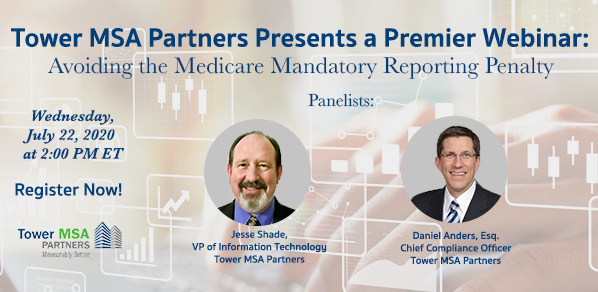
In a timely webinar, a full analysis of CMS’s penalties proposal will be provided by Tower’s Chief Compliance Officer, Daniel Anders, Esq.  Joining Dan will be Jesse Shade, Tower’s VP of Information Technology, who will break down new user-friendly enhancements to Tower’s Mandatory Insurer Reporting platform that are designed specifically to avoid the penalties CMS seeks to impose.     

A Q&A session will follow the presentation.  Plan to attend the webinar on Wednesday, July 22,  at 2 pm ET.

Thank you,

Dan Anders
Chief Compliance Officer

Forbes Technology Council Welcomes Tower’s Jesse Shade

June 24, 2020

Jesse Shade Portrait

Tower’s Vice President of Technology Jesse Shade has joined Forbes Technology Council, a prestigious invitation-only forum of senior CIOs, CTOs, and technology execs.  Members collaborate to help solve daily business challenges—like cybersecurity threats—and share insights in Forbes.com articles. Read the related release: Tower MSA Partners’ Vice President of IT, Jesse Shade Accepted into Forbes Technology Council here .

We know Jesse will be a major asset to the Council because he delivers such high value to Tower. Possessing an unusual blend of interpersonal skills as well as hands-on technical expertise, he is responsible for strategic planning and serves on Tower’s executive team.  

Tower designed and built its own technology based on best practices in MSP compliance and MSA preparation.  The seamless system drives all compliance processes from Section 111 Mandatory Insurer Reporting, conditional payment resolution, MSA triage, and clinical interventions all the way through MSA preparation, CMS submission, and claim closure.

To be simple for clients to use, technology has to be quite complex behind the scenes.  That’s where Jesse’s 35+ years of IT experience in numerous industries, including banking, defense and aviation, comes into play. He leads development efforts for our proprietary technology and its network infrastructure all within a cybersecurity framework that protects Tower and its clients and business partners. (To learn more about cybersecurity threats, especially during COVID-19, check out Jesse’s two Leaders Speak articles on WorkCompWire.)

We’re proud that Jesse will be participating in Forbes’ exclusive Technology Council and look forward to seeing his articles in Forbes.com.

Related information

Jesse Shade

Forbes business communities

CMS Provides Notices on Section 111 Reporting and Conditional Payment Processes

June 17, 2020

People using laptop and mobile phones to update Section 111 Reporting

CMS has recently issued two notices, one pertaining to mandatory Section 111 reporting and one relevant to Medicare conditional payment recovery.

First, in a “teaser” notice, CMS announced that on July 13, 2020 the Medicare Secondary Payer Recovery Portal (MSPRP) is scheduled to be enhanced to allow authorized users to view and print correspondence.

According to the notice,

MSPRP users who log in using Multi Factor Authentication will be able to view and print CMS mailed correspondence that is displayed on the Letter Activity tab. Additional information on how to use this new functionality will be available in Section 14.1.1.4 of the July version of the MSPRP User Guide.

Second, in an alert entitled “Reporting No-Fault Insurance Limit on Non-Group Health Plan (NGHP) Claim Input Files,” CMS reminds Responsible Reporting Entities (RREs) that they must combine both Med Pay and Personal Injury Protection (PIP) coverage limits for Section 111 reporting purposes.  This would be under circumstances where separate Med Pay and PIP coverages are being paid out on claims for the same injured party and incident under a single policy.

CMS also reminded RREs that ORM cannot be terminated until both Med Pay and PIP coverage limits are exhausted.  Further, that when providing the dollar amount for the policy limit, that it must accurately reflect two decimal places.  For example, a policy limits of $5,000 should be reported as 500000.

Practical Implications

In regard to the MSPRP enhancement to print documents, while we will have to see the specific guidance in the July update, this may prove quite useful in not having to wait for correspondence to come in the mail, print letters that were not received via the mail or reprint letters.

As for the alert to remind No-Fault carriers to report Med Pay and PIP coverage limits as a combined amount, while this guidance is already included in the NGHP User Guide, there was apparently some confusion that led CMS to provide this alert as a reminder of how such coverage must be reported.

If you have any questions, please contact Dan Anders, Chief Compliance Officer at daniel.anders@towermsa.com or 888.331.4941.

Dan Anders Weighs in on Legacy Comp Claim Closures

June 8, 2020

Stethescope and an insurance claim form illustrating legacy comp claim post

Business Insurance’s Louise Esola wrote an interesting More legacy comp claim closures anticipated with pandemic on an unexpected side effect of the coronavirus.  Injured workers who previously rejected settlement offers are rethinking their decisions. 

When researching the story, Esola contacted our Chief Compliance Officer, Dan Anders, who noted that insurers have long focused on legacy comp claim closures, especially those with high prescription drug costs.  He said they have, “become a little more proactive in looking at older legacy comp claims to see if this may be an opportunity to take a first or second look at settling those claims.”

At the same time, injured workers find themselves in financial conditions where a settlement would be critical. 

Tower’s Legacy Claims Settlement Initiative analyzes a payer’s portfolio of claims to detect those that could settle with or without clinical intervention. When future pharmacy costs inhibit settlement, Tower teams with myMatrixx to review drug regimens and find opportunities to reduce costs while protecting injured worker safety. Our recent Tower Premier Webinar: A Prescription for Settling Legacy Claims describes the program in detail.

After triaging the claim, Tower recommends interventions to optimize the MSA, identifies settlement partners, executes interventions, and helps move the claims to closure. 

Related:

WorkersCompensation.com’s Coverage of the Pharmacy/Legacy Claims Webinar